Chino's intent to avenge Bernardo
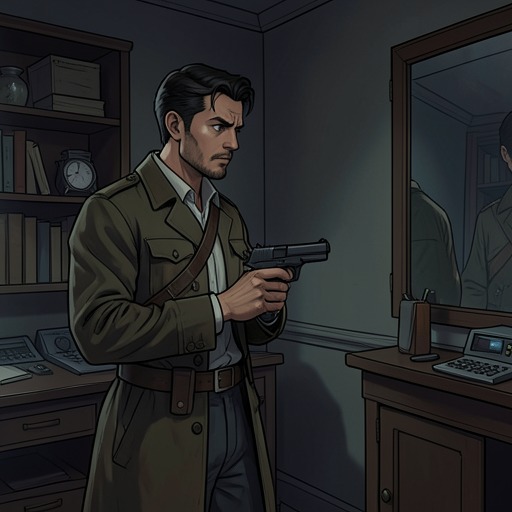
West Side StoryChino's intent to avenge Bernardo transforms the news of Bernardo's death into a private hunt for Tony Wyzek. Though no one gives Chino an order, he retrieves the pistol Bernardo had hidden, leaves Maria behind, and makes killing Tony his sole purpose. The concealed weapon connects Bernardo's trust in Chino to the violence that follows.
The revelation and the weapon
Chino delivers the news to Maria in the bluntest terms: Tony is alive, he says, but has just killed her brother. Maria refuses to believe him, striking at him with her fists and insisting that he is inventing the story. Her denial makes the revelation more than information passed between characters: the account of Bernardo's death overturns the future she had imagined with Tony and places Chino between her grief and the man she loves.
A police siren breaks into their confrontation. Chino leaves Maria and goes downstairs, not because Bernardo or any of the Sharks has directed him to pursue Tony, but because he believes they will all be looking for Tony and he has the strongest reason to find him. That reason is personal. Bernardo had treated Chino as a brother-in-law and had told him where he kept a pistol; the trust embodied in that confidence now gives Chino access to the weapon.
Chino reaches behind the bathtub, finds the compact package Bernardo concealed there, unwraps the pistol, and checks that it is loaded. In that moment, fear gives way to a hard, singular purpose: he understands himself as an extension of the trigger. Maria enters the apartment and sees that he is no longer simply delivering terrible news. She now believes him, but Chino has set aside explanation; his attention is fixed on finding and killing Tony.
The pursuit and its reversal
Anita warns Maria that Chino has a pistol and has sent the others after Tony. Maria responds with a vow to act if Chino harms him, but Anita forces the danger back upon her by asking whether she would do to Chino what Tony did to Bernardo. The exchange exposes how revenge has drawn even Maria, who is trying to protect Tony, toward the same violence consuming the gangs.
Tony’s search for Chino becomes a hunt across the neighborhood. When a police car passes, Tony ducks into a doorway; once it has gone, he runs toward the Coffee Pot, only to find Chino absent. He realizes he will not find him simply by searching the streets and will have to look through backyards, basements, and rooftops. In a courtyard between buildings in Puerto Rican territory, he calls Chino out and declares that he is no longer the prey but the hunter. The reversal is desperate: Tony is seeking the armed man who intends to kill him, while trying to make the confrontation happen on his own terms.
Chino’s pursuit ends with Tony shot fatally in the chest. Maria runs to Tony’s body, then orders Anybodys to stay back and tells Chino to come closer and hand over the pistol. She feels the weapon’s hard metal in her hand and recognizes how easily her palm fits its grip. Pointing it at Chino, she asks how many bullets remain and whether there is enough ammunition for him and for herself. She names the dead—her brother, Riff, and Tony—as people whom she and the others have killed, then turns the gun on Chino and asks whether she can kill him too. Her words make the consequence of Chino’s intent stark: the weapon has not avenged Bernardo so much as extended the chain of deaths, leaving Maria facing the possibility of becoming its next killer.
The duel's fatal reversal
Chino’s grievance has its source in the duel beneath the highway, where Tony Wyzek’s attempt to stop the fighting fails to prevent its lethal turn. As the two leaders close in, Riff breaks free from the Jets holding him and Bernardo strikes him in the chest with a fatal knife thrust. Tony then takes the knife from Riff’s limp hand and charges Bernardo, who is caught off guard and mortally wounded. The violence that Chino later answers is therefore already a chain of deaths: Tony intervenes to halt the conflict, but, after Bernardo kills Riff, Tony kills Bernardo in turn.
The account of the duel clarifies the personal stakes of Chino’s response without making his revenge an order from the Sharks. Bernardo had treated him as a brother-in-law and entrusted him with the location of the hidden pistol; after Bernardo’s death, Chino converts that intimacy into the means of pursuing Tony. The weapon passes from concealed safeguard to instrument of retaliation, while the original attempt to interrupt the duel becomes part of the sequence that revenge perpetuates.
The failed attempt to contain the conflict
The revenge takes shape against an earlier effort to keep the rival gangs inside the bounds of a public dance. When Riff, Action, and Tony Wyzek arrived, Murray Benowitz saw the Jets gathering behind them and the Sharks assembling behind Bernardo. He tried to draw everyone’s attention with a cheerful announcement, while signaling a passing police officer that the situation was under control. The strained reassurance could not erase what he saw: two opposing groups forming up, with girls among the Jets already removing their shoes so their high heels could serve as weapons.
The police presence briefly imposed a different arrangement. When Officer Krupke returned with another officer, the Jets and Sharks each formed a circle around the girls; Bernardo stood opposite Anita, while Riff paired with Graziella, who impatiently wanted the music to resume. Krupke insisted that the instructions be followed, and the circles eventually turned to the record as Murray clapped time. The dance’s orderly pattern was therefore a fragile containment, not a resolution: the groups continued to watch each other with hostility even as they moved to the music.
The confrontation later became an agreed duel. When Riff pressed Bernardo for an answer, Bernardo accepted and told the Jets to say when; the reply left the timing to him. That agreement carried the conflict out of the supervised dance and toward a contest in which the leaders would face one another. Tony’s cry to stop the fight interrupted the combat but could not restore the earlier boundary. The deaths that followed explain why Chino’s decision is personal, yet the sequence also shows how attempts to manage the rivalry—polite appeals, police authority, and finally rules for a duel—failed to prevent its violence from spreading into further retaliation.