Ethnic prejudice
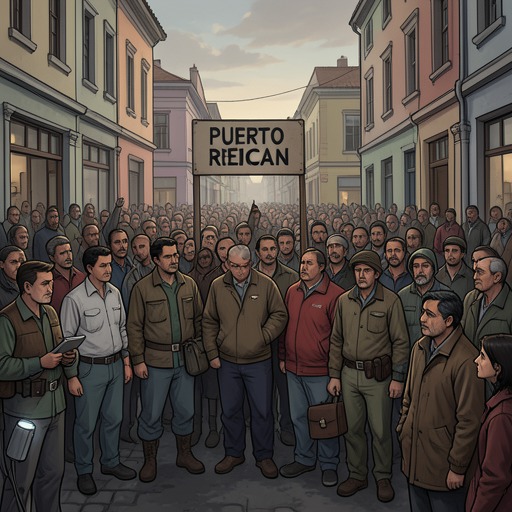
West Side StoryEthnic prejudice is a force that organizes both private encounters and public life on Manhattan's West Side. It makes Puerto Rican residents appear responsible for a neighborhood’s insecurity and scarcity, even as overcrowded housing, profiteering landlords, and political indifference form the deeper setting. In the gang conflict, that scapegoating becomes a rationale for territorial violence; in Maria Nunez’s argument about American identity, it meets a direct challenge that the surrounding world is not prepared to accept.
Scapegoating and the West Side
The novel places anti-Puerto Rican hostility within a city already shaped by deprivation. Ordinary residents have little affordable housing to move to, while landlords can raise rents when tenants leave or divide a three-room apartment into five, six, or even eight rooms and profit from packing in Puerto Rican families. The resulting overcrowding is not presented as a problem created by those families alone: the landlords’ pursuit of money and the neglect of buildings and tenants help produce the conditions that the gangs then interpret as ethnic competition.
The narrative describes a cruel reversal in how the gangs’ violence is understood. Before the Puerto Ricans arrive, gangs destroy whatever is available and turn on one another, making the city feel like a battlefield. Once Puerto Ricans become a target, the rest of the city seems safer by comparison, but only because the danger has been concentrated on them. Their presence is treated as the cause of trouble, and any harm that comes to them is rationalized as their own fault. The narration’s bleak irony exposes the convenience of this explanation: apparent public order rests on the persecution of one group, not on any resolution of the violence.
This scapegoating is reinforced by political exclusion. The West Side’s tenants are described as having had no say in the decisions that shape their neighborhood; politicians do not live there, and no newspaper speaks for its residents. In that vacuum, the Jets’ claim to speak and act for the neighborhood can seem persuasive even to people who dislike them. But the gang’s defense of local residents is inseparable from the belief that Puerto Ricans are intruders who should be driven away. The narrative shows how real grievances about housing, safety, and neglect can be redirected into ethnic blame instead of toward the structures and officials that sustain those conditions.
Territorial rivalry and the construction of an enemy
For Riff Lorton, the struggle with the Sharks is not merely a series of encounters between rival gangs. He remembers the Jets’ earlier fights to establish control of their block and sees Bernardo gathering Puerto Ricans as an effort to take that territory from them. His fear that the Jets will have nowhere to go if they lose their neighborhood gives the conflict a material stake, but his account turns that fear into a sweeping hostility toward Puerto Ricans as a group. The possibility of displacement becomes justification for imagining the rival group as an alien force that must be expelled.
The Jets’ own leadership tensions intensify that politics. Action considers challenging Riff Lorton for control, yet recognizes that taking command would mean actually directing the gang; remaining a critic lets him pressure Riff Lorton to prove his worth. The gang’s cohesion, and its reputation strong enough to deter other white gangs and keep Black groups at a distance, are described alongside the growing presence of Puerto Ricans. The neighborhood is thus imagined through competing group boundaries: protection for one group comes to mean confrontation with another.
Riff Lorton’s plan for one decisive, large-scale fight grows from his frustration with scattered attacks and his desire to end the conflict on terms the Jets can face together. When he asks whether they are willing to fight with knives or guns if the Sharks choose those weapons, the discussion reveals how quickly territorial rivalry can turn into a test of collective loyalty. Baby-John argues instead for fists or stones and a fair fight, hoping that refusing knives and firearms will expose the other side as cowardly if it fights dirty. His appeal offers a limited restraint, but it does not question the assumption that the two ethnicized groups must settle ownership of the neighborhood through violence.
American identity and unequal opportunity
Maria Nunez directly disputes the language used to mark Tony Wyzek as foreign. When Bernardo disparages him with an ethnic label, she argues that being born in America makes him American, and that even someone born elsewhere can belong by choosing to live there. Her claim shifts the question from ancestry to residence and shared civic identity. It also opposes the idea that Puerto Rican identity makes someone less American: she insists on a principle that could include Tony Wyzek without requiring the exclusion of her own community.
The debate over work complicates that appeal. Chino Martin describes a path from manual labor to delivery work and, eventually, to a position within the union. Bernardo counters that Tony Wyzek could be admitted ahead of Chino Martin and paid more simply because he is American. The exchange presents opportunity as both an economic concern and a racialized comparison: a job ladder is discussed in terms of who can advance and whose claim to advancement will be recognized. The novel supplies these characters’ competing judgments rather than resolving the dispute into a neutral account of employment practices. Maria Nunez, however, sees where Bernardo’s language leads: she believes his fixation on resentment and destruction can only deepen hostility, and invokes her priest’s warning that a life organized around the sword ends in violence.
Bernardo answers her not by engaging her definition of belonging but by suggesting that Tony Wyzek sees her as an easy target because she is Puerto Rican. His accusation redirects the discussion from Maria Nunez’s argument to the danger of interracial intimacy, treating her ethnicity as a vulnerability and Tony Wyzek’s desire as presumptively predatory. The scene makes clear that prejudice can adapt: when Maria Nunez challenges the claim that Tony Wyzek is an outsider, Bernardo recasts the issue as a threat to her rather than reconsidering his own exclusionary assumptions.
Violence, masculinity, and the limits of solidarity
At the confrontation between Bernardo and Tony Wyzek, ethnic insult becomes physical humiliation. Bernardo taunts and slaps Tony Wyzek; Riff Lorton, watching, feels shame and remembers having defended his friend against Action, Diesel, Baby-John, and Anybodys. That loyalty gives way under the pressure of a racialized ideal of masculine pride: Riff Lorton interprets Tony Wyzek’s refusal to retaliate as proof that he lacks courage, and reaches for the reassuring shape of the knife at his hip. The scene shows prejudice working within friendship as well as between groups. Riff Lorton’s bond with Tony Wyzek does not prevent him from measuring both men against a standard of white male honor that makes violence seem necessary.
The same group logic appears after the deaths and the search for Tony Wyzek. Diesel blames Tony Wyzek for Riff Lorton’s death and for the fact that Diesel did not knock Bernardo out. Action rejects the suggestion that the Jets should simply leave Tony Wyzek to be found by the Puerto Ricans: even while disavowing affection for him, Action insists that no Latino should get him first. The language of loyalty therefore has two edges. It can protect a former gang member, but it also asserts ownership over him through ethnic opposition and revenge.
Anita Palacio encounters the most openly gendered form of this hostility when she tries to deliver a message about Tony Wyzek. A-Rab and Diesel first block and mock her, using her Puerto Rican identity to deny her passage and turning her attempt to speak into an occasion for sexualized humiliation. When she says she wants to stop Chino Martin, A-Rab accuses her of trying to trap Tony Wyzek for him and uses that suspicion to justify attacking her: he twists her arm, knocks her down behind the counter, and begins tearing her dress while Diesel encourages him. The scene joins ethnic contempt to sexual coercion. Anita Palacio is not treated as a person carrying information; she is reduced to a racialized stereotype and then punished for the supposed threat the attackers project onto her.
Across these encounters, prejudice repeatedly converts social insecurity into a story of hostile outsiders, and then treats violence as proof that the story was true. Maria Nunez’s expansive account of belonging offers a counterprinciple, but the gangs’ territorial codes, masculine tests, and retaliatory loyalties make that principle difficult to sustain. The novel’s critique lies in the gap between the Jets’ claim to defend a neglected neighborhood and the exclusionary violence through which they define who may belong to it.