Gang territory rules
West Side StoryGang territory rules in West Side Story are informal claims to neighborhood space, made visible through the Jets’ collective movement and enforced by intimidation and violence. They promise the gang control over streets it regards as its own, but the promise of protection comes at the cost of making everyday space dangerous and treating Puerto Rican neighbors as rivals for control. The rules grow not from a stable civic order but from contested belonging, racial hostility, and the absence of reliable alternatives.
Claiming and Marking the Streets
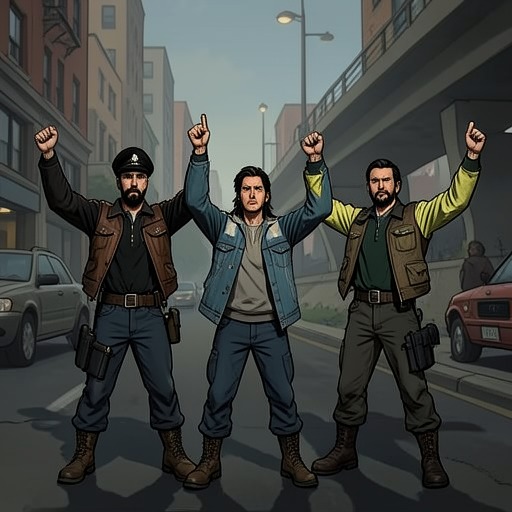
The rules are performed as much as stated. When Riff leads the Jets through the neighborhood, he walks with his shoulders thrust out, both thumbs tucked into the large buckle of his military belt, and his gaze fixed ahead. His exaggeratedly rigid stride communicates that anyone in their path is expected to move: the street is their territory. Baby-John stays close behind and imitates him, while Action, A-Rab, Big Deal, Snowboy, and Gee-Tar adopt the same posture. Their coordinated manner turns an ordinary walk into a public signal that the Jets are on the hunt and prepared to attack someone, somewhere, for almost any reason.
That display is backed by action. When a driver leans out to tell the Jets to hurry across the street, Riff stops and approaches the car with Action and Diesel behind him. The driver rolls up the window and locks the doors; the boys spit on the windshield and windows, kick the rear bumper as the car pulls away, and laugh at another intimidated motorist. The encounter shows how the territorial claim reaches beyond a rival gang: people using the street can be compelled to yield, even when they have no part in the contest over neighborhood control.
Possession, Memory, and Rivalry
For Riff, the claim has a history. He remembers the Jets fighting everyone to take possession of their block, and the scars he and the others carry serve as proof, in his view, that they won it and still hold it. He regards the arrival of Bernardo and the Sharks as a direct challenge to that achievement. Bernardo is described as gathering Puerto Ricans onto his territory; Riff reads this as a plan to take control of the neighborhood and drive the white residents out. His fear that the Jets would then have nowhere to go makes territorial defense inseparable from his own sense of security and belonging.
Riff states the claim collectively: the streets are all the Jets have, and he will not let anyone take what is his. Mouthpiece answers that Riff speaks for all of them, and Riff marks the group’s support with a fist striking an open palm. The exchange turns an individual declaration into a shared position. It also shows how a limited patch of streets acquires an importance far beyond its size: possession stands for the group’s right to remain in a neighborhood where its members feel they have little else.
The rivalry shapes what kind of conflict Riff wants. He argues that the gangs have fought hard for the territory and proposes one large, decisive battle rather than continuing to endure isolated attacks followed by retreat. He recognizes that the Sharks may arrive with bottles or knives, or even guns, rather than fight with fists. His proposed contest is therefore not a neutral procedure for resolving a boundary dispute; it is an attempt to settle ownership through organized force, with the possibility of lethal escalation already acknowledged.
A Target and a Fragile Order
The narrative places this rivalry within a wider pattern of gang violence. Before the Puerto Ricans become a target, the Jets’ hatred has no precise object: they roam without purpose and lash out at whoever or whatever they encounter. Their targets may include someone they treated kindly the previous day, a person they joked with moments earlier, a shopkeeper who extended credit, or a vacant building with an intact window. When there is nothing else to destroy, the gangs attack one another. The city, with its many streets, houses, roofs, basements, and alleys, becomes an immense battleground.
The arrival of Puerto Rican residents gives that diffuse hostility a designated enemy. In the account’s bitter irony, the city becomes safer for everyone except the people now targeted: the gangs have someone to fight, while the possibility that the Puerto Ricans might leave or be driven away is left as a danger the neighborhood would rather not examine. The territorial rule thus organizes violence without resolving its causes. The gangs’ conflict continues, and the city carries on living and dying around it.
The neighborhood’s response is divided. Onlookers watch the Jets pass on a warm night, but only those who openly approve call out to them; others look away or hide behind a newspaper or handkerchief because the gang means trouble. Yet even residents who dislike the Jets are described as having to concede that the boys help preserve what remains of the neighborhood. They act where politicians, who live in wealthier areas, are seen as doing little beyond talking. This reluctant approval does not make the Jets’ violence benign. It reveals a vacuum in which the gang’s coercive claim can appear to some residents as a form of protection when other sources of help seem absent.
Housing and the Limits of Public Space
The claim to territory takes shape amid conditions that make leaving difficult. Twenty years after the end of the Second World War, affordable housing remains scarce. When a white tenant moves out, a landlord can quickly re-rent the apartment at a higher price. Landlords can also subdivide a three-room apartment into five, six, or eight rooms, crowd Puerto Rican tenants into it, and profit while neglecting the halls, roofs, and walls. If a building collapses, it can be turned into a parking lot. These conditions sharpen competition over place, but the passage does not reduce gang territory to housing alone: it shows a neighborhood where residents have little control over their homes and where gangs assert control over streets.
The Municipal Community Center offers a contrasting attempt to make public space available to young people. Converted from an old church and opened to everyone, it was intended to draw boys and girls away from the streets through supervised recreation and education. Once long-time residents understood that Puerto Ricans were welcome, many avoided the center; Puerto Rican families also stayed away when they saw that it was being boycotted. Its clubs, books, games, and basketball court were often left unused. At a June dance, Jets and Sharks attend without starting a fight, but they take opposite sides of the dance floor and move as if a wall separates them. The scene does not erase territorial divisions; it shows them persisting inside a shared institution.
Gang territory rules therefore govern both who may occupy the streets and how groups encounter one another in nominally common spaces. Their force comes from collective gestures, remembered fights, and the threat of further violence. Their persistence is also tied to a neighborhood where housing is insecure, residents’ voices are poorly represented, and even a center designed for shared use is weakened by mutual avoidance. The streets may be all the Jets believe they have, but treating them as exclusive property keeps the neighborhood divided and makes the promised security inseparable from danger.