Gang warfare
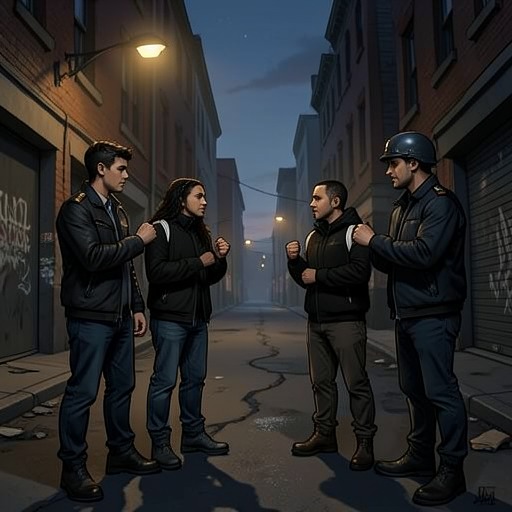
West Side StoryGang warfare in the novel is more than a contest between the Jets and the Sharks: it is a cycle of violence that gives aim to hostility already spilling across the city, then turns territorial rivalry into increasingly dangerous acts of retaliation. Its consequences are unequal. Once Puerto Ricans become the gangs’ target, the city seems safer to everyone except the people exposed to that hostility.
Indiscriminate violence and its target
The Jets’ violence is presented as strikingly indiscriminate. Their hatred has no fixed object: people they were friendly with the day before, children they had joked with minutes earlier, a shopkeeper who had extended them credit, and even a building with an intact window can all become targets. The point is not that each victim has provoked them. Rather, the Jets move through the city prepared to damage whatever lies in their path, unable to distinguish among people, institutions, or property as objects of destruction.
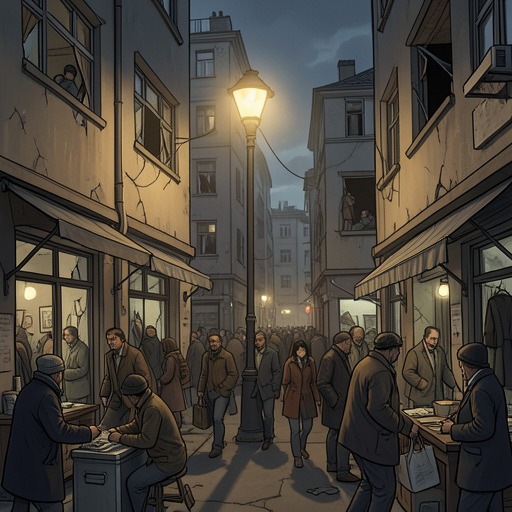
That aimlessness makes the violence contagious. When there is nothing else to wreck, the gangs turn on one another. A city of a thousand streets and ten thousand houses, rooftops, basements, and alleys becomes an immense battlefield, and its residents live in fear. The arrival of Puerto Ricans changes the direction of that violence without ending its underlying logic: they furnish the gangs with a target, and the city becomes safer for everyone else at their expense. The claim that disaster is their fault because they arrived uninvited exposes the prejudice that makes this apparent reprieve possible. Hostility is redirected, not resolved.
A rivalry that spreads through the neighborhood
The conflict between the Jets and the Sharks intensifies through repeated ambushes. For more than three weeks, the Jets attack the Sharks, who do not back down. Riff has to fight his way out of the lobby of his own building, while a paving stone misses Bernardo by only a few inches. These details make the rivalry concrete in ordinary neighborhood space: even a residential entrance is not secure, and a near miss is enough to register how readily an encounter could become fatal.
Night after night, the attacks grow more intense. Schrank and Krupke patrol the neighborhood after dark, looking for Riff, Bernardo, and their followers, but the young men know the streets better than the police. They hide in a freight elevator, in a box on a cellar shelf, or in a dark garbage can beneath a staircase. When the police leave—sometimes at two, three, or even four in the morning—the fights resume. Daybreak brings fresh injuries and renewed tension. The cycle therefore outlasts both individual clashes and police intervention: concealment postpones the violence, but does not stop it.
Retaliation and the attack on Baby-John
The contest shifts between the gangs. On the fourth consecutive night that the Sharks have had the upper hand, their traps prove more ingenious, but the Jets continue to retaliate. Mouthpiece throws another stink bomb into a grocery store, hoping to draw Bernardo and the Sharks out in force. Bernardo does not take the bait. Instead, he sends Pepe and Nibbles to attack Baby-John during an afternoon movie, carrying the conflict into a public place and away from the nighttime street confrontations.
The attack is calculated to leave both pain and a message. Pepe and Nibbles press an ice pick into Baby-John’s back and warn him to keep quiet, take him to the men’s restroom, stuff toilet paper into his mouth, and beat him in a stall. They nearly drown him in a toilet; then Pepe cuts Baby-John’s earlobe with the ice pick. The mark is meant to be shown to the Jets. The Sharks’ message distinguishes between fighting the rival gang and targeting the old, while warning that continued attacks will lead to worse violence. Yet the distinction does not undo the assault: a claimed boundary is communicated through another act of cruelty.
Territory, a declared war, and the proposed battle
The attack turns retaliation into an explicit call for war. When the Jets gather at Riff’s home, he declares that Baby-John cannot be beaten without consequence. Baby-John, by contrast, boasts of being a victim, giving the injury a place in the Jets’ collective account of what the Sharks have done to them. The assault is no longer only an individual grievance; it becomes a reason for the group to act.
Riff frames the dispute as a fight over territory that the Jets have struggled to win and cannot simply surrender. He rejects the Sharks’ practice of striking in isolated attacks and running away, and proposes one mass battle in which both groups face each other. His proposal aims to replace scattered ambushes with a decisive confrontation, but he also recognizes that the Sharks may bring bottles, knives, or guns rather than fight with fists. The plan’s promise of a single reckoning is thus shadowed by the possibility that it will intensify, rather than contain, the violence.
The proposed confrontation also depends on securing the other gang’s agreement. When Riff asks whether they accept, Bernardo agrees and tells the Jets to say when. That response gives the rivalry a negotiated form: opposing gangs who have attacked one another agree to meet for a battle, while the dispute over territory and the means of fighting remains unresolved. Gang warfare consequently operates both as uncontrolled aggression and as a crude system of rules, messages, and arrangements. Its recurring pattern—attack, retaliation, declaration, and planned confrontation—organizes the conflict without offering a way out of it.