Jets–Sharks
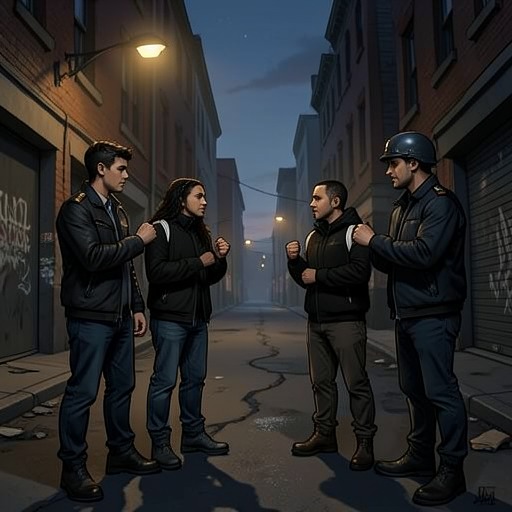
West Side StoryThe Jets–Sharks relation is a rivalry organized around group loyalty and ethnic division, and its decisive turn is a duel that leaves both gangs’ leaders dead. Attempts to contain the antagonism—in a public dance, through police authority, and in an agreed contest—do not resolve it. Instead, violence deepens the division, while the Jets’ response to the deaths shows that hostility and loyalty remain active even after the immediate confrontation ends.
Identity and Sources of Conflict
The rivalry is not presented as a simple disagreement over territory. It is shaped by competing claims about who belongs in New York and who can expect opportunity there. Bernardo resents what he sees as Americans’ advantages, arguing that Tony Wyzek could rise further in the union than Chino even if Chino had more reason to expect advancement. Chino, in turn, describes a path from manual work toward union membership. Their disagreement makes the gang conflict part of a wider argument over work, status, and unequal treatment.
Maria Nunez rejects the idea that belonging should be settled by birthplace or ancestry. When Bernardo disparages Tony, she argues that someone born in America is American, and that a person who came there to live should not be treated as a foreigner either. Bernardo counters that Tony sees her as vulnerable because she is Puerto Rican. The exchange reveals how the rivalry enters intimate relationships: Maria’s defense of Tony is also a challenge to her brother’s account of the danger she faces.
The antagonism has a personal history as well as a collective form. Maria recognizes Bernardo’s hatred of Americans as a powerful part of his character, while she herself considers hatred wrong and wishes to love rather than hate. Her position does not dissolve the division around her, but it supplies a clear contrast to the loyalties and resentments driving the gangs.
Public Encounters and Attempts at Containment
At the dance, the arrival of the Jets, including Riff Lorton, Action, and Tony, sharpens the tension already created by the Sharks’ presence. Murray Benowitz hopes the gathering will demonstrate progress in his work with neighborhood youth, but he notices the two groups assembling behind their respective leaders. His effort to address the crowd and keep the evening orderly meets a standoff rather than a shared celebration.
The police presence helps impose a temporary arrangement, not a reconciliation. Murray signals an officer that the gathering is under control; when Officer Krupke arrives, the gangs form separate circles around the girls and begin the instructed dance. The groups comply, but their hostile attention persists. The scene places a public, mixed gathering beside the gangs’ mutual suspicion: an official rule can direct their movements without changing the antagonism that governs them.
That managed encounter gives way to an agreed duel. When Riff presses for an answer, Bernardo accepts on behalf of the Sharks and asks the Jets to specify when. The acceptance gives the conflict a negotiated form, but its terms do not make the contest safe or restore trust. It turns the rivalry into a direct test between the groups, with their leaders at its center.
The Duel and Its Fatal Turn
Tony enters the confrontation by calling for it to stop and placing himself between Bernardo and Diesel. For a moment, the duel is interrupted. The interruption does not hold: Riff pushes Tony aside and attacks Bernardo, and the fight becomes a knife confrontation between the two leaders. Tony breaks free from the others’ restraint, but the struggle has already passed beyond the boundary he tried to impose.
The exchange ends with Riff and Bernardo dead. The deaths are not merely losses to each gang; they transform the rivalry from a contest led by opposing figures into a crisis that neither group can contain. A police car arrives, its light sweeping the area, and the Jets and Sharks scatter. Diesel pulls Tony away as Tony calls for Maria. Police intervention ends the immediate gathering, but it cannot undo the deaths or settle the enmity that produced them.
Aftermath and Continuing Division
Among the Jets, the aftermath brings a dispute over whether Tony should be protected. Anybodys argues that he needs help because people are looking for him. Diesel rejects the plan, wants the group to leave before the police can arrest and photograph them, and blames Tony for Riff’s death. His response turns grief into accusation and shows how the same event can intensify divisions within a gang as well as between gangs.
Action takes a different position. Although he says he has no affection for Tony, he insists that if anyone finds him, it should be the Jets rather than the Latinos. He confronts the other Jets in turn, treating their assent as a commitment to follow his decision. The dispute makes the rivalry’s lasting logic plain: personal anger and resentment remain, but group allegiance determines who is permitted to act against one of their own.
The relationship therefore survives the duel in a more fractured and consequential form. The deaths of Riff and Bernardo, the police dispersal, and the Jets’ argument over Tony do not produce reconciliation. They show instead how attempts at order and individual intervention are overwhelmed by a conflict sustained through ethnic suspicion, leadership, and the demand for loyalty.