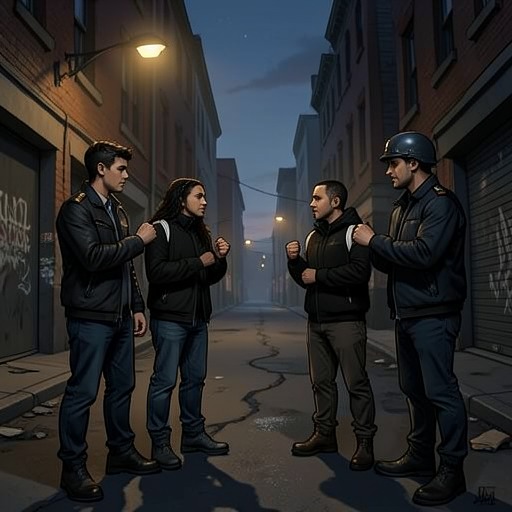
Jets–Sharks gang rivalry and violence
West Side StoryJets–Sharks gang rivalry and violence is sustained by more than a contest between two groups: ethnic hostility turns an individual confrontation into a test of collective loyalty, and retaliation makes its consequences fatal. The deaths of Riff and Bernardo do not settle the conflict. Instead, the Jets argue over Tony’s fate while the city largely carries on, leaving the violence framed as part of a cycle that may continue unchanged.
Rivalry and the pressure of allegiance
The confrontation becomes lethal after Bernardo humiliates Tony in front of the Sharks, taunting him as cowardly and striking him. Riff’s response is bound up with his own history of loyalty: he remembers defending Tony over weeks and months from Action, Diesel, Baby-John, and Anybodys. Seeing Tony endure Bernardo’s insults, Riff feels that their friendship and his own standing have both been demeaned. His reaction is also explicitly shaped by ethnic prejudice; he interprets the exchange through a racialized opposition between white identity and Latino identity rather than as a private insult alone.
That pressure exposes a conflict between individual choice and group expectations. Tony does not answer Bernardo’s provocation in the way Riff believes the Jets’ pride requires, and Riff’s frustration helps turn the humiliation into a fight. The scene does not present the gang’s loyalties as abstract: Riff’s memory of defending his best friend is immediately followed by his physical intervention. Yet the same loyalty that makes him act also binds him to a violent code, leaving little room for Tony’s different response.
From confrontation to deadly violence
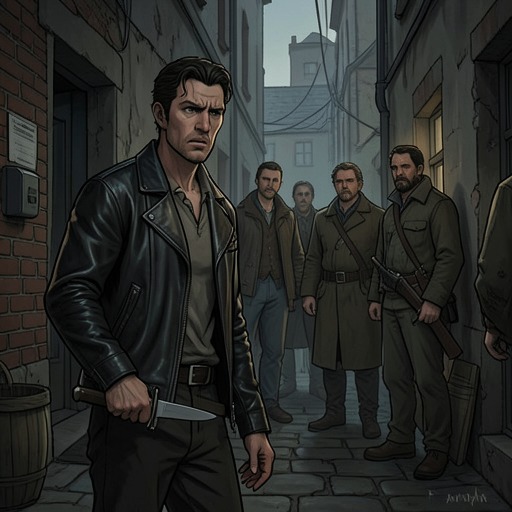
When Bernardo strikes Tony again, Riff pushes Tony aside and attacks Bernardo. Bernardo retaliates, and the two leaders draw knives while the surrounding Sharks are told to stay back. Action and Diesel restrain Tony when he tries to rush in. The confrontation thus becomes a duel between the gang leaders, even as the other young men’s actions determine who can intervene and who must watch.
The fight turns on a brief movement: Riff calls for the others to retreat and makes a broad gesture with his arm, giving Bernardo the opening to strike. Riff dies, and Tony takes the knife and charges Bernardo, who is fatally wounded. The sudden sequence converts the rivalry from a show of dominance into irreversible loss. A police siren and patrol car interrupt the scene; the Jets and Sharks scatter, and Diesel pulls Tony away. As he runs through tears, Tony repeatedly calls for the girl, but the sirens are the only answer.
The Jets’ divided response
After the killings, the question of whether to protect Tony brings the Jets’ competing loyalties into the open. Anybodys proposes finding him because people are looking for him. Diesel argues that the gang should leave Tony to be found, blaming him for Riff’s death and insisting that, without Tony, he would have knocked Bernardo out. His resentment turns the deaths into grounds for condemning Tony rather than a reason to help him.
Action rejects that course. Although he says he has no love for Tony, he insists that if anyone catches him, it should be the Jets, not the Latinos. He makes the decision concrete by confronting the Jets one by one and treating their silence or nod as a pledge to carry it out. His stance does not reconcile the gang with Tony; it redirects their anger into a claim of collective authority. Even amid disagreement over Tony, Action’s words preserve the ethnic boundary at the heart of the rivalry.
The city and the continuing cycle
The aftermath is both local and nearly invisible at the scale of New York. People in the surrounding streets may know what happened, and a small number of newspapers report the killings beneath the highway, but their accounts are brief and incomplete. Most of the city sleeps or enjoys Saturday night without knowing the details. The contrast makes the deaths devastating to those involved but marginal to the larger urban life continuing around them.
The closing reflection extends that contrast beyond the immediate scene: individual people love, hate, hope, and die, while the city is built to outlast its inhabitants. Some wishes may come true, but the city remains unchanged; unless something changes, the same condition will persist. The rivalry’s significance lies in this unresolved ending. The deaths do not produce a settlement, and the Jets’ response shows that loyalty, hostility, and the impulse to retaliate remain active after the duel has ended.