Krupke
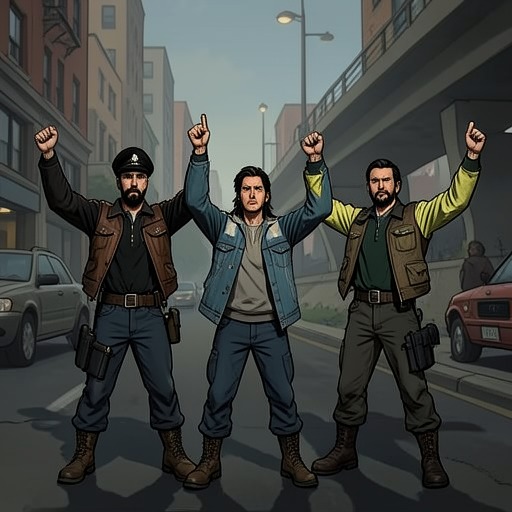
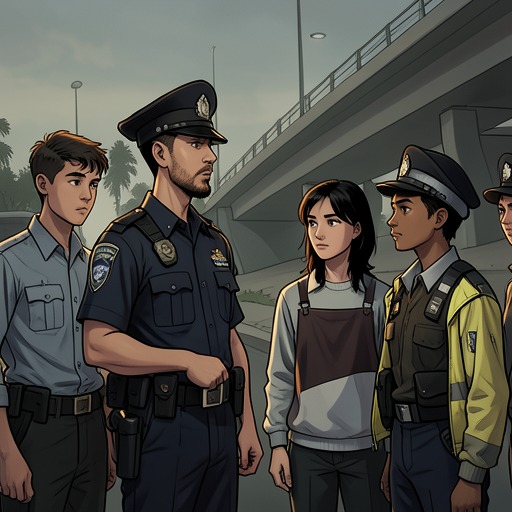
West Side StoryKrupke is a police officer whose brief appearances show the force of law entering the Jets’ world both as a target of mockery and as a source of immediate physical danger. Usually paired with Lieutenant Schrank, he is first seen trapped behind the wheel while the gang obstructs the car; later, Baby-John remembers escaping him and expects punishment if he is caught. Krupke’s small but recurring presence links the Jets’ taunting encounters with police to the consequences of their flight after the killings.
Identity and Role
Krupke is identified as an officer and is behind the wheel of the police car when Riff Lorton greets him and Schrank. The encounter makes the difference in rank visible: Schrank is the lieutenant who leads the questioning and issues the gang’s restriction, while Krupke is the uniformed officer caught in the car with Action and Big Deal. The narrative does not provide Krupke’s background or private perspective; it presents him through his work, his exchanges with the young people, and their expectations of police force.
That limited characterization matters. Krupke is not the principal speaker in the police confrontation, and Schrank’s statements and prejudices belong to Schrank rather than to Krupke. Krupke instead emerges through sharply contrasting details: a cutting joke directed at A-Rab, a patrol car temporarily under the gang’s control, and Baby-John’s later fear of his club. These moments give the officer a recognizable presence without making him the story’s chief representative of police authority.
The Car Encounter
When the officers arrive, Riff Lorton keeps a hand on the vehicle’s door to prevent the police from pursuing the Jets’ fleeing weapon carrier. He leans down to greet Schrank, then identifies the driver as Krupke. Action and Big Deal are holding Krupke inside the car, turning a police vehicle into a scene of temporary restraint: the officer who might ordinarily pursue the boys cannot get out until they allow it.
Riff eventually signals Action to let the officers out. The gang’s advantage is therefore brief and tactical, not a lasting reversal of authority. Before that release, Krupke joins the verbal sparring with an offer to take A-Rab into a nearby alley and improve his face by whatever means he chooses. The threat is framed as a taunt, but its humor depends on the possibility of a beating. Krupke’s manner differs from Schrank’s more sustained, openly hostile speech: he contributes a quick, rough joke, while Schrank controls the confrontation and lays down the terms for the Jets’ movements.
Police Authority and the Jets
Krupke is present when Schrank tells the Jets that the street does not belong to them and orders them to remain within their own block and stop obstructing the sidewalk. The restriction is Schrank’s, not Krupke’s; Krupke’s place beside him nevertheless situates him within the police presence that enforces the order. For the gang, the encounter is both a contest of dignity and a practical limit on where they can gather. Their sarcastic response turns the order into a joke, but the officers’ ability to impose boundaries remains real.
The distinction between the two officers is important to the scene’s characterization. Schrank grips Riff Lorton’s shoulder painfully, threatens the boys, and speaks with contempt about them and Puerto Ricans. The text supplies no equivalent speech or action from Krupke in this exchange. Krupke’s earlier alleyway threat gives him a capacity for intimidation, but it does not justify assigning Schrank’s whole outlook to his colleague. The officers function together in the encounter, while the narrative differentiates the lieutenant’s explicit hostility from Krupke’s briefer, more comic aggression.
Pursuit and Baby-John’s Fear
After Riff Lorton and Bernardo have died, Baby-John thinks about his own age and how little time might separate him from the same fate. At the scrapyard, he has climbed onto a fence and is balancing near a telephone pole, hoping that one of his comic-book heroes will somehow come to his rescue before the police find him. In his recollection, he has just escaped Schrank and Krupke, and he imagines Krupke knocked onto his backside during the getaway. The memory turns the officer from the butt of a gang’s joke into an immediate pursuer whom Baby-John has managed, for the moment, to evade.
That evasion does not make Baby-John feel safe. He expects Krupke to catch him eventually and imagines the officer showing no mercy with his billy club. A police siren and the sound of running then send Baby-John and A-Rab down into the scrapyard’s darkness as a patrol car speeds past. The officer in that passing car is not identified as Krupke, but the episode intensifies the danger already attached to the police in Baby-John’s thoughts. Krupke’s narrative significance lies in this recurrence: first physically confined by the Jets, then remembered as an officer they have escaped, he embodies the continuing threat of pursuit and punishment that outlasts the gang’s temporary victories.