Love as magic and transcendence
West Side StoryLove as magic and transcendence is the novel’s image for an intimacy that seems to carry Tony Wyzek beyond his former life and the boundaries of his surroundings. It first appears as an unnamed longing, then takes shape in Tony’s encounter with Maria Nunez: fireworks without sound, a world briefly transformed, and the conviction that the thing he has been seeking may be close at hand. The metaphor offers wonder, but Maria’s later warning that magic can be dark prevents it from becoming a simple promise of safety.
Longing and the search for elsewhere
Tony describes a recurring dream in which he stands with his arms outstretched, trying to catch something he cannot identify. At first he imagines that it lies thousands of miles away, among places marked on a world map. The dream gives his desire the scale of a quest while leaving its object unresolved: he knows the reach of his yearning more clearly than what would satisfy it.
Riff Lorton answers that imagined distance with a joke about finding different cultures within New York, while insisting that Puerto Rico is something he does not want to see in the city. Tony dismisses the narrowness of that outlook. He allows that what he wants may not be thousands of miles away at all; it could be just around the corner, behind a door, or even in the dark building above them. The change is important to the metaphor: transcendence need not mean escape to another place. It may be an inward and relational discovery in the familiar city.
When Riff worries that Tony’s desire to feel uplifted means he is taking drugs, Tony reassures him that he is searching for the feeling he had when he was a Jet. Riff, in turn, says that the thought of their still being friends is what lifts him. The exchange places Tony’s search beside a remaining bond with his old life. The desired intensity is not yet explained as romance; it is first framed as a need to recover a feeling of elevation, even as Tony’s emerging attachment will redirect that need.
Maria and the transformed world
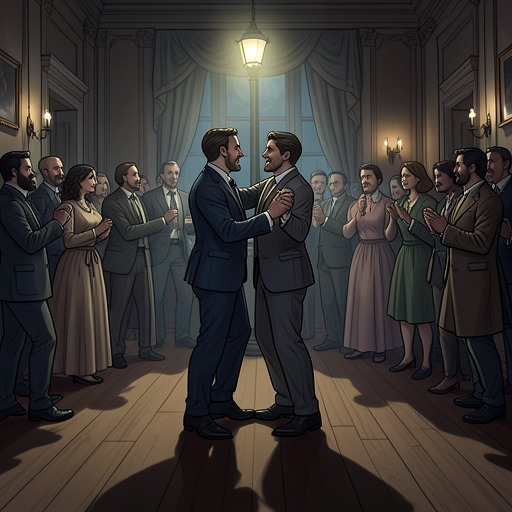
At the dance, Tony arrives without a partner and feels out of place among both the Sharks and the Jets. He is considering leaving when he sees Maria Nunez in a white dress. Their mutual notice abruptly erases his intention to go: he approaches her as if drawn by a magnet, and the narration describes him as being carried with her into another world. The language turns a meeting into an apparent answer to the earlier dream, though the desired object had remained unnamed until this moment.
Their first dance makes the transformation physical and tentative. Tony takes Maria Nunez’s fingers gently, admires the white dress as distinct from what the other girls wear, and barely brushes her back with his fingertips. When she begins to move away, he briefly tightens his hold before releasing her. The scene’s sense of enchantment therefore rests not only on grand imagery but on careful gestures, pauses, and the possibility of separation. Their closeness is felt in the body before Tony can give it a stable explanation.
Fireworks and shared perception
Tony gives the feeling a visual form by telling Maria Nunez that he saw an enormous fireworks display when she described feeling damp. He traces the rockets’ paths in the air and checks whether she can see what he sees. Her agreement matters: for a moment, the image is not only his private projection but a vision they can share. The fireworks rise, meet, and burst into hearts and stars before falling in cascades of light, converting the language of romance into a fleeting spectacle of union.
The scene also keeps that spectacle close to ordinary human contact. Tony kisses Maria Nunez’s palm when her hand comes near his mouth, and he feels her tremble. He leans toward her hair and kisses her lips gently, as if careful not to violate the boundaries of the magical world around them. The metaphor is not presented as proof of the supernatural; it gives emotional intensity a shape. The dance, the imagined lights, and the touch combine to make love feel like entry into another world without removing the characters from the physical vulnerability of the one they inhabit.
The limits of the magic
After the meeting, Tony thinks of Maria Nunez’s name through sounds he associates with beauty: church bells, a bird’s song, lovers’ whispers, and his mother’s voice. Even the summer stars seem brighter to him. He decides that she is the thing he has been searching for, but the discovery carries an immediate complication: she is Bernardo’s sister. Tony recognizes that this makes the attachment dangerous within the conflict surrounding them, even as he imagines that Maria may have an opinion of her own.
Later, Tony calls himself and Maria Nunez untouchable because they are still on a cloud, and insists that their magic will not disappear. Maria counters that magic can also be black and evil, then asks him to tell her the truth. Tony promises that he always will. Her response changes the metaphor’s force: love may lift the pair beyond ordinary divisions in feeling, but it does not abolish the dangers attached to their circumstances or guarantee that enchantment will protect them. The contrast between Tony’s confidence and Maria’s unease leaves the idea suspended between refuge and peril. In that tension, transcendence is both the promise of seeing the world anew and a fragile hope that must face the truth.