Maria's grief and conflict of loyalties
West Side StoryMaria's grief and conflict of loyalties are shaped by a devastating reversal: the man she loves, Tony Wyzek, is accused of killing her brother, Bernardo. Her response moves from furious disbelief to prayer, establishing the emotional and moral crisis she must face when love and family loss become inseparable.
The News and the First Response
Chino Martin tells Maria that Tony is well, then reveals why: Tony has just killed her brother. Maria refuses to accept the news, striking Chino with her fists and insisting that he is making it up. Her repeated denial is also an appeal to the family bond she believes still governs their relationship: she threatens to tell Bernardo not to let Chino visit again. A police siren interrupts her accusation, while Chino, pressed against the wall, seizes on its sound as relief from his immediate anguish and rushes away to carry out a task.
Prayer, Reunion, and the Meaning of Loss
Once Chino Martin leaves to find Tony Wyzek, Maria briefly considers pursuing him. Instead, she crosses the kitchen and kneels before icons of the Holy Family, rocking silently as she looks into the Virgin’s eyes. She then prays aloud in Spanish, trying to recall every prayer she has learned or heard, and begs for the report of Bernardo’s death not to be true, offering her own life in exchange. Prayer gives physical form to a grief she cannot yet accept: her first response to the news is not an explanation or a decision, but a plea for the world to be otherwise.
Tony appears and tries to raise her by the elbows. Maria recognizes him, but his face seems aged: his eyes are sunken, his mouth twisted, and his breathing breaks into spasms. She strikes him repeatedly and calls him a murderer, without his trying to defend himself. The violence of her response makes the accusation bodily; she is confronting the man she loves with the death he has caused. Then the anger gives way. Maria collapses into Tony’s arms, kisses his wet cheek as if trying to wipe away her tears, and cradles him while he weeps. His account of trying to stop the fight, not wanting to hurt Bernardo, and being driven by Riff’s death does not undo the loss, but it lets her encounter Tony as both the killer of her brother and a broken person in pain.
Later, Maria’s grief widens beyond the immediate family wound. Tracing the damp outline of Tony’s head on the pillow, she pities both him and Riff, whom she sees as resembling Bernardo. Though she never saw Riff’s eyes, she imagines them like Bernardo’s: restless, hostile, and fixed on proving manhood through hatred. In her view, Bernardo and Riff had lived through an excess of joy and violence for their age, destroying what they claimed to hate only in each other. She cannot imagine a future in which either would have grown wiser; boys like them became one another’s prey and were themselves hunted by anyone who could gain satisfaction or advantage from their violence. Her grief does not excuse their actions, but it refuses to make the dead into simple objects of blame.
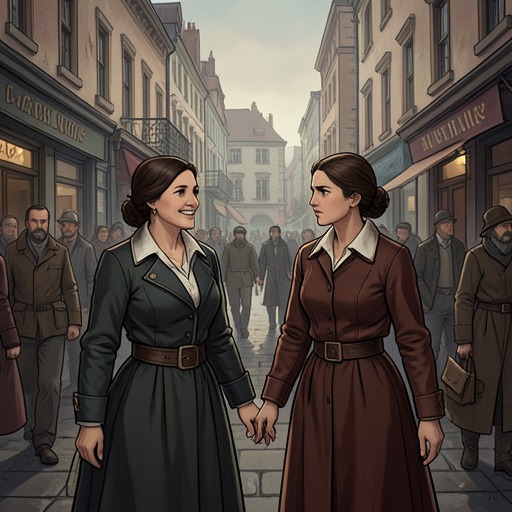
That judgment sharpens the conflict between mourning Bernardo and protecting Tony. Maria says that both Bernardo and Riff had to die, but that Tony must not, because he had once been like them and had wanted to change. Tony asks whether his killing Bernardo means nothing to her, given that Bernardo was her brother. Maria answers by holding two truths together: she was the one who sent Tony to the meeting that night, making him promise to go, but she had not wanted him to kill her brother. She insists that she can mourn the whole world: Bernardo is her brother, and Tony is the man she loves. Her loyalty is not a choice to stop grieving one person in favor of another; it is an effort to extend love beyond the people she knows to people she will never meet.
The same conflict surfaces when Maria asks Anita Palacio to remain until their parents return and tell them the news. Anita answers with bitter sarcasm, imagining Maria announcing her brother’s murder before fleeing with the man who killed him. Maria pleads with her to understand, then recognizes that Anita’s shouting itself shows that she does understand what is at stake and cannot bear it. Maria declares that she will find Tony at Doc’s and that anyone who tries to stop her will have to kill her too; she asks Anita to relay that message to Chino Martin. Her grief has not erased her attachment to Bernardo or the family that must be told. Instead, it leaves her committed to both mourning the dead and refusing to surrender the changed life she believes Tony might still choose.
The Abruptness of the Loss
The crisis is not only a collision between family loyalty and love; it is also a sudden collapse of the future Maria and Tony had imagined. In the dark, hot room, Tony looks blankly around and recognizes that they have passed from life and love to death too quickly. His words do not resolve Maria’s divided loyalties, but they name the speed with which the violence has overturned the world they had only just begun to share. Bernardo’s death is therefore both a personal bereavement and the abrupt destruction of a hoped-for life with Tony.
That compressed movement from love to death also sharpens the limits of Maria’s choice. She can affirm that Tony wanted to change and insist that he must live, but neither conviction restores Bernardo or makes the killing harmless. The scene leaves her holding grief and attachment together without a pause in which either can become simple: the future remains imaginable only in the shadow of what has happened.
An Ethics Without an Easy Absolution
Maria’s refusal to divide the living into the innocent and the guilty does not amount to absolution. She can recognize the destructive pattern that joined Bernardo and Riff without treating Tony’s act as harmless, and she can insist on a future for Tony without pretending that Bernardo’s death has ceased to matter. Her compassion therefore remains a demanding, unsettled position: it asks her to grieve beyond the boundaries of kinship while keeping the particular loss of her brother in view. The novel leaves that demand under pressure rather than converting it into reconciliation; the abrupt passage from life and love to death is the condition in which Maria must continue to hold both attachments.