New York City
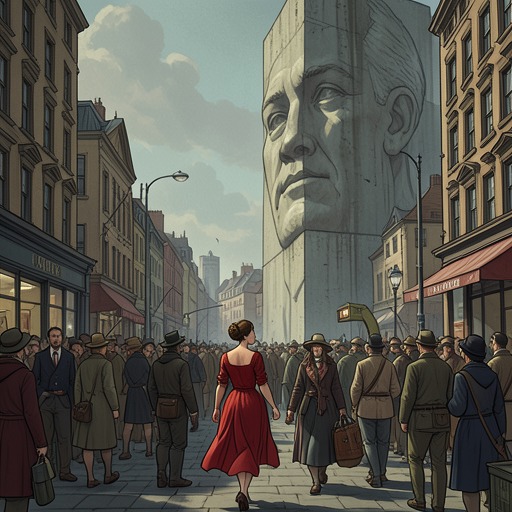
West Side StoryNew York City is both the crowded setting of the conflict and one of its forces: a place where housing pressure, racial exclusion, and neglected streets help turn territorial rivalry into a substitute for security and public power. The city can look dazzling from a rooftop, but for many of its residents it offers little room to move, little say in how the neighborhood changes, and few protections from violence.
The City and Its Unequal Neighborhoods
The novel describes the city as an immense battlefield, spread across a thousand streets and ten thousand houses, rooftops, basements, and alleys. In this account, the Jets’ hostility is not initially confined to a specific rival: they attack whoever or whatever crosses their path, and other gangs likewise turn to destruction, sometimes against one another. The result is a city where people live in fear and densely populated streets offer no refuge from the trouble surrounding them.
The setting’s most immediate pressures fall on Manhattan’s West Side, described as overcrowded and deteriorating. Moving elsewhere is not a realistic option for many residents: ordinary people still face expensive housing two decades after the Second World War, while a departing tenant can mean an opportunity for a landlord to raise the rent. Owners may divide a three-room apartment into five, six, or even eight rooms and pack in Puerto Rican tenants, then neglect the halls, roofs, and walls; if a building collapses, its owner can turn the site into a parking lot. The city’s deterioration is therefore not just atmosphere. It is bound up with who can afford to stay, who is made to live in overcrowded conditions, and who profits from the scarcity.
The narrative also presents a bitter political vacuum. Politicians do not live in the West Side or fight for a small room and breathable air, and residents were not consulted before Puerto Ricans came to the country. The account describes the Jets as the boys who use their voices and fists where newspapers do not speak for local residents. That explanation helps account for the gang’s local standing without making its violence harmless: some people who dislike the Jets’ methods still regard them as doing something to defend what remains of the neighborhood.
Ethnic Conflict and the Illusion of Safety
The arrival of Puerto Ricans appears, in the narrator’s bleak account of gang thinking, to give otherwise unfocused hostility a target. The city becomes safer for everyone except Puerto Ricans, while the gangs and Puerto Ricans fight back and forth. The apparent improvement is profoundly unstable: the city continues to live and die amid the prospect that the groups might destroy one another. This is not a neutral account of an actual threat posed by newcomers; it exposes a scapegoating logic in which Puerto Ricans are blamed for a crisis shaped by poverty, overcrowding, and neglect.
That logic is made concrete in Bernardo’s efforts to gather Puerto Ricans around him on the West Side. Riff interprets this as a bid for neighborhood control and imagines that the white residents will be forced to leave. His fear of displacement quickly becomes ethnic contempt and a threat to drive the Sharks into the river. The conflict is thus attached to a real struggle over who belongs in the neighborhood, but the characters’ racialized accusations turn that struggle into a justification for hostility rather than a path toward security.
New York City also figures in arguments over American identity and opportunity. When Chino describes a possible path from laborer to delivery worker and then to a union position, Bernardo counters that a white American would be favored over Chino even if Chino sought the same advancement. Maria rejects the use of an ethnic slur against Tony and argues that a person born in America is not a foreigner, and that a person who has chosen to live there can also be American. Her response challenges the idea that belonging should be denied on the basis of origin, even as Bernardo insists that Tony sees her as vulnerable because she is Puerto Rican.
Rooflines, Work, and Everyday Movement
From a rooftop in May, Maria looks toward Central Park and the illuminated windows of distant buildings. The spring night feels like early summer; above her, stars and thin clouds frame a city whose towers and stone façades seem to belong to a more luxurious life. The view makes the distance between neighborhoods visible: the buildings are less than a kilometer away, yet seem farther from her recent experience than the miles she has traveled in a week. Her comparison with Puerto Rico recalls streets that were often unpaved, homes without windows or running water, and widespread poverty. New York offers more of everything, she thinks, including hatred, but her preference for love makes the city’s abundance an ambivalent promise rather than a simple measure of improvement.
The conditions of arrival and family life further complicate that promise. Maria’s parents had emigrated to New York two years earlier, while Maria and her sisters stayed with relatives; Bernardo accompanied their parents as they tried to establish themselves. When Maria arrived, her parents seemed younger and better dressed than she remembered. In a later scene, she complains that Bernardo still accompanies her to the store each morning and returns to walk her home when Chino cannot. The protection limits her independence: she describes days spent sewing and evenings with nothing to do, much as in Puerto Rico.
Work and public space offer narrow routes through the city. Tony crosses from Brooklyn to the Bronx, then Queens and Manhattan on repeated train rides before returning to his Columbus Avenue neighborhood and sitting on a rooftop until dawn. The following morning he looks for work, and Doc offers him a job at the drugstore; four months later he is still working there. Nearby, a small wedding shop is equipped with three sewing machines, three mannequins, a cutting table, and a tiny fitting room. Its owner puts an English-language message in the window hoping to attract customers who are not Puerto Rican, but after a week she has not had an opportunity to speak English. The sign’s failure registers how little a written appeal can change the shop’s actual circumstances.
A City That Restricts and Exposes
The city’s everyday routines are marked by both constraint and danger. Maria’s daily escort to the store makes her family’s concern visible, but also keeps her under her brother’s supervision. At the wedding shop, Anita stays late to help alter the dress Maria plans to wear to a dance, while the shop’s owner hesitates to leave the young woman there alone. At Doc’s drugstore, Anita insists on going behind the counter to see Doc; Diesel blocks the door and makes a sexual remark about her body. These incidents place women’s restricted movement and exposure to harassment within the same urban landscape as the gangs’ territorial violence.
New York City’s central contradiction is that it holds out work, buildings, and the possibility of a different life while distributing security and opportunity unequally. A skyline seen from a rooftop can suggest distance from poverty; a job can suggest a path toward stability; a neighborhood can feel worth defending. Yet overcrowded housing, landlord neglect, exclusionary ideas of belonging, and the absence of a trusted public voice keep turning those hopes into new grounds for conflict. The city is not simply a backdrop to the characters’ choices: its pressures help define which choices seem available and whose safety those choices preserve.