New York City police
West Side StoryThe New York City police are the formal authority charged with containing gang violence on Manhattan's West Side, but the novel presents that authority less as a steady source of protection than through tense encounters with Lieutenant Schrank and Officer Krupke. Their patrols, threats, and use of the badge confront the Jets and the Sharks directly, yet their policing reproduces the neighborhood’s ethnic divisions and does little to address the conditions that sustain them. The contrast is stark: the officers can order young people off a street or out of a snack bar, while no comparable institutional force appears to give residents greater security, housing, or a meaningful voice in decisions about their community.
Presence and Methods
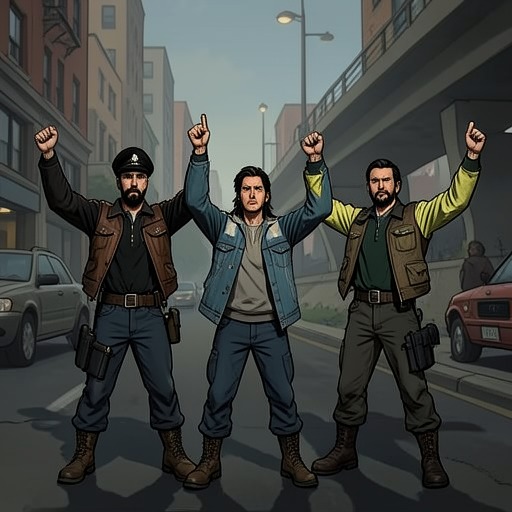
The police enter the street-level action in a patrol car, moving slowly enough for the Jets to recognize it and adjust their behavior. Riff signals the danger, and the gang returns to an ordinary pace while the car passes. The police are familiar enough to the boys that they know how to appear harmless while concealing their weapons: Mouthpiece, carrying knives, brass knuckles, and bicycle chains, slips into a building’s basement and uses the back routes to reach a hidden gang armory. Riff then keeps a hand on the patrol-car door as he greets the officers, helping prevent them from pursuing the armed boy. The scene shows the police as a constant presence that the gang watches and evades, but also shows how readily the boys have learned to manage encounters with them.
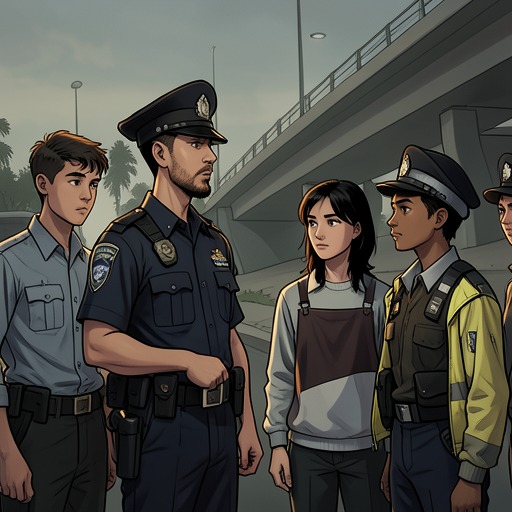
Schrank and Krupke represent different positions within the same confrontation. Schrank, a lieutenant with thirty years in the police, approaches the young people with a fatalistic belief that troublemakers must be subdued. He threatens to punish anyone who moves and singles out A-Rab for insult; Krupke joins in with a threat of his own. Their authority is expressed through physical intimidation as well as rank. When Schrank grips Riff’s shoulder in a painful hold, he tells the Jets that the street is not theirs and orders them to stay within their block and stop obstructing the sidewalk. The restriction is presented as an official response to raids and explosions between the Jets and the Sharks, but it also confines the youths’ movements rather than changing the circumstances of the rivalry.
Policing the Gang Conflict
The officers seek information about where the Jets intend to fight. At a snack bar, Schrank arrives while the gang is gathered with Bernardo and the Sharks; he takes a nearly full packet of cigarettes from the bartender’s pocket and smokes as he questions those present. His conduct makes the encounter feel less like a neutral inquiry than an assertion of possession and control. He has heard that a fight is being planned and tries to get the location from the boys, naming possible sites and urging them to cooperate with his stated aim of clearing the streets.
When Schrank orders the Sharks out, he invokes the badge as the practical source of his power: although he acknowledges that he has no legal right simply to order them away, he insists that they must comply unless they take him to court. The Sharks leave together, then disperse in different directions before Krupke can follow them. Schrank’s effort to control their movement succeeds momentarily, but it does not produce the information he wants or stop the planned violence. The police can make a group move; they cannot, in these encounters, make the gangs trust them or disclose their plans.
The threats are not directed evenly or delivered in neutral language. Schrank calls the Sharks Latinos and tells them to leave, then turns on the Jets with ethnic abuse aimed at immigrants and personal insults directed at individual boys and their families. He also makes clear that he expects the gangs to hurt one another before the police arrive, threatening that the officers will finish what remains. This is more than a promise to intervene against violence: it frames the young people as disposable antagonists and treats their possible injuries or deaths as an acceptable prelude to police action.
Institutional Attitudes and Neighborhood Context
Schrank’s perspective is shaped by a broad contempt for the people he polices. He sees the Jets and the Sharks as examples of the gangs that infest the West Side and concludes that gangs, like cockroaches, must be crushed. His long service has hardened him into a fatalism in which everyone is corrupt and force is the necessary answer to disorder. The narrative gives this outlook weight as a feature of his experience, but its encounters also expose the limits and costs of that certainty: he uses racialized insults, threatens beatings, and applies authority coercively even while claiming to be on the side of safer streets.
That approach sits within a neighborhood where residents often avoid the Jets rather than challenge them, and where those who object to the gangs have few effective public channels. Some residents regard the Jets as preserving what remains of their neighborhood, even though they disapprove of the boys’ methods; politicians, by contrast, are described as absent from the West Side and remote from the struggle over cramped rooms, air, and safety. This context does not make the police and the gangs equivalent, but it makes the gap between formal authority and everyday security visible. The officers can threaten and disperse young people, while residents remain exposed to street violence and to decisions made without their participation.
The Municipal Community Center offers a related measure of the institutional problem, though it is not a police operation. Established in a former church to draw young people from the streets through supervised activities, it is weakened by ethnic boycotts: longtime neighborhood residents avoid it because Puerto Ricans are welcome, and Puerto Rican families also stay away when they believe the center is being boycotted. At a June dance, Sharks and Jets occupy opposite sides of the floor and dance as if separated by a wall, despite the absence of a fight. The contrast clarifies what policing alone cannot supply. An officer can impose a boundary or order a group to leave; building a shared public space would require participation and trust that the police encounters do not create.
Significance
The New York City police are neither absent from the West Side nor shown resolving its central conflict. Their officers patrol, investigate, issue restrictions, and invoke the authority of the badge, but their interventions repeatedly meet concealment, silence, and dispersal. Schrank’s brutality and ethnic hostility compound that failure: his demand that the gangs stop fighting is undercut by his readiness to demean them and to imagine their mutual destruction as preferable to disorder on his terms. Through this institutional presence, the story distinguishes the power to control a street for a moment from the harder work of making the neighborhood safe. The police can compel obedience in an encounter; the evidence does not show them overcoming the social divisions and material neglect that keep the conflict alive.