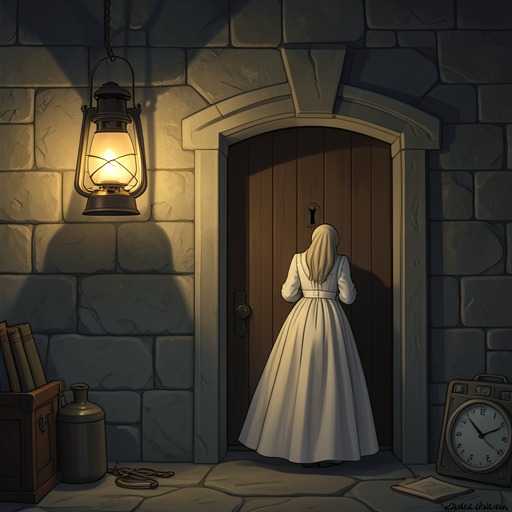
Nunez rooftop
West Side StoryThe Nunez rooftop is both a refuge from the crowded apartment below and a stage on which the characters’ private hopes meet the pressures of life on Manhattan’s West Side. Reached by an exterior fire escape and ladder, it offers Maria Nunez a view beyond her family’s cramped kitchen, but not an escape from the poverty, isolation, and conflict that shape the neighborhood. Its changing uses—as a solitary retreat, a family threshold, a gathering place, and the setting for a clandestine meeting—make it one of the story’s most charged domestic spaces.
Setting and Access
In May, during a mild spring night that feels like the beginning of summer, Maria climbs from the fire escape up a ladder to the roof. She chooses the height partly to avoid unnecessary conversation with her father, mother, two uncles, two aunts, and several family friends, all crowded into a small kitchen with one window. The roof gives her distance from that compressed interior without requiring her to leave the building.
From her vantage point, Maria can see lit windows and scattered lights in the direction of Central Park. The sky is generous with stars, and the moon has cut through delicate clouds. Nearby buildings seem less than a kilometer away, yet their apparent distance exceeds what she feels she has travelled during the entire preceding week. As darkness softens the outlines of the towers and brings colored patterns into their windows, the view gives her a way to imagine lives unlike her own.
That contrast is sharpened by Maria’s memory of Puerto Rico. There, she recalls, houses were often small, without upper floors or window glass, and lacked running water; many streets were unpaved and had no sidewalks. New York’s illuminated buildings may appear rich and beautiful from the roof, but their grandeur does not remove the crowding in the Nunez apartment or the precariousness of life below.
A Private Retreat Above a Crowded Neighborhood
The rooftop’s height creates a temporary solitude, not a separate world. Maria can look toward distant buildings and stars while remaining only a ladder’s climb from the family gathered below. Its privacy is therefore practical and partial: it lets her pause outside the crowded kitchen, but it cannot free her from the expectations and relationships that follow her there.
The surrounding neighborhood makes that limited refuge significant. Residents see the Jets pass through on a warm night; some openly approve, while others look away or hide behind a newspaper or handkerchief because the gang is associated with trouble. In this densely populated district, the narrative presents trouble as already abundant. The rooftop’s elevated calm stands against streets where gangs emerge at night to haunt basements, alleys, roofs, and sidewalks.
The pressures are also material. Ordinary people have few affordable places to move, and landlords can raise rents when tenants leave. Some owners divide apartments into still smaller rooms, profit from housing Puerto Rican tenants, and neglect halls, roofs, and walls; a collapsing building can even be turned into parking. Against this abandonment, some residents concede that the Jets do something to preserve what remains of the neighborhood, while politicians who live elsewhere offer little beyond speeches. The rooftop belongs to that strained urban landscape: a small opening onto the city, not proof that the people living beneath it have meaningful choices.
Family and Neighborhood Gathering Place
The roof is not exclusively Maria’s hideaway. Bernardo enters through the heavy metal door and finds his sister sitting alone. His stern question about what she is doing there interrupts her solitude, while the sound of his voice dispels her brief fear of the dark figure at the entrance. The encounter makes the roof a threshold between Maria’s private thoughts and her family ties: she has climbed away from the crowded kitchen, but her brother can still reach her there.
On another occasion, the roof hosts a gathering. Chino has placed an old radio on an old foam mattress, and several young people dance in their socks or stockings. Bernardo, however, leans on the parapet, smoking rapidly and staring coldly at the city. The contrast between the dancers’ makeshift pleasure and his isolation turns the same rooftop into a measure of unequal emotional experience. The city seems vast around him, yet he feels it refuses to make even a small place for him. He cannot imagine a life there that he wants or can take pride in, and he anticipates failure with anger at the prospect that others will suffer alongside him.
A Meeting Place for Maria and Tony Wyzek
The roof also becomes the destination of a carefully negotiated clandestine meeting. At night, Tony Wyzek tosses a coin toward a window and listens for movement. Maria appears in white, opens the window farther, and signals him to be quiet. She asks him to identify himself before he comes closer, making the encounter depend on secrecy as well as recognition.
When they climb, they do so hand in hand. Tony tells Maria to look upward toward the stars rather than down; he stays half a step behind her, holding his arms against the ladder’s rails to form a protective arc around her. She reaches the parapet and steps onto the roof, where she turns as if the arrival itself calls for a dance. In this scene, the height that earlier gave Maria solitude becomes shared space. The stars and the upward movement frame their intimacy, while the careful ascent registers the danger and constraint surrounding it.
Narrative Significance
The Nunez rooftop holds several incompatible possibilities without resolving them. Maria uses it to imagine distance, beauty, and a life beyond the crowded rooms below; Bernardo looks out from the same elevation and sees a city that denies him a future he can value. For a gathering, it offers a radio, a mattress, and room to dance, but it cannot make everyone feel included. For Maria and Tony Wyzek, it briefly provides a private place to meet, reached through a window and an exposed climb.
Its recurring force comes from that contrast between physical elevation and limited freedom. From the roof, the city can look immense and full of light, yet the residents remain hemmed in by expensive housing, neglected buildings, ethnic hostility, and decisions made without their voices. The rooftop gives the characters a place from which to look outward and toward one another; it does not erase the conditions that make escape, privacy, and belonging so difficult.