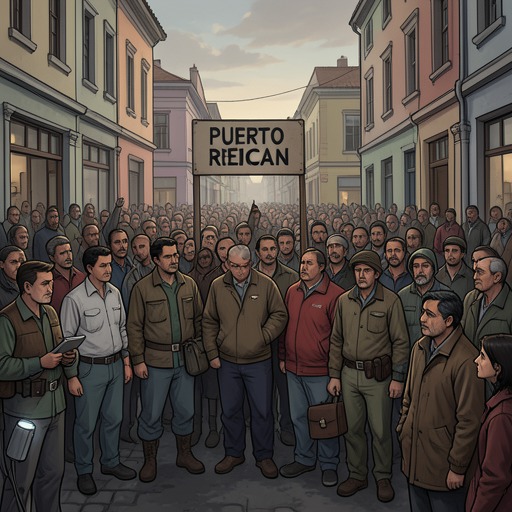
Puerto Rico
West Side StoryPuerto Rico is the homeland Maria measures against New York, but it is also a place made into a target by the neighborhood’s ethnic hostility. Its significance rests on that contrast: Maria remembers material poverty there while longing to belong in America, as other characters turn Puerto Rican migration into a story of intrusion and territorial threat.
Homeland and Migration
From a rooftop in New York, Maria looks toward the distant lights and compares the imposing buildings around her with the homes she remembers in Puerto Rico. There, houses were often small, lacked window glass and running water, and stood on streets that were mostly unpaved and without sidewalks. The contrast is not simply between two landscapes: the city’s illuminated towers suggest a wealth and comfort that Maria can imagine but does not know from her own experience.
The family’s move to New York had divided them. When Maria’s parents emigrated two years earlier, she and her sisters remained with relatives in Puerto Rico, while her brother Bernardo accompanied their parents until they could establish themselves. Maria has recently arrived in New York, where her parents seem younger and more confident than she remembers. The family’s departure is explained through material want rather than a speech about ambition: when asked why they left, they need only touch their pockets and look at the kitchen sink and its taps.
Maria’s first impressions of New York are also shaped by being crowded into a family kitchen with her parents, two uncles, two aunts, and family friends. From the roof she can look toward Central Park and the lit buildings, but the distance feels greater than the miles suggest. Puerto Rico remains close in family conversation—people talk about San Juan and the community they once called home—while Maria stands apart, listening to Spanish or to English she experiences as sounding like Spanish.
Maria’s Memory and Aspirations
Maria’s relation to Puerto Rico is affectionate but not uncomplicated. She recalls the island’s poverty, yet her strongest wish in New York is to speak English like Americans, with the hard consonants and dry vowels she associates with them. She considers studying English grammar or practicing with her father, while knowing that the family’s crowded kitchen is likely to draw her back into the language and memories of the place they left.
That desire to assimilate does not mean Maria accepts hatred of Puerto Ricans or of Americans. She believes that hating is wrong and would rather love than carry resentment. When Bernardo disparages Tony Wyzek as a foreigner and argues that an American would be favored in the workplace, Maria objects: in her view, a person who has chosen to live in America belongs there, whether or not he was born there. Her defense of Tony turns belonging into a principle that can include both him and her family, rather than a privilege reserved for one group.
A Homeland Made into a Target
The wider account of Manhattan’s West Side shows how Puerto Rican migration becomes entangled with neighborhood violence. The narration presents Puerto Ricans as having supplied gangs with a clear target, making the city feel safer to others at their expense. The irony is sharp: they are treated as responsible for the danger directed against them because they supposedly arrived without being invited. The possibility that they might flee or be driven out is raised, but the neighborhood carries on without confronting what might happen next.
Material pressures feed that hostility without making the people who migrate its cause. Affordable housing is scarce, ordinary residents have little room or air, and landlords can subdivide apartments to fit more Puerto Rican tenants while raising profits and neglecting building maintenance. Residents were not consulted about the newcomers’ arrival, and they have no newspaper speaking for them. The narration describes this absence of a voice as part of the resentment, while also exposing how easily economic exploitation and frustration are redirected toward the people with the least power.
Territory, Work, and Belonging
Bernardo interprets Puerto Rican presence through the language of territory. He gathers other Puerto Ricans around himself and, in Riff’s thoughts, appears to be trying to take control of the neighborhood; Riff fears that success would force white residents to leave. His reaction turns migration into a zero-sum contest over who may remain, and his contemptuous thoughts reveal the prejudice beneath that fear. The threat is not presented as a neutral account of Puerto Rican intentions: it is filtered through Riff’s racial hostility.
Work offers another measure of what migration might promise and what prejudice might obstruct. Chino Martin describes a path from assistant to operator and full union membership, while Bernardo counters that Tony Wyzek would advance sooner and earn more because he is American. Maria challenges that division between American and foreigner, but the argument exposes how ethnic identity shapes expectations of opportunity. Puerto Rico thus remains present in New York not only as remembered home, but as a contested category through which characters debate labor, citizenship, race, and who has a claim to the neighborhood.