The American Dream
West Side StoryThe American Dream in West Side Story is not a single, settled promise. It means the possibility of a better life, but the novel places that hope beside overcrowded housing, precarious work, racialized suspicion, and the gangs’ struggle to control the neighborhood. For Maria Nunez, America offers a chance to belong without hatred; for the Sharks, the Statue of Liberty embodies a promise they can invoke against exclusion; for the Jets, the newcomers appear as rivals for territory and security. The ideal remains powerful precisely because the people who appeal to it do not share equal access to it.
Promise and Material Conditions
The promise of a new life is measured first against the conditions that brought people to New York. In the Nunez family’s kitchen, talk of San Juan and the community left behind accompanies a blunt reminder of why they came: their pockets and the kitchen sink’s faucets make the reasons visible without anyone needing to explain them. The migration is bound up with economic need, not simply aspiration. Maria Nunez, meanwhile, studies English grammar and considers practicing with her father. Watching a plane cross the sky, she wonders whether it has come from Puerto Rico, then longs to speak English with the hard consonants and dry vowels she associates with Americans. Her desire is both practical and intimate: she wants access to the language of the society around her and hopes to recognize herself as belonging to it.
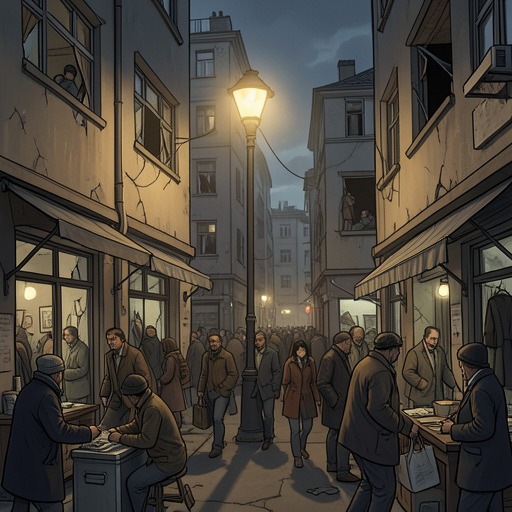
That aspiration encounters a city whose housing market offers little room for ordinary people. The Second World War ended twenty years earlier, yet apartments working people could afford remain expensive. Landlords can raise rents when white tenants leave, subdivide a three-room apartment into as many as eight rooms, and profit from crowding Puerto Ricans into the resulting spaces. Maintenance is neglected, and even a collapsing building can be turned into a parking lot. The promise of upward mobility therefore sits against a housing system in which scarcity and profit shape who can live where, while tenants have little say in the conditions imposed on them.
Belonging and Exclusion
The novel gives the promise a deliberately divided geography. The arrival of Puerto Ricans supplies the gangs with a common target, and the surrounding city becomes safer for everyone except the people now exposed to their violence. The narrative’s bitter irony is that they are treated as responsible for the danger directed at them: because they supposedly arrived uninvited, any disaster that befalls them is framed as their fault. The neighborhood’s hostility thus converts a claim to belonging into an accusation of intrusion.
The Jets’ territorial fear gives this exclusion a local and material form. Riff imagines Bernardo gathering the Sharks in order to take control of the neighborhood, after which, in his view, white residents would have to leave. His angry fantasy of being driven into the river makes the struggle for a block sound like a struggle over whether the Jets have any future in the city. That fear is presented within a larger account of landlords, costly rooms, and political neglect, but it does not undo the prejudice directed at Puerto Ricans. The gangs’ claim to defend a neighborhood and their willingness to make another group bear the cost of that defense remain in tension.
The narration also describes how some residents accept the Jets as doing something to protect what remains of their neighborhood, even when they dislike the boys’ methods. Politicians, by contrast, live elsewhere and do not have to compete for a small room or even a little air. Tenants were not consulted about Puerto Ricans arriving in the country, but having no say does not mean they welcomed the decision. With no newspaper speaking for them, the Jets become the young people who make themselves heard through their voices and fists. This account helps explain the appeal of local belonging without equating that appeal with justice: the boys’ visibility answers a real absence of political representation, yet their violence makes the neighborhood’s divisions more dangerous.
The Statue of Liberty and the Promise in Dispute
Bernardo turns the Statue of Liberty into an instrument of argument. He jokes about buying small steel statuettes, roughly forty centimeters long, to strike the Jets, then invokes the inscription’s promise to poor people who come seeking a better life. The joke is aggressive, but the symbol beneath it is serious: Bernardo points out that the Jets do not believe the welcome the statue represents, so he imagines forcing its meaning into their heads. An emblem of refuge becomes both a makeshift weapon and evidence in a dispute over who is entitled to the American promise.
Maria Nunez resists the hatred that makes this dispute seem inevitable. She objects to the idea that it must happen this way and says she does not hate the people around her. Later, when Bernardo dismisses Tony Wyzek as a Polish outsider and assumes that an American-born worker will advance ahead of Chino Martin, she challenges both the ethnic label and the definition of belonging behind it. In her view, Tony Wyzek is not a foreigner simply because he is Polish, and even someone born elsewhere would become American by choosing to live in America. Her argument makes belonging an open possibility rather than a privilege reserved by ancestry. Bernardo’s reply—that Tony Wyzek sees her as an easy target because she is Puerto Rican—shows how sharply that ideal collides with her awareness of vulnerability.
Work, Gender, and Unequal Access
The American Dream is also presented through the promise of employment and advancement. Chino Martin describes a work ladder in which a handler can become a delivery worker and an assistant can become an operator and a full union member. His account gives the ideal a concrete shape: steady work can lead to status, security, and a place within an organized workforce. Bernardo interrupts that confidence with a claim that Tony Wyzek will reach the union first and earn more because he is American. The exchange does not settle who is right about the job prospects; it establishes that the promise of advancement is being argued over through competing experiences of ethnic disadvantage.
Women’s choices reveal a different limit on the promised freedom. A sign in a small wedding shop announces that English is spoken there, in the hope of attracting customers who are not Puerto Rican, but the shop’s owner has not had a chance to use English in the week since it went up. The sign registers a desire to cross a social and commercial boundary, while its lack of practical effect shows how little a declared welcome can accomplish on its own. At home, Maria Nunez complains that Bernardo still accompanies her to the shop and comes back for her if Chino Martin cannot; she is tired of sewing by day and sitting idle in the evening, as she did in Puerto Rico. Although she wants independence, her future is discussed through protection and an arranged marriage to Chino Martin.
The restrictions are not simply protective. Bernardo reaches toward Anita Palacio’s chest as he teases her, and she later rebukes him for interrogating Maria Nunez about a dance while neglecting his own girlfriend and her future. Anita Palacio insists that coming to America with open hearts does not mean that the women have also offered sexual access. When she goes to see Doc, Diesel blocks her way and makes a degrading remark about pregnancy; she notices the men staring at her breasts and feels unsafe. These episodes place gendered control inside the same world of racialized suspicion and limited autonomy: the promise of a new life does not automatically give young Puerto Rican women authority over their movement, relationships, or bodies.
Significance
The ideal persists through a conflict between its language and its distribution. Maria Nunez believes that belonging can be chosen and that love is better than hatred; Bernardo invokes the Statue of Liberty while preparing for a violent contest over territory; Chino Martin’s account of union advancement offers an image of progress that Bernardo suspects is racially unequal. Around them, expensive housing, crowded apartments, political indifference, and constrained options give those disagreements material weight. The American Dream is therefore neither simply fulfilled nor dismissed: it remains a claim the characters can make, but the novel shows how prejudice and poverty turn the claim into a source of argument, longing, and danger.