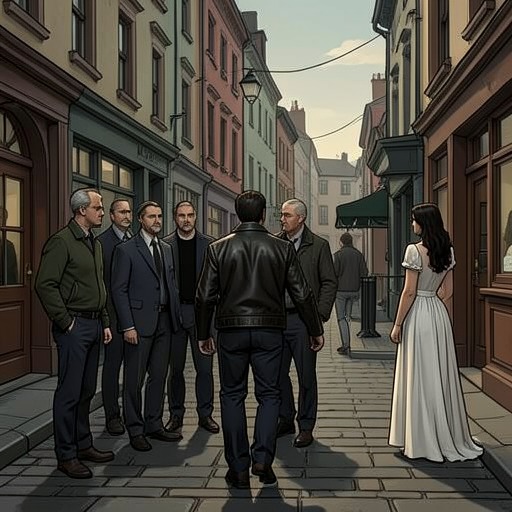
Tony's remorse and despair
West Side StoryTony's remorse and despair emerge from the widening gap between what he tries to do and what he believes he has become. He enters the dance with Riff and Action, attempts to interrupt the fight beneath the highway, and then kills Bernardo after Bernardo kills Riff. When Maria holds him and he asks her forgiveness, he is already preparing to surrender to the police; later, convinced that Maria is gone, he seeks Chino as a way to end his own life. His state is not a single reaction to violence but a tightening sequence of guilt, bereavement, and self-condemnation.
From attempted intervention to irreversible violence
At the dance, Tony appears alongside Riff and Action, despite Murray's understanding that Tony had left the Jets. The sight of the two gangs assembling makes the danger plain: Murray sees the Sharks behind Bernardo and the Jets behind Riff, while the crowd's hostility resists his effort to redirect the evening. When the confrontation later becomes a knife fight, Tony arrives and cries for the combatants to stop. His intervention comes too late to prevent the deaths. As the two leaders circle with knives, Tony breaks free from Diesel and Action; Riff's broad gesture gives Bernardo the moment to drive his blade into Riff's chest. Riff dies before he reaches the ground. Tony takes the knife from Riff's limp hand and charges Bernardo, who is fatally stabbed.
The sequence makes Tony's remorse inseparable from his failed intervention. He has entered the scene trying to halt the violence, but Riff's death transforms his response into another killing. The distinction matters to Tony: later, he insists to Maria that he tried to stop them and did not mean to hurt Bernardo. Yet his explanation cannot undo what happened, and his sense of responsibility is intensified by the fact that Riff was like a brother to him. The fight's swift reversals leave no interval in which he can preserve his intention to intervene from the consequences of his action.
Confession, grief, and the request for forgiveness
When Tony and Maria are together after the killings, her first response is physical and accusatory: she strikes him repeatedly, calling him an assassin. Then she collapses into his arms. Their embrace brings grief rather than absolution; Maria kisses away her tears and holds him while he cries. Tony explains that he had tried to stop the fight, that he had not wanted to harm Bernardo, and that Riff's death drove his response. His account shows the divided meaning of the same act: to him, the killing follows from shock and loyalty, while to Maria it confirms that he has killed her brother.
Tony says he had to tell Maria and ask her forgiveness before going to the police. The confession links his love for her to an intended act of legal surrender: he does not present himself as free of responsibility, and he does not expect their reunion to erase it. When Maria begs him to stay because she is alone, he answers that he is not afraid now. In the moment, that assurance sits beside the guilt that brought him to her and the expectation that he will give himself up. The exchange makes his despair visible not as withdrawal from Maria but as a belief that he cannot resume an ordinary future with her.
Intimacy under the shadow of death
The narrative later shows the couple together on a bed. Tony clings to Maria in desperation, and the encounter is framed by his conviction that their life together will end within minutes or, at most, an hour or two. He then trembles, tries to rise, and breaks down crying before falling asleep. The scene gives physical closeness a compressed, precarious duration: their intimacy does not settle the deaths or restore the future he believes they have lost.
That fatalism also shapes what Tony can imagine for their relationship. When Maria asks him to be her husband, he refuses because he considers himself an assassin. When she asks him to be her lover instead, he still cannot accept, invoking Bernardo and the fact that he killed him. His refusal exposes a conflict between their desire to remain together and his belief that Bernardo's death makes their union impossible. Tony does not merely fear punishment; he treats the identity of killer as a moral barrier to intimacy, even when Maria is asking him to stay.
From anticipated surrender to seeking death
After leaving the drugstore, Tony runs in anguish, believing Maria has gone and will never return. His guilt has grown, and he thinks the work is not finished because Chino remains. Tony does not know what Chino intends to do, but decides to find him and be killed by him. He regards this as the only way to end matters and says, in effect, that he no longer wants to live. The movement is a stark reversal from his earlier plan to go to the police: surrender had meant facing the consequences of the fight, while his new purpose is to provoke Chino into killing him.
The streets offer no refuge or clear route to this intended death. Tony hears people on stoops, sidewalks, and beside cars talking about ordinary things, while a police car's black-and-white pattern sends him ducking into a doorway. Once it passes, he runs toward the Coffee Pot, but Chino is not there. Tony realizes he will not find him simply by searching the street and considers backyards, basements, and rooftops instead. He now describes himself as no longer the prey but the hunter, a change in posture that serves his effort to locate the person he wants to kill him. His despair thus turns outward into pursuit, even as its stated aim is self-destruction.
The shape and significance of Tony's remorse
Tony's state develops through a series of failed endings. The plea to stop the fight fails; the killing meant as a response to Riff's death cannot restore Riff; the request for Maria's forgiveness cannot make Tony believe he can marry or remain with her; and the plan to surrender gives way to a search for Chino when Tony thinks Maria is lost. Each step narrows his sense of what remains possible. His remorse is attached to concrete relationships and consequences, especially his bond with Riff, the death of Bernardo, and Maria's loneliness, rather than to an abstract regret detached from the plot.
The contrast between his attempted intervention and his later pursuit of Chino is central to the tragedy of this state. At the duel, Tony tries to stop the violence; after the killings, guilt makes him accept the identity of an assassin, and despair makes death seem like the only conclusion available. Yet the story preserves the difference between his intention and the outcome without allowing intention to cancel responsibility. His love for Maria keeps him seeking her forgiveness and close to her, while his condemnation of himself repeatedly interrupts the future she asks him to share.