Tony–Maria
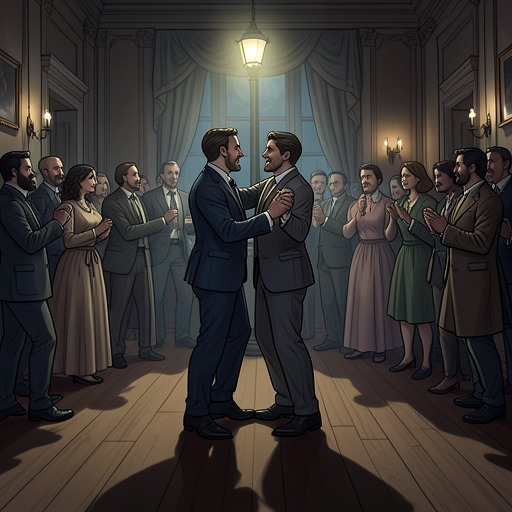
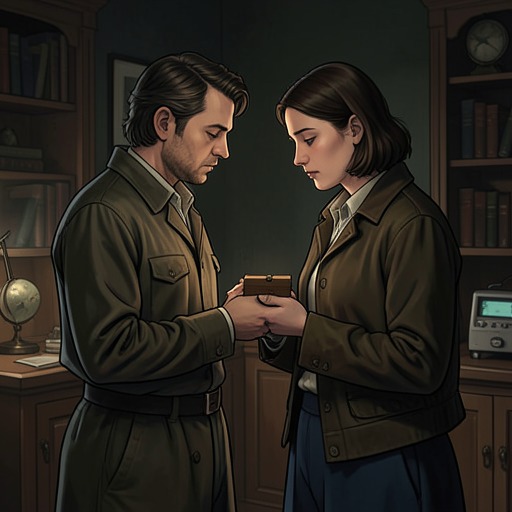
West Side StoryTony–Maria is a love relationship that the story sets against mistaken assumptions, imminent danger, and finally Tony Wyzek’s death. Maria speaks of marriage and describes love as an almost weightless transformation; later, she treats their union as already real, cares for Tony in his despair, and insists that they will leave together. Their private sense of a shared future survives only briefly against the violence around them: Tony is shot, and Maria reaches him after the fatal bullet.
Anticipation and mistaken assumptions
In a conversation with Consuelo and Rosalia, Maria announces that she is waiting that evening for the boy she will marry. Consuelo dismisses the supposed secret and assumes Maria means Chino Martin, praising him as steady and employed. Rosalia likewise treats Chino’s job as the obvious attraction. Their guesses show how little the friends understand the relationship Maria is describing: the passage lets them misread her words even as Maria’s confidence points toward a different beloved. The contrast matters because the scene places her private certainty beside the ordinary social explanations her friends offer.
Maria soon gives that certainty a more expansive form. She says she feels extraordinarily well, wonderful, and beautiful, and imagines that she could fly, run from one rooftop to another, and see stars and four or five moons. She names her love for the most incredible boy. Consuelo again takes the statement to mean Chino, while Rosalia’s dry reference to his good job punctures the assumption that employment could account for Maria’s elation. The scene does not present Maria’s feeling as a calculated choice based on a suitor’s practical merits; it presents it as a transformation in how she experiences herself and the world. The friends’ mistaken interpretation sharpens the difference between the man they imagine and the love Maria is actually asserting.
A marriage made present
When Tony is with Maria later, she recalls telling the girls on the rooftop about her marriage and tells him that they were married that afternoon. She asks whether he remembers, then answers his wish that they could return to that afternoon by insisting that they are still in it and that time will not move forward for them. Her language gives their union the force of a shared present: rather than treating marriage only as a future promise, she speaks as though the commitment has already been achieved. The passage supports this as Maria’s understanding of their bond, not as evidence of a legal ceremony.
That insistence also shapes how she responds to the danger around them. When Tony asks about going to the police, Maria says he can do so later, after he has rested. She takes his hands as she directs him to rest and holds his attention on their imagined, or declared, married life. Her care does not erase the peril or resolve what should happen next; instead, she postpones the police question and offers him a moment organized around intimacy and a future they claim as theirs.
Intimacy and care in despair
The relationship is also shown through physical closeness at a moment when Tony is overwhelmed. As he lies on the bed in despair, Maria kisses him. He clings to her and presses his lips against hers; in his anguish, he touches her breast beneath her clothing, hesitates, and then draws her toward him so that they are together on the bed. The account presents their intimacy in the shadow of an impending separation: Tony believes their life together may end within minutes or, at most, an hour or two. The scene therefore joins desire to fear rather than offering intimacy as an escape from the danger surrounding them.
Afterward, Tony trembles and tries to rise. Maria moves to the other pillow and listens as he cries and then falls asleep. Her presence becomes an act of care when she cannot undo his grief or make the crisis disappear. The passage preserves both the closeness of the encounter and its limit: the two share the bed, but Tony remains shaken, and Maria stays beside him while the possibility of loss presses in. Their relationship is thus shown not only in declarations of love, but in her remaining with him through his collapse.
Choosing a future, then losing it
Maria makes the relationship an explicit choice when she pleads with Anita Palacio to understand. She says she is going to find Tony at Doc’s drugstore and that they will leave together; if anyone tries to stop them, that person will have to kill her too. She asks Anita to repeat this to Chino Martin. The plan is direct and urgent: Maria intends to reunite with Tony and leave, and she is willing to face lethal opposition rather than abandon that choice. Her appeal to Anita makes the future more than a private fantasy, even though the evidence does not show the pair carrying out their escape.
That future ends when Tony is shot in the chest. As he is struck, he believes he sees a white figure running toward him and calling his name. Maria throws herself onto his body, her tears wetting him as he lies dead. The image answers the earlier rooftop vision of flight and stars with a body on the ground and a reunion that arrives too late to save him. Maria rises but continues to cover Tony’s eyes; then she orders Anybodys to stop and tells Chino to come to her and give her the pistol. Her final actions place her beside Tony while bringing her into direct confrontation with the violence that has ended their shared future. Their love is sustained in the narrative as a determined bond, but its promised escape and marriage remain inseparable from an ending in death.