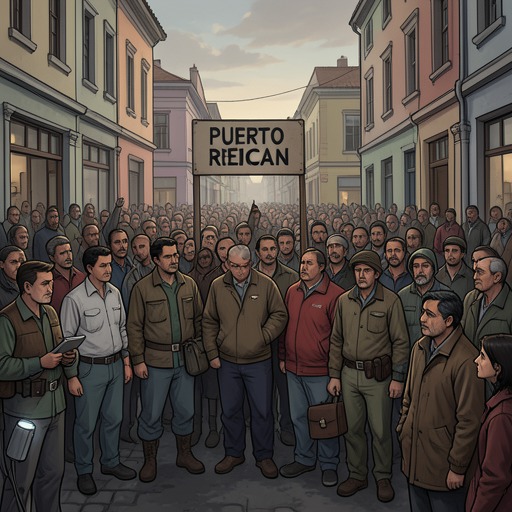
West Side's ethnic hostility and exclusion
West Side StoryWest Side's ethnic hostility and exclusion are not merely a rivalry between the Jets and the Sharks; they are a neighborhood condition in which territorial fear, housing pressure, and racialized ideas of who belongs reinforce one another. The story exposes the hostility’s self-serving logic: Puerto Ricans are treated as the cause of danger and displacement, while the economic and political arrangements that make the neighborhood precarious go largely unchallenged. Against that logic, Maria Nunez argues that American identity cannot be denied on the basis of ethnic origin.
A neighborhood organized around exclusion
The Jets’ violence is initially presented as having no stable target. They move through the city ready to attack whoever or whatever happens to cross their path, and the account describes their hatred as indiscriminate: even people they were friendly with the previous day, or businesses that had extended them credit, could become targets. The city’s crowded streets, houses, rooftops, basements, and alleys seem to form one enormous battlefield. This broad violence does not arise from a considered political program; it is destructive and opportunistic, and when the gangs have no other target, they turn on one another.
The arrival of Puerto Ricans appears to give this violence a direction. The narrative’s grim irony is that the city seems safer for everyone except the people now singled out: the gangs have acquired a target, and their war against Puerto Ricans becomes a substitute for confronting the wider conditions around them. The account even presents mutual destruction as an imagined optimistic outcome. That bleak expectation reveals how thoroughly the neighborhood’s hostility has been normalized: peace is pictured not as coexistence, but as one side eliminating the other.
Housing pressure and political abandonment
Ethnic resentment is entangled with a real scarcity of affordable housing. Although the Second World War ended twenty years earlier, ordinary residents still cannot easily find housing they can afford. When a white tenant leaves an apartment, a landlord can quickly rent it again at a higher price. The account thus links the fear of being displaced to a housing market that rewards rent increases, rather than treating conflict as a simple clash of cultures.
The description of landlords makes the imbalance sharper. A three-room apartment might be divided into five, six, or even eight rooms and filled with Puerto Rican tenants, allowing its owner to profit while neglecting the halls, roofs, and walls. If the building collapses, the owner can turn the property into parking. Puerto Rican residents are therefore portrayed both as people targeted by prejudice and as tenants exploited within the same system that fuels neighborhood insecurity.
Political neglect compounds that pressure. The politicians described do not live on the West Side and do not have to compete for a small room or even a little air. Residents were not consulted about the arrival of Puerto Ricans, and no newspaper speaks for them; the Jets are depicted as the young people who make themselves heard with their voices and fists. That claim explains some of the gang’s local appeal without making its violence a remedy: the group occupies a space left open by political absence, but its chosen means of action deepen the danger it purports to address.
Territorial rivalry and the making of a target
The Jets’ sense of possession is tied to a history of fighting for their block. Riff Lorton remembers the scars the group earned in claiming and holding the territory, and he regards Bernardo and the Sharks as a challenge to that hard-won control. He interprets Bernardo’s gathering of Puerto Ricans as an effort to take over the neighborhood and imagines that, if the Sharks succeed, white residents will have to leave. His account turns competition over place into an ethnic threat: the Sharks are not simply rivals for territory but representatives of a group imagined to be driving the Jets out.
The narrative also shows how this grievance sustains gang leadership and collective action. Action questions whether he should challenge Riff Lorton for control, but recognizes that taking command would mean actually directing the Jets; by remaining a critic, he can pressure Riff to prove himself. Riff’s need to hold the group together helps keep the Jets cohesive, while hostility toward the Puerto Ricans offers a common enemy. On a second uneventful night of patrol, Riff knows that the restless members may turn against him, exactly as Action anticipates. When three Sharks are spotted across the street and flee into a hallway, the encounter produces frustration rather than resolution.
Riff proposes ending the territorial contest in a single mass fight, because he is tired of the Sharks striking in small groups and running away. He says he is prepared to meet them on whatever terms they choose, including the possibility of knives or guns. Baby-John, frightened but trying to articulate a limit, argues for fists or stones rather than knives and firearms, and suggests that a clean fight would expose the other side if it fought unfairly. The appeal to fairness offers a restraint within the gang’s plan, but it does not question the premise that the ethnic and territorial dispute should be settled through violence.
Belonging disputed in work and identity
The conflict also enters ordinary conversations about employment and advancement. Chino Martin describes a path from laborer to delivery worker and then, by comparison, from assistant to operator and full union membership. Bernardo responds that Tony Wyzek could enter the union ahead of Chino and earn more simply because Tony is American. His claim makes national identity a disputed explanation for unequal opportunity and treats Tony as the beneficiary of a system closed to Puerto Ricans.
Maria rejects the ethnic label Bernardo applies to Tony. She argues that if Tony was born in America, he is not a foreigner, and that even someone born elsewhere would not remain an outsider merely for choosing to live there. In her view, that choice makes him American on the same terms as the Puerto Ricans. Her intervention directly contests the boundary Bernardo draws between the two groups. Bernardo answers by casting Tony as someone who sees Maria as vulnerable because she is Puerto Rican, replacing her argument about shared belonging with suspicion of an individual motive.
The cycle's consequence
The story’s account does not collapse material hardship and prejudice into one cause. Expensive housing, landlord profiteering, political indifference, territorial competition, and ethnic hostility remain distinct pressures, but they feed a single cycle: residents feel abandoned and insecure; the Jets treat Puerto Ricans as the visible explanation for that insecurity; and the resulting attacks confirm the neighborhood’s reputation as a place of danger. The notion that the city benefits when Puerto Ricans become the gangs’ target is therefore exposed as a temporary and cruel illusion, not a solution.
The state of hostility also narrows the choices available to the young people who inherit it. Gang membership can supply solidarity, a role, and an immediate purpose; during a police scare, Baby-John feels newly useful when A-Rab relies on him, even as his imagined response is to prepare for a more dramatic confrontation. Such belonging does not overcome exclusion: it binds the boys more closely to a culture of threat and retaliation. Maria’s insistence on a shared American identity points toward a different principle of membership, but the surrounding conflict shows how little power that principle has when territory, opportunity, and public voice are all treated as possessions to defend.