West Side's poverty and urban decay
West Side StoryManhattan's West Side's poverty and urban decay are not merely a backdrop to the novel’s gang conflict; they are the conditions that make territorial violence seem to some residents like a substitute for housing, safety, and political representation. Overcrowding and neglect confine people to a neighborhood they cannot readily leave, while the city’s institutions fail to offer a persuasive alternative to the order imposed by gangs. The result is a place where everyday survival and collective hostility become entangled, and where apparent safety can be purchased at the expense of another group.
A crowded and dangerous neighborhood
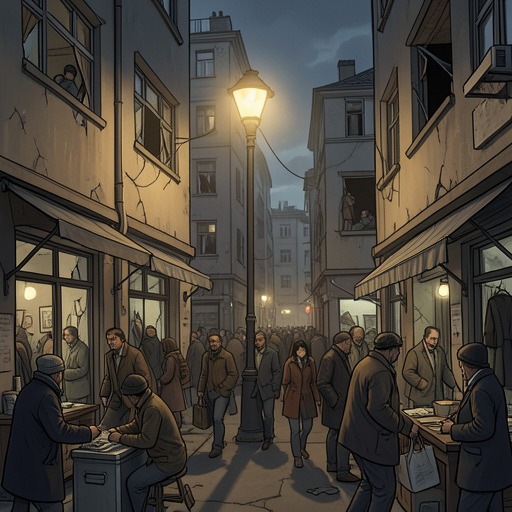
The novel renders the city as an immense battlefield made up of a thousand streets and ten thousand houses, rooftops, basements, and alleys. Its scale suggests not a single arena for conflict but a whole inhabited environment in which violence can recur anywhere. Residents live in fear. The streets become more dangerous as night falls, and the density of the neighborhood makes trouble difficult to avoid: problems seem more plentiful than air, light, or hope.
Other gangs emerge across the West Side as evening approaches, moving through basements, alleys, rooftops, and streets. Their presence makes the neighborhood feel occupied after dark, not simply populated. The disorder is not represented as the product of one isolated rivalry: the city’s many spaces provide room for repeated encounters and territorial contests. Urban decay and gang violence thus reinforce one another, turning ordinary routes and buildings into part of a continuing landscape of threat.
The people who watch the Jets pass on a warm night reveal how fear shapes public life. Some residents openly call out in approval, but others look away or hide behind a newspaper or handkerchief. Their silence is a practical response to a gang associated with trouble, rather than evidence that the neighborhood is at ease. In this densely inhabited setting, even witnessing violence carries a cost; keeping one’s head down can seem safer than asking for more trouble.
Housing scarcity and neglect
The neighborhood’s physical confinement has an economic cause. Although the Second World War ended twenty years earlier, housing ordinary people could afford remained expensive, and residents had nowhere else to go. A white tenant who moved out might simply create an opportunity for the landlord to rent the apartment again at a higher price. Moving, therefore, did not necessarily release a household from the pressures of the housing market; it could serve the owner’s interests instead.
The narrator describes the landlord’s incentives with particular sharpness. An owner might divide a three-room apartment into five, six, or even eight rooms and crowd Puerto Rican tenants into the resulting spaces, collecting enough money to spend much of the year in Florida or California. In this account, the same landlord need not visit the building or its tenants, or make the effort to maintain halls, roofs, and walls. If the building collapsed, the owner could still turn the property into a parking lot. The passage presents neglect not as an accidental blemish but as a consequence of a system in which crowded tenants and deteriorating housing can remain profitable.
The consequences extend beyond buildings to the limits placed on daily life. Maria complains that, after a month in New York, Bernardo still accompanies her to the shop in the morning and comes to escort her home if Chino cannot. Her routine of sewing during the day and sitting idle in the evening recalls the restrictions she experienced in Puerto Rico. Her complaint does not reduce her confinement to housing conditions alone, but it shows how life in the neighborhood is narrowed by dependence, supervision, and the difficulty of moving freely. The pressures of the setting are lived in hours and journeys as well as in rooms.
Ethnic scapegoating and compromised safety
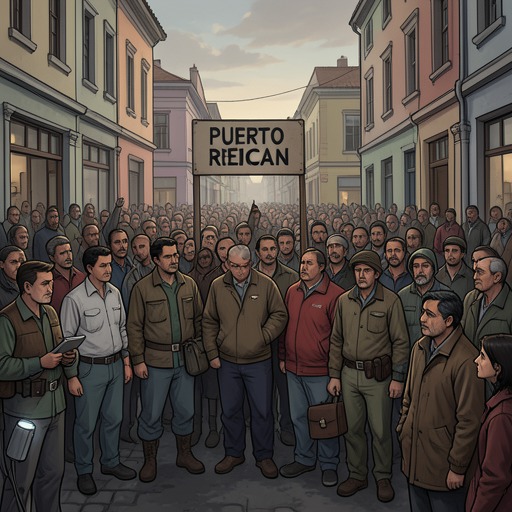
The novel shows how a neighborhood’s insecurity can be redirected into hostility toward its Puerto Rican residents. Before they arrived, gangs lacked a single clear target and attacked whatever or whoever stood in their way. Their arrival supplied one. The narrative’s bitter irony is that the city consequently became safer for everyone except the Puerto Ricans, who were blamed as though their presence had caused the disasters directed against them. The temporary appearance of a common enemy does not resolve the neighborhood’s disorder; it distributes danger more unequally.
The same tension appears in Riff Lorton’s fear that Bernardo and the Sharks will take control of the neighborhood and force white residents to leave. He imagines territorial change as a threat to his own place in the city, and his language turns that anxiety into racist contempt. His belief that the Sharks are gathering Puerto Ricans to take over the area echoes the broader struggle for territory, but the passage exposes how a fight over space becomes a claim about who belongs there. The text gives this hostility a material setting—scarce housing and contested streets—without making the prejudice that accompanies it an objective account of Puerto Rican residents.
Economic prospects are also interpreted through ethnic resentment. Chino explains a possible path from assistant to operator and full union membership, while Bernardo insists that Tony would advance ahead of Chino and earn more simply because he is American. Maria rejects the implication that Tony is foreign on the basis of his Polish background: she argues that being born in America makes him American, and that choosing to live there would make someone belong as well. Their disagreement shows how the neighborhood’s competition over work and status can be expressed through racialized ideas of national identity. Scarcity gives these arguments urgency, but it does not make Bernardo’s claims neutral facts.
Public institutions and the limits of local voice
The Municipal Community Center offers a revealing alternative to gang life, but its history shows how difficult it is to sustain a shared public space. The building had once been one of the West Side’s oldest churches. After two congregations joined, the church most in need of repairs was put up for sale and remained empty for almost a year, its windows becoming easy targets. Its former congregation eventually offered it to the city for use, and it was converted into a center with clubs for boys, girls, and adults. The doors opened, but the program never attracted enough participation to satisfy its organizers.
The center’s purpose was to draw young people from the streets through supervised recreation and education. Its openness to everyone, including Puerto Ricans, became the reason some residents avoided it. Longtime neighborhood families stayed away, and Puerto Rican families also withdrew because they did not want to use a center boycotted by the Ricains. The result was a public facility that was formally open to all but practically abandoned by both groups: rooms and clubs stood empty, books and games remained on shelves, and the basketball court had no players. The building’s failed use mirrors the larger neighborhood division: shared resources exist, yet ethnic exclusion prevents them from becoming genuinely common ground.
The absence of political representation further weakens the prospect of a civic response. No politicians lived in the West Side, and tenants had not been consulted before Puerto Ricans were accepted into the country. The passage records the resentment this produced without endorsing its premise that Puerto Rican neighbors were to blame for local deprivation. Residents felt they had no voice in decisions affecting their lives; no newspaper spoke for them, and the Jets were among the few who used their voices and fists. Even people who disliked the Jets could admit that the gang seemed to preserve what remained of the neighborhood, especially when politicians appeared to offer only speeches from more comfortable districts. That reluctant concession is the sharpest measure of civic failure: violence gains a local claim to usefulness because the institutions meant to serve residents appear remote, while neglect and overcrowding continue.