Booger
What Are You Going ThroughBooger is a silver-furred cat whose arrival in his new household connects an ordinary domestic scene to a history of shelter life and adoption. The book gives him a voice through which he describes his past and his hopes, making his adoption more than a change of address: it becomes the unexpected formation of a family bond.
Identity and Introduction
The narrator learns by text from a host that the household has acquired a new member. The host later says the grandchildren chose the cat’s name and regrets having let them settle on Booger. The name’s comic awkwardness contrasts with the seriousness of the history the cat is given, while also locating him in a family already organized around its own shared jokes and decisions.
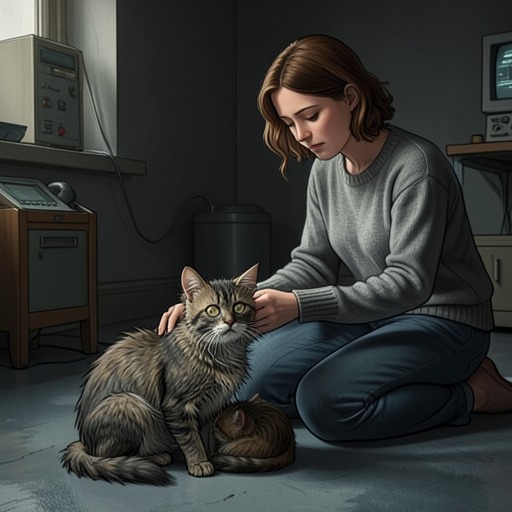
The narrator encounters Booger in the host’s home. He has been by the fireplace and later jumps onto the bed, where his purring accompanies the close, quiet scene. The narration first presents him through this simple domestic presence, before opening onto his earlier life. His passage from shelter animal to household companion is thus introduced not as an abstract rescue story but as a new member becoming familiar within a home.
Shelter Life and Return
In the account spoken through Booger, his first home is a shelter, where he was born in a cage. He describes that early situation as decent by the standard of what he knew: food and fresh water arrived each day, and he had a dry bed. The distinction matters. His prior life was not represented as wholly without care, but he had no experience by which to imagine the greater happiness of living with a particular person.
Booger says he later found himself back at the shelter and was nursed back to health. The account does not explain the circumstances that led to his return or the nature of the health problem. It does, however, mark a change in his prospects: after recovering, he and about a dozen other cats and dogs were transported by bus to a shopping mall. The movement from shelter to a public adoption event makes the possibility of a different home concrete, though it does not guarantee which animal will be chosen.
Adoption and New Attachment
Booger recalls that the mall event was his first Rescue Me Day and that he was adopted there. His original hope was to be reunited with his mother. That hope is not fulfilled; instead, he comes to regard the woman who adopts him as his second mother. The account holds these facts together without making the adoption a substitute reunion: the loss of the hoped-for outcome remains visible, while a new attachment becomes possible.
The woman’s place in Booger’s story is defined by care and companionship rather than by any elaborate account of her actions. He describes the promise of life with the right human and identifies his adopter as the person who gives that promise a particular form. The text also identifies her as a woman living without a partner. This detail situates the pairing as a household companionship between the two, while the narration does not claim that either depends on the other in only one direction.
Narrative Role and Significance
Booger’s history arrives through a striking shift in narrative mode: a scene of a cat settling close to the narrator gives way to the cat’s own account of shelter, recovery, transport, and adoption. The voice is presented as his, although the book provides it as part of the narrator’s literary telling. This device lets the animal appear not merely as a pleasing feature of a home but as a character with a remembered past, an unrealized hope, and a way of interpreting his new relationship.
The sequence also sets practical care beside emotional belonging. Food, water, and a dry bed were meaningful forms of shelter, yet Booger’s account distinguishes them from the happiness he associates with life alongside a particular human. His adoption does not erase his earlier history or the wish to find his mother; it adds a new relationship to that history. By placing the cat’s arrival in the same account as his own recollection of being adopted, the book gives Booger a life that extends beyond the moment when the household names him.