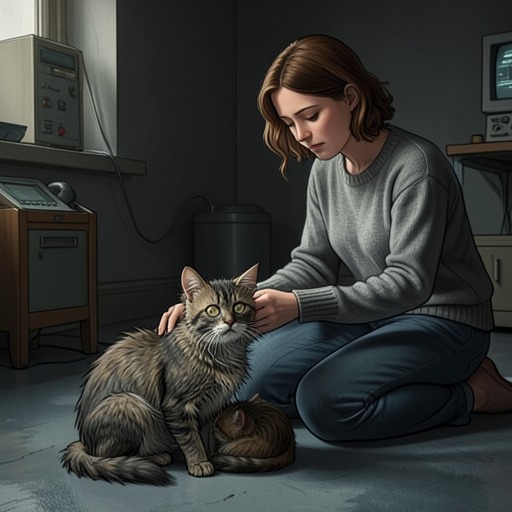
Booger Is Rescued and Adopted
What Are You Going ThroughBooger Is Rescued and Adopted is a reversal from displacement and danger to shelter and attachment. Told by Booger as an embedded story, the episode follows him from the fire that destroys his home through a second stay at the shelter to his adoption at a mall event. Its resolution is not a reunion with his first mother, which he had hoped for, but the discovery of a second maternal bond.
Fire and Displacement
Before the fire, Booger had already experienced separation from his mother. In the early days of an earlier adoption, he had been the last kitten placed and had a few days with her to himself; he missed her and cried after leaving. The fire later begins a new rupture. Smoke pours from the basement of the store where he is living while the store’s son is working alone. The son runs outside without thinking of Booger, who follows him through the door and across the highway.
The escape does not leave Booger safe. He is unused to being outdoors, and the freezing night leaves him unable to feel his ears and paws. He takes refuge under a porch, safer from exposure but not warm. At first light he returns to the store and finds it reduced to a reeking, waterlogged, blackened wreck. A lock and chain secure the front door, and there is no sign of the people he calls his peeps. The ruined building and secured entrance make his former home physically inaccessible as well as unrecognizable.
Abandonment and Captivity
Booger waits in a daze while cars pass. Some people slow down to look, but no one stops; his small gray body makes him easy to overlook. Two boys arrive on bicycles. He knows them as local troublemakers who had stolen snacks from the store and mocked the old man who worked there. Their familiarity does not protect him: one lures him with a balled-up foil wrapper that smells of meat, then grabs him by the scruff, while the other takes his tail. After swinging him about, they throw him into the dumpster behind the store, shut its cover, and bang and kick at its sides until they lose interest and leave.
The dumpster is empty but slimy, cold, and damp. Trapped at the bottom, Booger shakes, cries out as loudly as he can, and receives no answer. Hunger, thirst, and cold keep him mostly awake, while exhaustion leaves him scarcely alert. His account moves from active terror to a near-collapse in which he feels himself slipping into a deeper darkness. At that point, a voice discovers him. The people who find him disagree over what to do: one urges getting him out, while the other fears he looks sick and might have rabies, and proposes calling the ASPCA. The narrative does not describe the mechanics of his removal, but establishes that he ends up back at the shelter.
Recovery and Adoption
Booger’s return to the shelter is a return to care, though not to his original home. After he has been nursed back to health, he is placed on a bus with about a dozen other cats and dogs and taken to a shopping mall. There, at his first Rescue Me Day, he is adopted. The sequence gives the adoption its particular force: it follows the fire, the failed return to the store, the boys’ cruelty, and the long wait in the dumpster, rather than arriving as an untroubled beginning.
His preferred outcome would have been to find his first mother again. That hope is not fulfilled; at the shelter there had been no trace of her, not even her smell. Instead, Booger identifies the woman who adopts him as the next best possibility, his second mother. The account elsewhere describes what makes that bond feel maternal to him: warm milk, baths with a wet washcloth, clean bedding, and a woman hovering nearby as he investigates each room of his new house. After the helplessness of the fire and the dumpster, these acts of care let him recognize a familiar kind of protection in a new home.
Narrative Significance
The rescue story is presented as Booger’s own telling, inside the narrator’s larger account. He describes human behavior from a vulnerable animal’s perspective: passersby look but do not stop; boys turn hunger into a means of capture; and strangers who find him debate whether to intervene or call for help. The eventual return to the shelter and adoption offer a concrete counterweight to that neglect, not a claim that the earlier danger has been undone.
The episode also gives adoption a meaning more complicated than simple replacement. Booger remembers his first mother and hopes for reunion, yet accepts a new attachment without forgetting the old one. His account ends not with the recovery of his former life but with the recognition of a second mother. The movement from a locked, burned-out store to a cared-for home makes rescue consequential because it restores the possibility of dependence and belonging after those have been violently taken away.