Cats
What Are You Going ThroughCats appear throughout the narrative in sharply contrasting circumstances: one has died before the narrator arrives, another becomes a rescued household companion, and cats more generally shape ideas of home, comfort, and dependence. The most sustained account belongs to Booger, whose imagined first-person history gives an animal a past extending beyond the moment humans encounter him. Through these recurring presences, Cats are not merely decoration or consolation. They have histories and needs of their own, even as the narrator’s attention to them becomes entangled with her friend’s approaching death.
Domestic Absence and Return
During the narrator’s first stay in a retired librarian’s tidy apartment, a cat had been promised, but none appeared. Only as the narrator was leaving did the host briskly disclose that her cat had died between the booking and the visit. She changed the subject at once. The narrator had been about to ask about the loss, sensing that the host might want to be asked, but also considers another possibility: that the host feared a complaint about hearing too much about a dead pet. The exchange leaves the loss present but unspoken, caught between a wish for recognition and the rules of a guest-host transaction.
When the narrator returns to the same room to visit her friend after treatment has failed and the tumors have spread, the apartment’s household has changed. The host announces a new member: a sleek, silver-gray young cat with bourbon-colored eyes. Her grandchildren have named him Booger, a choice the host regrets but accepts as settled. She describes him proudly as lively and mischievous, warning the narrator to keep her bedroom door shut at night because he roams and might bother her.
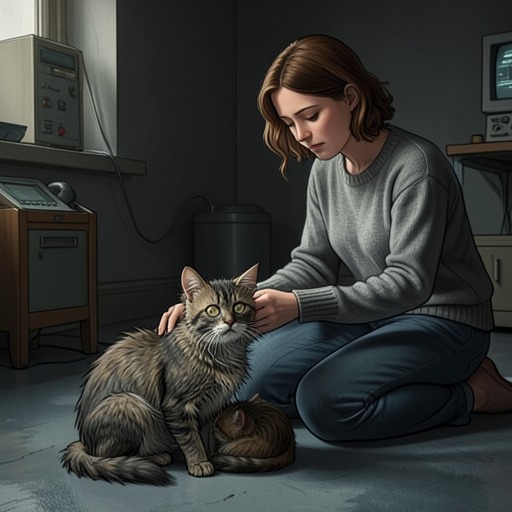
That warning leads to an unexpectedly intimate encounter. The narrator is not aware of Booger until he jumps onto the bed; he snuffles at her cheek, his whiskers tickling her, and settles close enough for her to feel his warmth as he purrs and kneads the duvet. The narrator had found the apartment’s carefully arranged comforts stifling, but the cat’s warm fur and loud purr make the bed feel inviting. The shift is not a change in the room’s furnishings but in the kind of presence it offers: a living creature’s unplanned closeness replaces the manufactured coziness she distrusts.
Booger’s History
As the narrator lies in bed, the account gives Booger a voice and a life that began before his adoption. He remembers being born in a shelter and, for a few days, remaining with his mother longer than the other kittens. After he was adopted, he was kept not as a pet but as a mouser in a roadside convenience store run by an older man, his wife, and their son. His world was a cardboard box lined with a worn towel and a bowl kept full of dry food. He describes the people as not cruel by human standards, but not especially interested in cats either.
A small attempt at affection clarifies the difference between having shelter and being welcomed. When Booger jumps onto the shopkeeper’s lap, the man sends him flying into boxes of cereal. Afterward, the cat keeps his distance. He reflects on the broad range of human responses to cats: some treat them as tenderly as human children, while others regard them as little more than pests. The observation gives the story an animal’s point of view on a human scale of care that can range from affection to indifference and rejection.
Booger also remembers his mother. At first he misses her and cries, though he says he adjusts to the store. A fire later drives him outside in the middle of the night. He follows the shopkeeper’s son out but receives no help from him, then runs across the highway and hides beneath a porch. The cold numbs his ears and paws. In the morning he returns to find the store a waterlogged, blackened wreck, its front door secured by a lock and chain and its people gone. The narrative does not reduce this history to a neat rescue scene: Booger’s survival includes fear, exposure, and the loss of the only home he had known.
After a second stay at the shelter, he is nursed back to health and transported with about a dozen other cats and dogs to a shopping mall adoption event. He hopes to be reunited with his mother; when that proves impossible, he is adopted by the host on his first Rescue Me Day. In the host’s home, warm milk, baths with a wet washcloth, clean bedding, and watchful attention make him feel mothered again. The young cat who was once a working animal in a store becomes a cherished household member. His account ends not with a claim that the earlier hardship has vanished, but with the recognition that, with this human, he has discovered a different kind of life.
Cats and the Experience of Illness
Booger’s story is placed beside the narrator’s visits to her gravely ill friend. When the friend returns to hospital after treatment has failed, she says she is angry with herself for having endured treatment and its vomiting, diarrhea, and fatigue because she believes she yielded to false hope. She fears severe pain most: in agony, she says, a person cannot think clearly or remain self-possessed. The narrator’s response to the rescued cat’s description of being dehydrated and reduced to skin and bones is to think of her friend. The parallel is the narrator’s, not an equivalence between a cat’s hardship and terminal cancer: it makes bodily vulnerability newly immediate across the distance between species.
The friend wants to avoid a death marked by pain, fear, and loss of control. She speaks of wanting peace and order, and of not wanting to die in mortifying anguish. Later, as the narrator recounts the friend’s plan, the familiar household detail of a bedroom door left ajar because she had cats becomes consequential. The friend intends that a closed door will signal that she has taken the euthanasia medication; one morning the narrator panics when the door is closed, only to discover that wind has blown it shut through an open window. Cats therefore belong not only to the apartment’s comfort but also to the ordinary habits through which the friend’s possible death is imagined, anticipated, and misread. The accidental door closure briefly turns a domestic routine into a source of terror.
Narrative Perspective and Significance
The book’s treatment of Cats shifts between observed animal presence and imaginative attribution. Booger’s history is delivered as speech the narrator hears while lying awake, and she later says that he told many stories but that this was the one she remembered in the morning. The episode preserves its fable-like uncertainty rather than presenting the account as ordinary animal biography. Yet its details—the cardboard box, the cereal aisle, the cold porch, the locked and ruined store—give the cat a particular history instead of leaving him as a generic emblem of comfort.
The cat’s presence also unsettles the narrator’s earlier response to domestic coziness. She finds the guest room’s pillows, duvet, dried flowers, and paperback mysteries alienating, yet responds to Booger’s physical warmth and purring. Care becomes persuasive not as a prescribed atmosphere but as a relation enacted between living beings. At the same time, the first cat’s death and the friend’s fear of a painful ending prevent that comfort from becoming sentimental reassurance. Cats bring companionship into the narrative, but they also make visible how much depends on attention: who notices an animal, who cares for it, and whether vulnerability is met with tenderness or neglect.