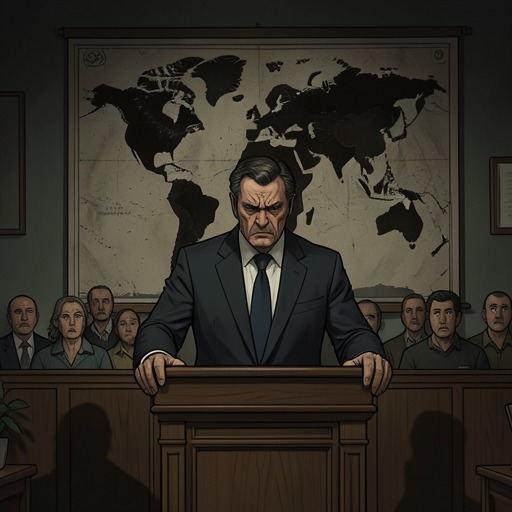
Delivering a Speech at the Global Crisis Conference
What Are You Going ThroughThe speech at How Bad Can It Get turns a widely read account of global catastrophe into a live confrontation between a speaker’s certainty and an audience’s desire for discussion, or at least some way forward. The narrator’s former partner presents humanity as having lost the collective will to avert disaster, then refuses questions; afterward, his defense of that refusal exposes the anger and guilt that his controlled delivery had kept nearly invisible.
Announcement and Setting
The event enters the narrative through a coincidence. While browsing a bookstore in a shopping mall, the narrator’s friend spots a poster advertising a conference on global crises, titled How Bad Can It Get. It is scheduled for the following week at a state university campus in the next town. The notice makes the upcoming appearance feel newly charged: the narrator has already read the speaker’s magazine article, and the friend in the hospital has read it too.
The speech is based on that article, whose argument many people in the room already know. Some audience members have come hoping to ask questions and hear a discussion. They do not learn until the talk is over that the speaker will take none. The decision shapes the event before its final words: it makes the lecture a sustained declaration rather than an exchange, and leaves the audience’s response to surface afterward.
The Argument: A Convergence of Risks
The speaker’s central claim is that catastrophe is no longer a distant possibility that collective resolve might prevent. Humanity has failed to summon the will to act, he argues, and has entered a new condition in which the old reassurance—that the world and what people value will continue after individual lives end—can no longer be trusted. He invokes the image of forest before humanity and desert after it, and describes the human species as seemingly possessed by a death wish.
Nuclear weapons supply one immediate route to disaster. The speaker condemns the creation and spread of weapons capable of killing everyone many times over, especially their availability to leaders he portrays as reckless, nihilistic, and without empathy or conscience. Even the hypothetical removal of the world’s nuclear arsenal, however, would not resolve the crisis. Human shortsightedness and self-deception have created other dangers, while political leaders and fossil-fuel interests have obstructed action on climate change. The speaker links ecological breakdown to the displacement of people fleeing shortages of food and clean water, and predicts that desperate refugees will meet not compassion but human cruelty.
The list extends beyond war and climate. Cyberterrorism, bioterrorism, an inevitable flu pandemic for which societies are unprepared, drug-resistant infections associated with indiscriminate antibiotic use, the rise of far-right governments, propaganda and deceit as instruments of policy, and the inability to defeat global jihadism all appear as threats to life and liberty. The breadth of the catalogue is part of the argument: no single emergency can be isolated from the political failures and accumulated risks around it.
The speaker also identifies concentrated technological power and mass surveillance as dangers to freedom. He warns that the systems on which powerful technology companies depend could become instruments of ruthless control, while ordinary people seem helpless before them. His questions about surveillance capitalism and the public’s tolerance of constant tracking turn technological convenience into a political problem: people who claim to value freedom, he argues, have allowed the means of their own subjection to grow.
Performance and the Withheld Exchange
The speaker delivers this bleak case with remarkable control. He consults an iPad on the lectern but does not simply read; his delivery appears memorized, actorly, and assured. He neither hesitates nor stumbles, and supports his claims with references. To the narrator, he seems less concerned with persuading listeners than with stating what he regards as irrefutable fact. The composure is at odds with the scale of the disasters he describes. Only when discussing animals does his voice catch slightly; otherwise, the narrator detects little pity for human beings. At intervals he looks across the audience with a raptor-like gaze.
That manner intensifies the frustration of the missing question period. The narrator had expected that an in-person talk might offer at least a gesture toward possible action after the familiar account of impending disaster. Instead, the speaker provides no hopeful turn and no discussion. His refusal is not announced in advance, and the audience’s disappointment becomes clear afterward: at brunch the next morning, he tells the narrator that attendees objected to his refusal and that one had called it cowardly.
Aftermath: Anger, Guilt, and the Reason to Speak
When the narrator challenges the speaker’s presentation as cranky, arrogant, even bullying, he insists that he is reporting facts, not choosing pessimism for effect. The narrator presses the distinction between telling an awful truth and delivering it as though its horror offered grim satisfaction. He laughs at the suggestion that this is pleasure, describing the manner instead as a defense against imagining the suffering ahead for his grandchildren.
His explanation reveals the personal stakes beneath the public indictment. He is furious at Americans who elected a climate-change denier to the world’s most powerful office and at oil executives who concealed evidence about fossil fuels and global warming while action might still have been possible. He says he has lost faith in people’s willingness to do what is right, feels angry and guilty, and believes he failed to do enough earlier. Yet he continues to speak so that his grandchildren may one day know he did not remain silent when asked what he had done. Even if he believes humanity cannot be roused in time, he wants people to face the truth and consider the harm they might have prevented. The speech’s contradiction is therefore deliberate: it offers almost no hope of changing the outcome, but insists that speaking—and making listeners confront their responsibility—still matters.