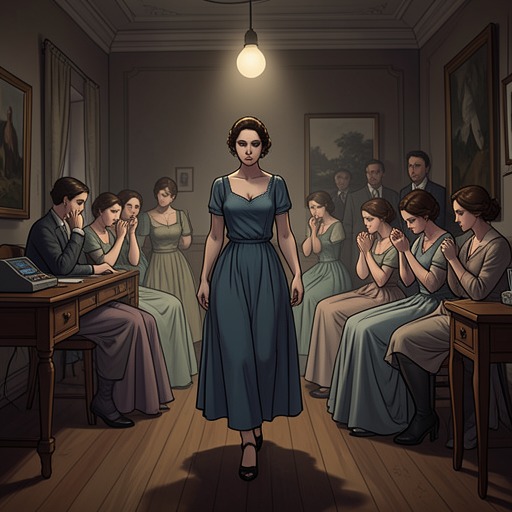
Dora Carrington and Lytton Strachey’s relationship
What Are You Going ThroughDora Carrington and Lytton Strachey’s relationship was an unconventional, largely unrequited attachment that endured through Carrington’s marriage to another man and ended only with Strachey’s death. The account presents its significance as double-edged: Carrington’s devotion shaped her life, yet the story of that devotion came to eclipse her identity as a painter and was bound to the circumstances of her death.
Formation and Unequal Desire
Carrington loved Strachey despite knowing that he was gay and thirteen years older than she was. He had once proposed marriage to Virginia Woolf, and the account frames his relationship with Carrington as scandalous from its beginning—not because the attachment lacked intensity, but because its desire and prospects did not fit a conventional romance. For seventeen years, Carrington remained devoted to him. The disparity between that devotion and the relationship’s limits is central: the attachment endured, but it could not become the marriage Carrington wanted.
The account also describes the relationship through the language of women’s love stories, especially those that are unconventional, difficult, or hopeless. Carrington’s story exemplifies that interest, but it does not resolve into romantic fulfillment. Its emotional force comes instead from the persistence of a bond that could not be made reciprocal in the ordinary sense, and from the life Carrington organized around it.
Marriage and Shared Life
Carrington’s marriage to another man did not separate her from Strachey. Instead, all three lived together. The arrangement made their intertwined attachments a lived domestic reality: Carrington was married to one man, while that man’s object of desire was Strachey. The marriage therefore did not replace Carrington’s attachment or offer a conventional alternative to it; the three-person household held their mismatched desires in the same space.
After agreeing to marry, Carrington wrote Strachey a letter lamenting the fate that made it impossible for them to become husband and wife. The letter gives her desire a direct expression, but its circumstances underline the relationship’s constraint: she could tell him what she wished for while proceeding with a marriage to someone else. The three then went to Venice together on honeymoon. That journey compresses the arrangement into a striking image—not a private honeymoon for the newly married couple, but a trip shared by all three, with Carrington and Strachey’s attachment still present within the marriage.
Death and the Relationship’s Aftermath
Strachey died of stomach cancer. Carrington survived him by less than two months before shooting herself in the stomach, just short of thirty-nine. The account notes that this was not her first suicide attempt. The brevity of the interval makes Strachey’s death the immediate context for her own, while the broader narrative connects the two deaths to the long devotion that had shaped Carrington’s life. The sequence should not be mistaken for a simple explanation of suicide; rather, the account presents Strachey’s death as the loss after which Carrington said she had nothing left to do.
The day before her death, Carrington told the Woolfs, “There is nothing left for me to do,” and “I did everything for Lytton.” The statements make her devotion explicit in her own reported words, but they also show how completely the relationship had come to organize the account of her remaining purpose. She had no gun in the house, so she went next door and borrowed a rabbit gun. The ordinary, almost casual act of borrowing a weapon sharpens the contrast with the fatal outcome; the account adds that it was the wrong weapon for the job and that her dying was long, slow, and painful.
Retelling and Reputation
The narrative says that Carrington became known less for her painting than for her hopeless love of Strachey: for how that love shaped her life and how it caused her death. That formulation identifies a cost of the relationship’s afterlife. Carrington’s artistic identity is displaced by a story organized around her attachment to a man, so that the very devotion that makes her story memorable also narrows how she is remembered.
D. H. Lawrence’s response offers a harsher version of that reduction. Obsessed with the subject of women in love and confident in his authority to judge it, he accused Carrington of hating “real” men. In Women in Love, the account identifies a caricature in the figure of Minette Darrington: pretty and deceptively innocent-looking, she is presented as deeply lascivious, and as an artist’s model rather than an artist. The changed surname and altered artistic role sharpen the contrast with Carrington, whose work as a painter risks disappearing beneath other people’s stories about her desire. The relationship thus persists not only as Carrington’s lived attachment but as a contested narrative, repeatedly recast in terms that diminish the woman at its center.