The Ex’s Speech at the Global Crisis Conference
What Are You Going ThroughThe Ex’s Speech at the Global Crisis Conference presents public warning as an act caught between urgency and despair. The speaker argues that humanity has created dangers it lacks the collective will to confront, yet he offers no reassuring route out and refuses questions. The narrator’s account connects the speech’s apocalyptic claims to the speaker’s anger, his unease with public indifference, and his private wish to answer to his grandchildren for what he did—or failed to do.
Occasion and Context
The conference appearance was announced at a bookstore in a shopping mall. The poster advertised How Bad Can It Get, a conference on global crises at a state university campus in the next town, scheduled for a week later. The narrator’s friend noticed the announcement and asked whether she wanted to attend. The narrator reminded her that she had already heard the speaker’s talk and read the magazine article on which it was based; her friend had forgotten. That prior familiarity matters: the conference speech was not presented as a new line of thought, but as the public restatement of an argument already circulating in print and in an earlier talk.
The speaker was the narrator’s former partner. The morning after his conference appearance, she met him for brunch at a waterside restaurant and asked how it had gone. His shrug and account of the audience’s response shift the focus from the warnings themselves to the conditions under which he delivered them: people objected that he had not taken questions, and someone called that decision cowardly. He acknowledged that such criticism would once have mattered more to him.
The Case for Catastrophe
The address treats catastrophe not as a distant possibility that can be neatly separated from ordinary life, but as the consequence of decisions already made. The speaker invokes the image of a forest before humanity and a desert after it, then argues that people have failed to muster the collective will required to forestall disaster. The consoling belief that individual lives may end while the world and the things people love endure has, in his account, become untenable. His audience must face the possibility that civilization itself will not survive.
Nuclear weapons form one strand of this case. The speaker describes a world that has permitted weapons capable of killing everyone many times over to be made and placed in the hands of leaders without empathy or conscience. Because societies have failed both to control the spread of weapons of mass destruction and to keep such people from power, he sees apocalyptic war becoming increasingly likely. Nor, he insists, would human extinction spare other species: animals would be doomed alongside humanity, whether by the same catastrophe or by damage already caused through human activity.
He then removes the possibility that eliminating nuclear arsenals alone would solve the crisis. Even without that threat, he argues, generations of shortsightedness and self-deception have produced other perils. Fossil-fuel interests and their political allies have profited enormously while working to deny climate change; the world’s most powerful nation has, in his account, taken their side. The resulting ecological disaster threatens food and clean water, drives refugees from their homes, and makes compassion for them unlikely. The speech connects slow environmental damage to the prospect of intensified human cruelty rather than treating climate change as an isolated technical problem.
The list of dangers broadens beyond war and climate. Cyberterrorism, bioterrorism, a future flu pandemic for which humanity is unprepared, drug-resistant infections associated with indiscriminate antibiotic use, rising far-right regimes, political propaganda, and the failure to defeat global jihadism all appear as threats to life and liberty. The speaker also turns to concentrated power in technology companies. Mass surveillance, he warns, could make those companies’ tools instruments of ruthless control, while ordinary people seem unable to resist a system that follows and continually targets them. His questions about how a supposedly freedom-loving public accepted surveillance capitalism culminate in the possibility that people may prefer submission to the burdens of freedom.
Delivery and Refusal of Questions
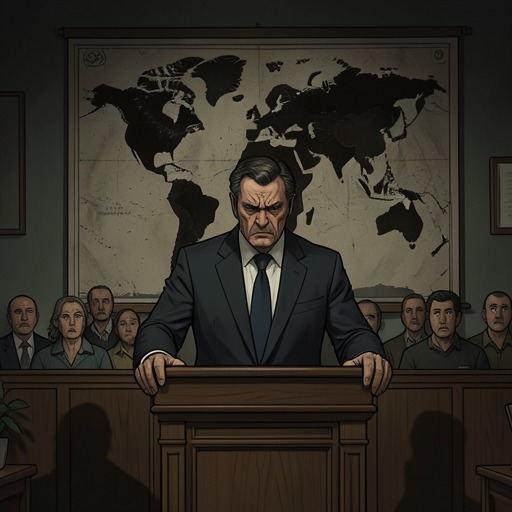
The narrator depicts a speaker whose performance made the bleakness harder to dismiss. He stood at a lectern with an iPad, occasionally glancing at it, but spoke without stumbling or sounding as though he were simply reading. His delivery had an actor’s command and an air of authority. The article and the talk supported their claims with numerous references; nevertheless, his manner suggested that persuasion was not really the point. He presented the argument as irrefutable fact, not as a position he hoped to negotiate with listeners.
That certainty was matched by restraint. The narrator expected some gesture toward a possible way forward after the catalogue of horrors, but the speech supplied no crumb of hope. The speaker’s sentences were calm and measured rather than openly emotional. The one visible break came when he discussed animals: his throat caught slightly. When he looked over the lectern, the narrator read his gaze as raking the audience. She later thought that his unwillingness to take questions might have been a response to the predictable experience of public discussion: at least one person may ask something irrelevant or reveal that they had not listened. Whatever his reason, the refusal left the audience with the speech’s claims but no opportunity to test them with him in the room.
Audience Response and the Speaker’s Motive
After the conference, the narrator challenged the way he presented his case. She told him that he came across as cranky, arrogant, and even bullying, and objected that he could not simply tell people there was no hope. He countered that the time remaining to change course was short—perhaps a dozen years before a point of no return—and questioned whether humanity could get itself together in time. The disagreement was not over the scale of the danger so much as the meaning of delivering it in this manner. The narrator heard a misanthropy that seemed almost to take satisfaction in the dreadful forecast; he called that impression a defense mechanism and denied taking pleasure in imagining suffering for his grandchildren.
His explanation joined anger to responsibility. He said he had lost faith in people doing the right thing, citing both the privileged, well-educated Americans who had elected a climate-change denialist to the most powerful office and oil executives who concealed their own research when action might still have been possible. Yet he continued speaking because he wanted to be able to face his grandchildren when they were old enough to ask what he had done. He felt angry and guilty, believing that he had failed to do more earlier and had wasted time on concerns that later seemed trivial. The wish he expressed was not confidence in political success, but a hope that his grandchildren might forgive him.
Significance
The speech’s central tension is that its speaker treats the future as nearly foreclosed while continuing to address an audience. His public certainty that humanity will not act coexists with the private need to bear witness: even if a talk cannot awaken people in time, it can force them, briefly, to consider the damage they might have prevented. The conference appearance therefore does not resolve the narrator’s objection that warning without hope may alienate listeners. Instead, it reveals the emotional cost beneath the speaker’s hard manner—his anger at collective inaction, his guilt over his own past, and his fear of what his grandchildren may ask.
The event also sets intimate troubles beside planetary ones without making them equivalent. The narrator arrives at the earlier talk exhausted from spending the afternoon at the hospital with her friend, and her attention wanders even as the speaker describes civilization’s possible end. Later, her own conversation with him turns on what people notice, what they neglect, and what responsibility remains when the scale of a crisis seems overwhelming. His speech makes global danger impossible to ignore; its reception shows how difficult it is to convert attention into shared action.