The Friend’s Estranged Relationship with Her Daughter
What Are You Going ThroughThe Friend’s Estranged Relationship with Her Daughter is defined by a painful episode from the daughter’s adolescence, two incompatible accounts of what happened, and the friend’s eventual acceptance that they would not reconcile. The friend describes the memory as a wound that repeatedly returns, while her daughter disputes its meaning and, eventually, whether the incident happened at all. Their estrangement thus persists not simply as a disagreement about the past, but as a failure to arrive at a shared account of it.
The Incident and the Mother’s Account
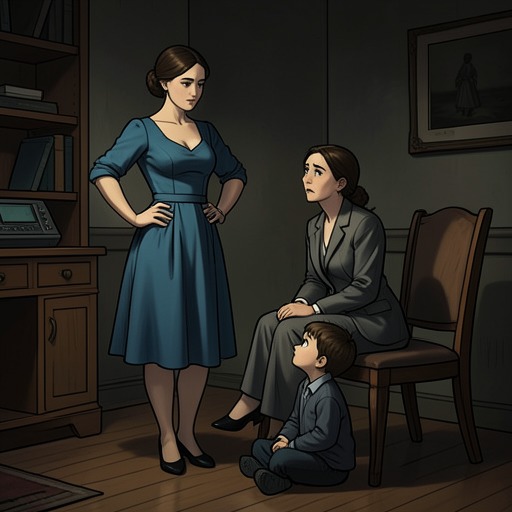
The friend tells the narrator that, when her daughter was still a teenager, the girl came between her and a boyfriend. In the friend’s telling, her daughter pursued the man under her own mother’s nose, and he was flattered by the attention. The friend says she intervened before the situation could become worse, banning him from their lives and threatening to involve the police. Once he was gone, she says, her daughter forgot about him. The injury, as the mother understands it, was not merely the boyfriend’s conduct: she believes the daughter meant to hurt her and to expose her to the greatest possible humiliation.
The friend identifies this as the moment when she understood how much her child hated her. That conclusion gives the episode a larger force in her memory than a single conflict over a boyfriend. She describes it as a stain that could never be washed away and as a sorrow that might surface unexpectedly, especially during an otherwise happy or peaceful day. When it returned, she says, she was made to relive the experience. Work could help her get past it, but sometimes the memory left her depressed for days. The recurrence made the old event an active presence in her life rather than a settled episode of family history.
Competing Memories and Failed Discussion
The daughter remembers the episode differently. In her view, she was a child and was not the guilty party: the boyfriend was a creep, while her mother had been too infatuated to see what he was like. She assigns responsibility to her mother for bringing such a man into their lives. The accounts therefore differ both over the daughter’s actions and over the adult’s responsibility for the relationship that preceded the dispute. The friend sees a deliberate betrayal by her child; the daughter sees an inappropriate man and a mother who failed to recognize the danger.
The disagreement does not resolve as the daughter grows older. When the narrator asks whether they ever tried to discuss the incident in later years, the friend says that they did, but got nowhere. The daughter subsequently calls her mother’s reaction an overreaction. She reasons that, if the episode had mattered as much as her mother claimed, she herself would remember it; instead, she cannot recall which of her mother’s boyfriends they are discussing. Later still, she insists that her mother has misremembered the event and says nothing happened between her and the man, whoever he was. Her account moves from disputing culpability to questioning the scale of the mother’s response and then to denying that the alleged encounter occurred. The text presents these as conflicting recollections, not as a dispute it can independently adjudicate.
An Unforgiven Wound
The mother’s continuing distress is intensified by the distance between the meanings each assigns to the episode. For the friend, it remains proof of a profound hostility from her own child; for the daughter, the incident either reflects her mother’s poor judgment or is too indistinct to remember. Their efforts to talk do not produce a common interpretation, and the friend cannot simply set aside an experience that her daughter appears to minimize or reject. The gap between them is therefore also a gap in memory: the event that organizes the mother’s sorrow does not occupy the same place in the daughter’s recollection.
The friend reflects on forgiveness while telling the narrator about the estrangement. She believes people should want to forgive everything, yet says there are things a person cannot forgive even when dying. That inability, she says, becomes its own open wound. Her remark links the enduring grievance to the final stage of her life without suggesting that illness has softened it or supplied a resolution. Instead, the approaching end makes the unresolved relationship more explicit: forgiveness remains an ideal, but not an outcome she can claim.
The Final Refusal and Its Significance
Near the end of her life, the friend says that she does not want visitors because she has already said her goodbyes. She also refuses to reach out to her daughter one last time. Her decision is not presented as a sudden reconciliation or as proof that the earlier injury no longer matters. She describes herself as reconciled to their not being reconciled: she accepts the absence of repair rather than reopening the relationship in a final attempt to change it.
That choice gives the estrangement a quiet, consequential ending. The friend’s account of the teenage incident remains unconfirmed by any shared understanding, and the daughter is not brought into a last exchange that might settle the dispute. The relationship closes, instead, with the mother acknowledging the limit of what she can forgive and the limit of what she expects from reconciliation. In the narrator’s telling, the friend’s willingness to describe the wound and her refusal to make one more contact coexist; speaking about the estrangement does not erase it. The relationship’s defining pattern—pain returning, attempts at discussion failing, and memories remaining irreconcilable—continues through the final decision.