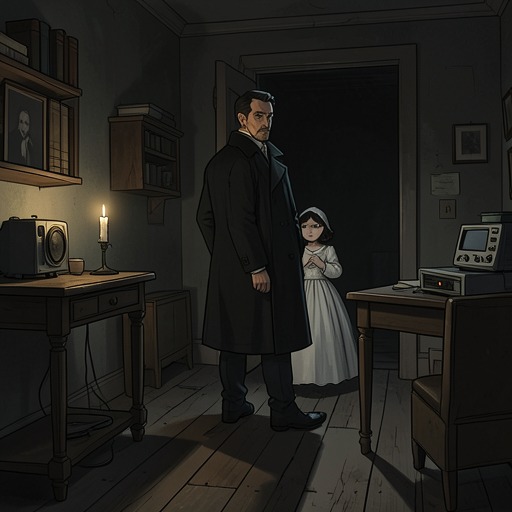
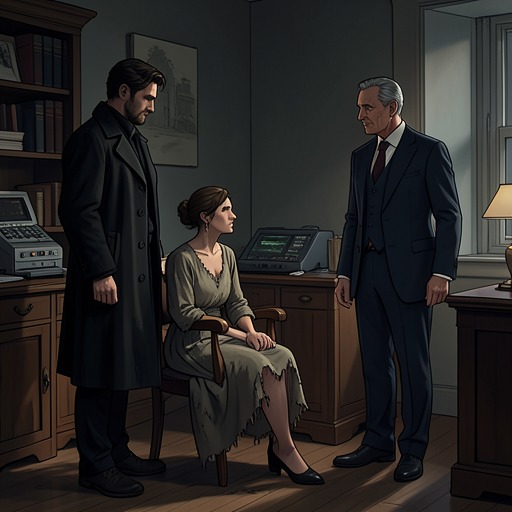
A woman mistaken for Isobel is buried
When You Were MineThe burial of a woman mistaken for Isobel Davenport turns a small village grave into seemingly decisive proof of her death. A necklace found on the stranger’s body persuades Dominic Cavendish and Peter Davenport that Isobel has been murdered; its later appearance in their reunion with her exposes the mistake and reveals how an object of personal meaning became evidence for a false conclusion.
Discovery and Burial
During their search for Isobel, Dominic and Peter questioned people in towns and villages and combed the surrounding fields, moving north without finding her. A chance conversation overheard by Peter in a village pub outside Peterborough led them to the woman’s resting place. She had been found dead on the outskirts of the town, wearing nothing but a necklace. The farmer who discovered her and other local witnesses helped the men learn where she had been buried.
The woman had no identification, and the local Magistrate, unaware of who she was, ordered a pauper’s funeral. She was buried in a small rural graveyard, away from the family crypt and among people with no known connection to her. A plain wooden cross marked the grave. Even that modest marker depended on the sympathy of a villager: without it, the woman would have had no marker at all. The circumstances of the burial thus reflected not her actual identity, but what the community could establish about an unknown stranger.
The Necklace as Evidence
The necklace made the grave appear to answer the question Dominic and Peter had been pursuing. It was a thin chain carrying a small stone in a star-shaped setting: Isobel’s star necklace, given to her by her father on her tenth birthday. Though of little financial value, it had been deeply important to her, and she had continued wearing it after his death. Both men believed she would never willingly give it up.
When Sir Hubert Williams, the Magistrate, arrived at the graveyard, Peter confirmed that the dead woman was his sister and asked about the item found on her. Sir Hubert produced the necklace, which he had retained as the only object on the body that might help identify her. Dominic reached to touch it, and the sight of the familiar gift made him believe he had lost Isobel forever. Peter likewise recognized it as hers. Its sentimental history made it persuasive evidence to the men, even though it could not establish that the body belonged to its owner.
The necklace therefore carries two meanings in the event. For the men at the grave, it connects an unidentified woman to the person they are searching for and turns uncertainty into apparent confirmation. In the larger sequence, that same connection proves unreliable: the object’s strong association with Isobel is not proof that she is dead. Its emotional authority exceeds its evidentiary force.
Grief, Suspicion, and the Magistrate
The burial intensifies Dominic’s grief and anger. He and Peter understand that the circumstances suggest murder, but neither can bring himself to say the word aloud. Dominic asks why Isobel did not go to Havistock Hall for help, recalling that he had told her to contact the estate and had instructed his man of business to assist her. He has received no report that she sought that help. The absence of such a communication leaves him with a question rather than an explanation.
Peter trusts Dominic with his own life and with his sister’s, and understands how deeply Dominic loved her. At the graveside, however, the immediate task is practical as well as personal: Peter says Isobel should be moved from the pauper’s grave to the family crypt and asks Sir Hubert to assist. Dominic then presses the Magistrate for the circumstances of the woman’s death. The exchange marks the grave not as a settled end, but as the starting point of an inquiry into what happened and how the body came to be identified.
Sir Hubert’s own part in the events is shadowed by doubts. After leaving the men, he reflects that he had promised a friend long ago to take whatever action was necessary and had acted on that promise. The men’s honest distress at recognizing the necklace troubles him: he wonders why he was asked to secure the outcome he had, and whether his actions a month earlier were sound, even if well intended. He considers whether to reveal the truth and looks back toward the small cross marking an empty grave. The account does not fully explain his arrangement at this point, but makes clear that his earlier involvement and hesitation are part of the uncertainty surrounding the burial.
Retrospective Revelation
Later, after Isobel has returned, Dominic tells her that he and Peter were informed she was dead and shown her grave. He produces the same necklace, explaining that the Magistrate gave it to them after it was found on the body of a badly beaten woman by the roadside in Newisham. The chain had been the evidence that convinced them the dead woman was Isobel. Isobel’s reaction is hesitant and troubled: rather than asking where the necklace was found, she asks who gave it to Dominic. Her response signals that the object’s history is not straightforward, though the available account does not establish precisely how it came to be on the other woman.
The later disclosure reverses the graveyard scene without erasing its consequences. Dominic and Peter had not merely feared that Isobel was dead; the burial and the necklace gave that belief a place and a material proof. Their grief was genuine, but their identification was wrong. The pauper’s grave consequently stands for a failure of recognition: a woman without a name was assigned Isobel’s identity through a cherished possession, while Isobel herself remained absent and beyond their reach. The event sustains the mystery of her disappearance and explains why her eventual return must confront not only the past danger, but also the certainty her supposed burial created.