Chaperonage and respectable-woman convention
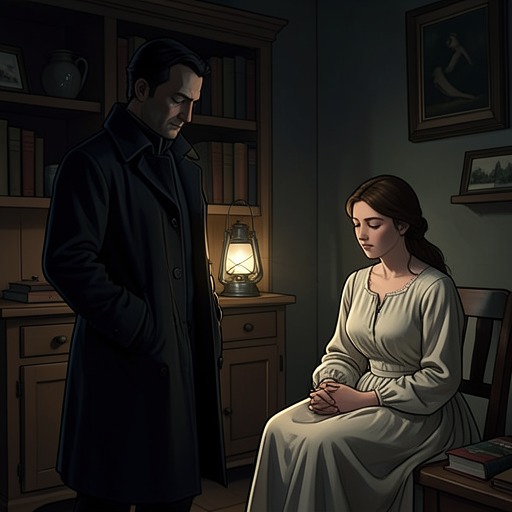
When You Were MineThe Chaperonage and respectable-woman convention is a social expectation that a woman’s movements should be accompanied and observable, marking her as respectable. In Isobel’s story, it is more than a rule of etiquette: it helps define which spaces she may enter safely, and turns journeys made for survival or affection into potential sources of scandal. Her increasingly independent movements expose the tension between a convention of feminine respectability and her need to act for herself.
Social Constraint and Escape
Before her flight from Gosport Hall, Isobel had never been allowed out alone without a chaperone. When Kitty gives her the chance to escape Rupert’s violence and an impending forced marriage to Bertram DeLisle, Isobel must contemplate crossing the house and setting out alone at night, with only a few coins and clothes. Kitty supplies her life savings and helps her prepare, making possible an escape that the convention would ordinarily render improper as well as dangerous.
The house itself makes the cost of movement tangible. Isobel waits in darkness, listening for signs of anyone in the hallway, then crosses the upper passage of the home that had once been familiar to her. At Peter’s old bedroom window, she abandons the trellis route because her dress would make climbing it hazardous and conspicuous. Instead, she searches the room for Peter’s old local clothes and leaves disguised in breeches, a rough shirt, boots, a jacket, a flat cap, and a riding cloak. The disguise and the night journey let her move without being recognized, but they also show how much concealment her freedom requires.
She continues on foot through the night, avoiding gravel, roads, and notice, and pauses at a stream near a hamlet at dawn. The boots from Peter’s drawer chafe her feet, and hunger and a pounding head accompany her progress. She declines to take one of Rupert’s horses because she expects he would have her arrested for theft. In this episode, the convention’s demand for supervised female movement is set against the immediate risks of being caught: remaining within the rules would leave her in Rupert’s power, while leaving alone requires disguise, secrecy, and endurance.
Secret Visits and Reputational Risk
The same expectation shapes Isobel’s later decision to visit Dominic at night. After hearing his horse return, she spends an hour debating whether to ride alone to his uncle’s house, about two miles away. She knows the journey is audacious and could bring a fall from grace, as well as Dominic’s anger and Peter’s disapproval. Nevertheless, she saddles Betsy, covers herself with her riding cloak, and travels through the woods to Sedgwick House.
Rather than ride openly up to the house, Isobel ties Betsy to a fallen branch and approaches the stable courtyard on foot, keeping to the shadows. Dominic finds her there and challenges her for coming unchaperoned. The encounter makes the convention explicit: the issue is not only that she has entered a private estate after midnight, but that she has done so alone. Her purpose is personal, yet the manner of her arrival places her reputation at risk.
Later, when Isobel and Dominic approach Rupert’s house together, she again moves through darkness and concealment, helping assess the watch by tracking a candle as it passes from window to window. She identifies the guard’s circuit and proposes a moment when they may enter without being heard. The episode gives her practical agency within a world of restricted movement: the same caution that once helped her escape now becomes a skill she uses in a shared operation.
Reputation and Social Judgment
Isobel later articulates how easily her actions can be made into evidence against her. She tells Peter that she spent several weeks living as a pauper on the streets and her first month at a single man’s house lying in his bed in the master suite. Even allowing for her illness, she believes these circumstances could bring scandal and lasting harm to the family name. The convention therefore reaches beyond being accompanied on a particular journey: it governs how others may interpret a woman’s residence, vulnerability, and contact with men.
Rupert’s deceptions intensify that danger. He has told people that Isobel was betrothed to DeLisle before her disappearance; Aunt Elspeth has reportedly told much of The Ton that Isobel was kidnapped by her uncle and married off to a diseased despot. Isobel recognizes that some may dismiss Elspeth, but others may believe the story and regard her as already married to DeLisle. Her reputation is thus exposed not only to her own choices but also to rumors circulated by people who control the account of her absence.
Significance
The convention functions as a social pressure rather than a formal rule whose legal operation is described. Its force lies in the consequences attached to visibility: Isobel anticipates judgment for traveling alone, while a secret route or disguise offers temporary access at the cost of further risk. Her repeated crossings of boundaries—from the darkened corridors of Gosport Hall to the woods and the grounds of Sedgwick House—make respectability a question of who can move freely and who must hide.
The narrative does not present Isobel’s independence as effortless. She weighs the danger of scandal, Dominic’s response, and Peter’s disapproval even when she chooses to act. But the same scenes show that accompaniment is not a reliable measure of virtue or safety: Kitty’s aid makes escape possible, and Isobel’s own judgment helps her evade pursuit and later navigate Rupert’s guarded house. The convention constrains her, yet her decisions reveal its limits as a measure of her character or capacity.