Isobel escapes Gosport Hall
When You Were MineIsobel escapes Gosport Hall by turning the house’s own routines and remnants into the means of her flight. With Kitty’s help, she slips away from the confinement Rupert has imposed, avoids recognition by disguising herself as a boy, and sets out on foot toward Coniston. The escape is both a physical break from captivity and the beginning of a precarious attempt to secure an independent life: freedom first means darkness, hunger, sore feet, and the need to keep moving.
Causes and Stakes
The flight is urgent because Isobel expects to be taken away the following day, and fears that going with those who will take her may cost her her safety or even her life. Her fear is sharpened by the prospect of marriage to an elderly man whose leering attention has already made her feel threatened. The immediate choice is therefore not between safety and danger, but between remaining under Rupert’s power and risking escape with almost nothing.
Kitty recognizes the urgency and urges Isobel to leave. Isobel has a pouch of coins that Peter left her, but Kitty also presses her own life savings into Isobel’s hand. She asks that the money be returned if Isobel becomes safe, while making clear that getting out comes first. The money is not simply assistance for the road: it is a practical resource offered at personal cost by the person risking punishment for helping her.
Kitty proposes a first destination rather than pretending to have a complete solution. Her relatives in Coniston, in the Lakes, can offer Isobel a warm, dry place for a time, though they cannot keep her indefinitely. Kitty directs her to ask for her cousin Annie, who works at Winheld Hall. Isobel accepts the plan while understanding that it offers temporary shelter, not a settled future. Her eventual independence will require finding work and making a life without the usual references.
Kitty’s Part in the Escape
The escape depends on Kitty’s willingness to expose herself to danger. To make her own assistance less apparent, she tells Isobel to tie her up. Isobel recoils at the thought of causing her pain, even while recognizing why Kitty has proposed it. In the dark, Isobel can see blood at the corner of Kitty’s mouth; she apologizes and wishes she could undo the ties and comfort her. Kitty, however, insists that Isobel leave immediately. Their farewell is brief and restrained: Isobel looks back for reassurance, receives Kitty’s encouraging nod, and disappears into the upper hallway.
The exchange establishes the escape as a shared act of courage, not a solitary feat of ingenuity. Kitty supplies the funds, the destination, and the plan to disguise her own involvement; Isobel must accept help even when doing so means leaving her ally behind in a vulnerable position. Isobel also tells Kitty that if Rupert punishes her or throws her out, she should make her own way to Coniston. She imagines the possibility of meeting there again and asks whether Kitty has enough money of her own. Even as she flees, Isobel remains concerned about the person who made her flight possible.
The Route Out of Gosport Hall
The house has been Isobel’s virtual prison for two months. Her route out begins in Peter’s old bedroom, at the far corner of the sprawling house. Its furniture remains under dust cloths and old sheets, and the room has not been aired, but it still carries a faint trace of Peter. The room brings grief with it: Isobel longs to stop and give way to sobbing, yet dawn is approaching, and discovery would endanger both her and Kitty. The need to escape overrules the comfort of lingering in a place associated with her brother.
Peter’s old method of leaving the house gives her a way out. During his youth he secured a rose trellis to the wall and used it to climb down. Isobel first tests the bedroom window, struggling with its stubborn metal latch until the old ironwork releases. She sees that the trellis is still in place, but recognizes that climbing it in her skirts would be dangerous. The escape route is available only if she changes how she will be seen and how she can move.
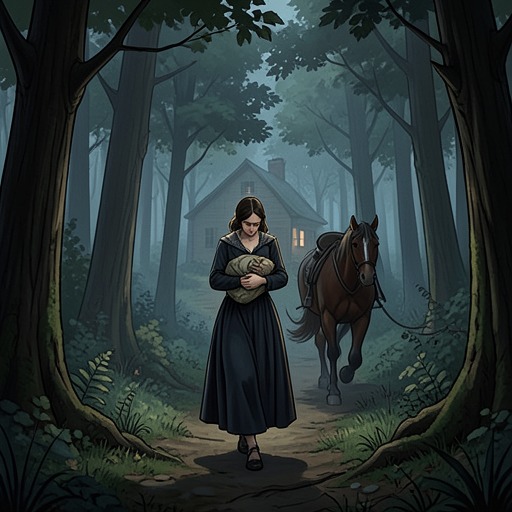
A drawer hidden at the bottom of Peter’s linen press provides the answer. Isobel remembers that he had dressed like a local when he went into the village, and finds buff breeches, a rough cotton shirt, old boots, a thin jacket, a flat cap, and a riding cloak. She binds her chest with torn strips of her petticoat, conceals her dress and shawl in the drawer, and ties the boots around her neck because they are too large to wear. The disguise is assembled from Peter’s discarded clothing and her own torn garments; it is practical rather than comfortable, and designed to make her less recognizable as she travels alone.
Once dressed, Isobel climbs through the window and grips the trellis above the darkness below. She closes the window as quietly as she can, then works her way through thorny rose bushes to the ground. She crosses the yard in the shadows, avoiding the gravel, and reaches the woodland beside the house. The route converts a familiar feature of Peter’s youth into an escape path, but it offers no guarantee of safety: one slip on the trellis could have proved fatal.
Flight on Foot
Isobel travels through the night and stops near dawn to drink from a small stream outside a hamlet. Her borrowed boots chafe her feet, while hunger, exhaustion, and a pounding head steadily worsen. She avoids taking one of Rupert’s horses because she believes he would use a charge of horse theft to have her arrested. Walking is slower, but she hopes that staying away from busy roads and out of sight will make her harder to find.
The journey remains uncertain and physically punishing. Isobel does not know precisely where she is or how far she has travelled. She skirts towns and crosses fields, ducking from farmers and the occupants of passing carriages. At one point, with dusk coming on and her strength nearly spent, she rests in the woods and eats one of two apples taken from an orchard. She has no dependable shelter and only a little food; the immediate task is to regain enough strength to continue toward Coniston.
The escape thus changes Isobel’s danger rather than ending it. Inside Gosport Hall she faced confinement and the approaching threat of being taken away; outside, she faces exposure, pursuit, and the practical difficulty of surviving without money enough for the winter. She is willing to work for her keep and recalls enjoying the occasions when she was allowed into the kitchen to make jam and tarts with Cook. But without references, she does not know how she will persuade anyone to employ her. Kitty’s relatives matter because they may help her find a way to maintain her independence, even if only for the immediate future.
Later Account and Significance
At Willowbrook Hall, Isobel later explains that she remained at Gosport Hall rather than being moved elsewhere, and that the familiar setting gave her some comfort while also giving her the opportunity to escape. She identifies the rose trellis as the way out and explains that she survived recapture by dressing as a boy. Peter recognizes the trellis as the route he used to visit the village taverns; Dominic understands that the disguise accounts for Isobel’s clothing. Her account connects the escape’s separate practical decisions—the old trellis, the hidden clothes, and the concealment—to the wider search that followed.
Isobel also explains why she did not travel directly to Dominic. She remembered what he had told her before leaving for Norfolk, but kept to country lanes and away from towns because she did not know whether Rupert was following her. On foot, her winding route took longer than expected, and she had to earn additional pennies for food. When Dominic found her, she had been heading toward him because she could think of no one else she trusted; she had intended to ask for his help in reaching London secretly. The account makes clear that escape was not a single triumphant departure from the house, but a prolonged effort to remain unseen while choosing whom to trust.
The event’s decisive turn lies in the difference between leaving and becoming secure. Kitty helps Isobel pass beyond the walls of Gosport Hall, but the road ahead offers no protection by itself. Isobel’s resourcefulness—using Peter’s route, changing her appearance, avoiding roads and towns, and seeking work—makes survival possible, while the need for allies remains. Her escape begins her effort to reclaim control over where she goes and how she lives, without pretending that freedom has already made her safe.