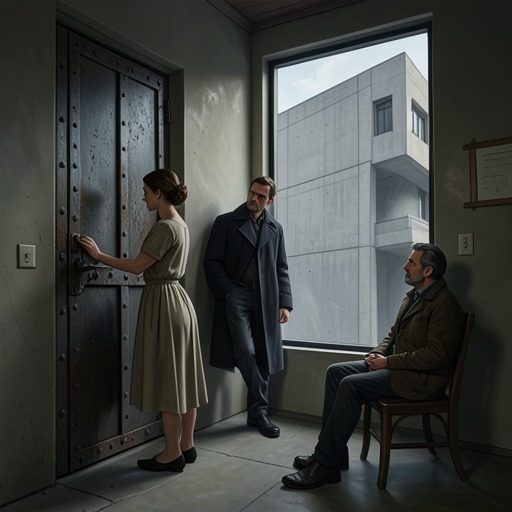
Isobel's compromised social standing
When You Were MineIsobel Davenport’s compromised social standing is a precarious condition produced by her six weeks living unchaperoned in Dominic Cavendish’s house, including an extended stay in his master suite while she recovered from serious illness. Peter Davenport treats the arrangement as a likely public scandal and urges marriage as protection; Isobel refuses to let gossip dictate her choice. Her circumstances expose a society that judges women’s reputations more harshly than men’s, while her account of isolation and abuse reveals how little that society protected her when she needed help.
The Circumstances of Her Stay
When Peter arrives at Dominic’s house, he is impatient with the butler’s evasiveness and goes upstairs to find his sister. He opens the master-suite door and adopts a show of anger at finding Isobel there with Dominic. Inwardly, however, he is relieved that she is alive and relatively well, and pleased that she is with the man he expects to marry her and protect her from Rupert Davenport. His reaction contains the central contradiction of her position: what appears to compromise Isobel in public is, to Peter, also evidence that she has found safety and a future ally.
The social risk is made explicit when Peter urges Isobel to accept Dominic’s offer of marriage. He argues that the Ton will respond badly to reports that she has lived alone with Dominic for six weeks, particularly because she spent much of that period in his master suite. Her illness explains the circumstances to those who know them, but Peter does not expect that explanation to prevent gossip. The length and intimacy of the arrangement, rather than any account of Isobel’s intentions, are enough to threaten her reputation.
Isobel does not treat marriage as an automatic remedy. When Dominic privately asks her to become his wife, she says she does not want him to make a sacrifice on her account and worries that her conduct will be judged as inconsistent with the expectations of a respectable woman. She also calls herself unconventional, pointing to having left the house without a chaperone and having lived in Dominic’s bedroom. Beneath these objections is a personal uncertainty: his care and tenderness during her recovery have mattered to her, but she wants to understand the depth of his affection before making a lifelong commitment.
Reputation and the Double Standard
Peter presents acceptance of Dominic’s offer as necessary because scandal would have consequences beyond Isobel herself. He says the family could be affected, invoking obligations that Isobel does not believe deserve priority over her own choice. Her response is pointed: she says little family remains to be protected, naming their dead parents, an unknown uncle in Scotland, Aunt Elspeth, whom she considers indiscreet and long absent from the Ton, and Rupert, whom she regards as more concerned with money than with them. The argument makes clear that Peter’s concern for reputation is bound up with family standing, whereas Isobel sees no trustworthy family network that could justify sacrificing her autonomy.
Isobel identifies the unequal rule behind Peter’s warning. In her view, a woman’s indiscretion can bring social exclusion and a lasting sexual stigma, while a man’s comparable conduct is commonly ignored or carries little disgrace. She says she does not intend to move in the Ton’s circles and refuses to arrange her life around its judgment. Her objection is not simply defiance of gossip: she challenges a system in which men can participate in conduct that damages women’s standing while escaping equivalent consequences themselves.
Her refusal is grounded in experience of abandonment, not just principle. During the argument, Isobel asks who helped when she was alone, who offered shelter when the weather turned cold, and who protected her from Rupert’s repeated physical abuse. The disclosure surprises both men; she realizes what she has revealed, is overcome by humiliation, and leaves the room. Dominic starts to follow, but Peter restrains him and advises that she be left alone. The scene shifts the question from whether Isobel has met society’s standards to why that society was absent when she needed shelter and protection.
Guardianship, Isolation, and Coercion
Isobel’s account of her removal from Willowbrook Hall explains how she became vulnerable before arriving at Dominic’s house. She had spent two and a half weeks with Aunt Elspeth when Rupert arrived, angry at being kept waiting. He said that Peter had died in Norfolk and that a magistrate named Worthing had informed him of the death, making Rupert Isobel’s legal guardian. He ordered her to pack and leave at once, claiming he could not remain at Willowbrook and would arrange its disposal later. Isobel was distressed by the news about Peter and did not know how to verify it.
Rupert also threatened to have Aunt Elspeth sent to an asylum, which distressed her enough that Isobel agreed to leave after obtaining his promise that Elspeth could remain at Willowbrook for the time being. Rupert gave Isobel little time to pack and did not tell her where she was going. She insisted that Kitty accompany her as her maid and refused to leave without her until Rupert relented. These details show how a claim of guardianship, a threat against another vulnerable relative, and the speed of the departure narrowed Isobel’s choices; her later dependence on other people’s shelter cannot be separated from that forced isolation.
Peter’s recollection identifies Gosport Hall as a small, remote hunting lodge near Northampton that had been inherited by Isobel from her father. It had been left closed and mothballed, and the family had stopped visiting after their mother’s death. Peter says it was Isobel’s to decide what to do with when she came of age, but he had forgotten it. Its significance in the conversation is therefore not merely that it was an out-of-the-way family property: it was an asset and a place connected to Isobel that could be overlooked even by those trying to find her. The contrast between her inheritance and her dependence on others sharpens the instability of her position.
Marriage as Protection and a Legal Dispute
Dominic’s offer gives Peter a practical answer to the threatened scandal: he wants Isobel to marry the man he believes will protect her from Rupert. Yet Isobel resists being made to accept marriage simply because other people may gossip. Her concern that Dominic might be sacrificing himself also shows how reputation has entered their private relationship: she fears being chosen as a solution to her compromised status rather than as a beloved partner. His direct proposal and her hesitation leave the decision personal, even while Peter frames it as a family necessity.
Later, while explaining the events that drove her onto the streets, Isobel remembers a betrothal document that she had previously forgotten. Rupert had tried to force her to sign a document naming Bertram DeLisle as her intended; she refused, and the men’s response makes clear that her defiance brought punishment. The episode links her compromised standing to the attempted use of formal marriage arrangements to control her. The document is not presented as her voluntary choice, but as part of the pressure exerted on her while under Rupert’s power.
When Rupert and Bertram DeLisle later dispute the supposed marriage, Peter challenges their claim by invoking his role as Isobel’s guardian. He says he never gave permission for her to marry anyone except the man he identifies as Lord Havistock, and argues that she could not legally have married DeLisle without such permission. Peter also says he possesses papers, signed and witnessed by magistrates, recording Isobel’s betrothal to Dominic some three years earlier. These are Peter’s assertions in the confrontation, and he says he intends to investigate the alleged marriage before Isobel is taken anywhere. The competing documents and claims make her reputation inseparable from the question of who had authority to decide her marital future.
Significance
Isobel’s social vulnerability is not a simple consequence of living with Dominic. It is shaped by a gendered code that threatens to punish her for circumstances created by illness, isolation, and the absence of safe alternatives, while treating men’s conduct more leniently. Peter sees marriage as a means of containing the scandal and securing protection; Isobel insists that protection cannot justify overriding her choice. Her challenge to the Ton’s judgment gains force from the history she discloses: she had been left without shelter or protection and then subjected to Rupert’s control. The resulting conflict makes reputation both a social hazard and a tool through which questions of autonomy, guardianship, and marriage are contested.