Isobel's captivity at Gosport Hall
When You Were MineIsobel’s captivity at Gosport Hall turns the authority of guardianship into a means of confinement and coercion. Under Rupert’s control, Isobel is isolated, repeatedly abused, and told that her future will be decided through a marriage to Bertram DeLisle. The prospect of that marriage prompts Kitty to act: Isobel escapes into the upper hallway with little more than her boots and shawl, while Kitty remains behind in danger. The episode makes escape both a refusal of Rupert’s power and a painful separation from the person who made it possible.
Arrival and the New Guardian
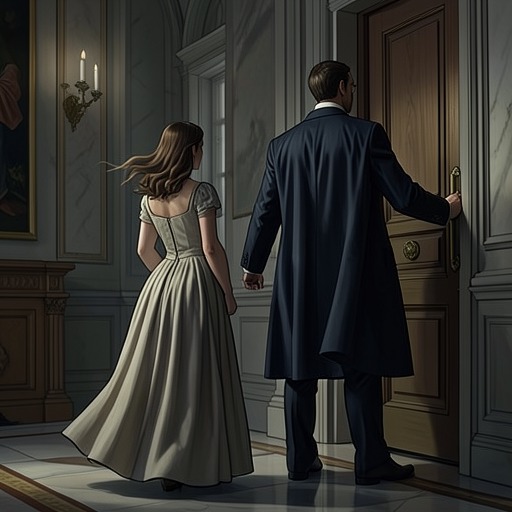
Isobel recalls that Rupert’s conduct changed after they arrived at Gosport Hall. At Willowbrook Hall he had been curt but not openly hostile; at Gosport Hall, she was summoned to speak with him after he had been drinking in the library. He announced that he was her guardian because Peter was dead and told her to become accustomed to the rules of his house. Isobel remembers that he recited rules she did not take in, but his manner and hostility made the encounter a warning of what life under his authority would become.
The setting of that first summons establishes the structure of her confinement. Rupert controls the house and presents his commands as the rules Isobel must obey. His authority is not merely formal: she later describes beatings on most days, sometimes severe enough that she feared she would not survive. At points she did not want to survive. Her account distinguishes the physical danger from its accumulating emotional weight, while making clear that both were part of her captivity.
Abuse and the Marriage Plan
The abuse grew more ferocious over time, and Isobel feared what might happen during Rupert’s next outburst. Later, recounting the period to Dominic, she says the beatings became less frequent toward the end. That change did not signal safety. Rupert had begun speaking of Bertram DeLisle’s visit and telling Isobel to improve her appearance; he described her as something he had sold and DeLisle as coming to inspect what he had bought. The arrangement turned Isobel’s lack of control over her own life into an explicit plan for her future.
The threat became more immediate when Rupert’s manservant told the few remaining servants that Isobel was betrothed and would soon leave to marry DeLisle. Kitty learned of the plan and understood that Isobel needed to leave that night. The marriage was not simply a new development in the household: it created a deadline. Isobel knew what another of Rupert’s rages could mean, and the prospect of being sent away to DeLisle gave Kitty a reason to risk intervention before the planned departure.
Kitty’s Intervention and Isobel’s Escape
Kitty was Isobel’s maid and her only ally in the house. To give Isobel the chance to escape, she took a considerable risk; by the time Isobel was preparing to leave, Kitty had been restrained and left in a room behind her. Isobel’s immediate response is divided between urgency and remorse. She wants to comfort Kitty and undo what has been done to her, but Kitty insists that she go. Isobel’s departure therefore depends on accepting help she cannot repay in that moment.
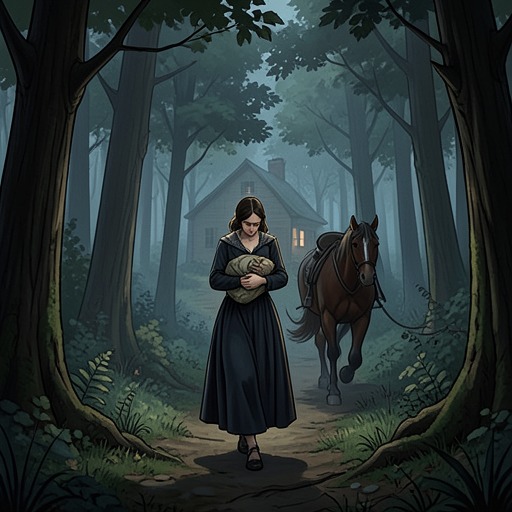
The practical limits of the escape sharpen the decision. Kitty gathers the scraps of clothing Rupert had allowed Isobel to keep, but the garments are worn and soiled from repeated use. Isobel decides not to carry them, reasoning that traveling without a bundle will let her move faster. She puts on her walking boots and takes her only remaining shawl. These few possessions mark how little she has been permitted to retain, while her decision to leave the clothes behind shows her prioritizing speed over any attempt to preserve the remnants of her former life.
After a final exchange of reassurance, Isobel turns from the bedroom that has been her virtual prison for two months and enters the dark upper hallway. Kitty’s encouraging nod is the last confirmation she receives before disappearing from view. The escape is not presented as a clean break: Isobel leaves Kitty confined, and can only hope that one day she will be able to thank her and ensure that Kitty may remain in employment for as long as she wishes. Even in flight, Isobel’s thoughts include the risk that Rupert might dispose of Kitty before that future becomes possible.
Significance and Aftermath
Isobel’s later account to Dominic places the escape within a longer history of control rather than treating it as an isolated act of flight. She identifies Rupert’s claim to guardianship, his house rules, the repeated beatings, and the planned marriage as connected parts of the same captivity. Her decision to recount what happened, despite the difficulty of speaking about it, also makes the hidden conditions of the household available to those seeking Rupert’s downfall.
The episode’s central reversal is modest in scale but decisive in meaning: Rupert had treated Isobel’s future as something he could assign, while Isobel chooses the dangerous uncertainty of leaving. Freedom begins not with possessions, protection, or a secure destination, but with a pair of walking boots, a shawl, and a passage through the upper hallway. Kitty’s sacrifice makes that choice possible, and her continued danger prevents Isobel’s escape from becoming an uncomplicated victory.