Isobel's fugitive period and male disguise
When You Were MineIsobel's fugitive period and male disguise turn a desperate escape from Rupert into a prolonged test of resourcefulness: she abandons the recognizable signs of her former life, travels on foot toward Cumbria, and survives by keeping to the margins of roads and towns. The disguise is practical rather than theatrical, assembled from Peter's old clothes and altered to conceal her figure; it lets her move through the country while remaining afraid that Rupert may be following.
The escape and the borrowed clothes
The escape begins in Peter's untouched bedroom. Dust covers the furniture, old sheets and cloths remain in place, and the room has not been aired, yet the faint scent of Peter still lingers. Its stillness brings Isobel a rush of grief: she wants to lie down and give way to sobs, but dawn is approaching and discovery would endanger both her and Kitty. The room is at once a refuge linked to her brother and a place she cannot safely remain.
The window offers a way out, but not an easy one. Isobel works the stubborn metal latch for several minutes, then checks the outside wall and sees that Peter's trellis is still secured where he left it. Looking down at her soiled dress, she remembers his warning that climbing it risked his neck even without skirts to impede him. The trellis and the dark drop below make escape physically dangerous; staying, however, seems worse. Her decision is framed by that stark calculation, not by confidence that she can manage the descent safely.
Before leaving, she realizes that her dress will make her conspicuous and expose her to danger. Peter's memory supplies a solution: when he went into the village, he had dressed like a local rather than like a lord's eldest son, and he had mentioned a drawer hidden at the bottom of his linen press. Isobel searches it and finds buff breeches, a rough cotton shirt, old boots, a thin jacket, a flat cap, and a long riding cloak. The clothes are musty and worn, but their plainness is precisely their value: they replace a recognizable appearance with one less likely to draw notice.
She binds her breasts tightly with strips torn from her petticoat, puts on the loose clothes, and hangs the boots around her neck after doubting their size. She hides her dress and shawl in the drawer and eases it shut with a soft click. The change depends on small, deliberate choices: concealing her figure, leaving her former clothes behind, and carrying footwear she cannot yet comfortably wear. Reassured by the lingering trace of Peter's presence, she climbs out into the night. On the trellis, with her fingers locked around the timbers and her knees trembling above the darkness, she struggles to close the window behind her.
A journey made on foot
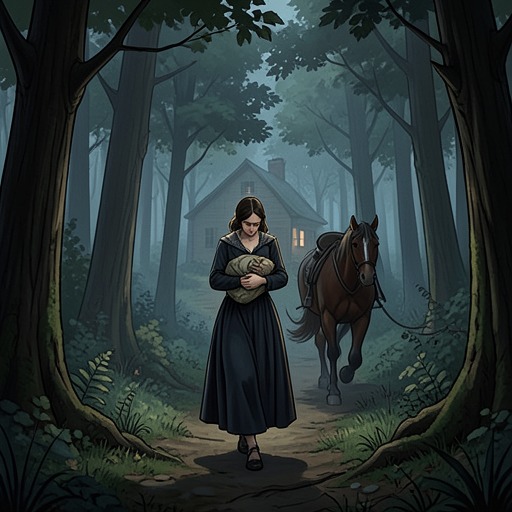
Once clear of the house, Isobel crosses the yard away from the gravel, keeps to the shadows of the hedgerows, and disappears into the woodland. She walks through the night and drinks from a tiny stream near a hamlet as dawn rises. The journey is not a direct or well-provisioned flight: she has no reliable map of the country before her, and her effort to keep out of sight makes progress slow and uncertain.
Her destination is the north. She studies mileage stones and reasons that travelling away from London will take her toward Cumbria and farther from Gosport Hall and Rupert. A childhood journey through Cumbria offers only a hazy point of reference; the countryside seen from a fast carriage had not prepared her to navigate it on foot. She relies on her wits and a vague sense of direction, while recognizing that the distance is considerable. Though she is an excellent horsewoman, she does not take one. She fears Rupert would have her arrested for horse theft, and judges that walking, though slower, will let her disappear more readily if she avoids busy roads.
The physical cost steadily narrows her choices. Peter's oversized boots, initially carried around her neck, chafe her tender soles once she wears them. She continues despite aching feet, a pounding head, hunger, and exhaustion. At dusk, after walking through fields and skirting towns, she is trembling and doubts that her strength will last much longer. She has seen no sign of Rupert or his servants, but knows that their absence from view cannot prove that she is safe. With only two apples taken from an orchard, she eats one during a brief rest, savouring its moisture as well as its sweetness, and wonders how she can reach Coniston.
Concealment and its costs
Disguise does not end the danger; it changes the terms on which Isobel faces it. When later explaining how she survived the risk of recapture, she says that she was dressed as a boy. Her appearance has been altered beyond the borrowed garments: her breasts are bound, her hair is cut short, and baggy clothes hide her remaining feminine outline. After several long weeks on the streets, her cheeks have hollowed and her skin has become bronzed. She has not seen a mirror for so long that she cannot judge the full transformation, but knows she looks nothing like before and that a casual observer would scarcely read her as a woman.
The concealment is also bound to deprivation. Isobel travels on foot, keeps away from towns and country roads where she might be noticed, and has to find ways to earn pennies for food. Her route winds into places she had not meant to go, making the journey longer than she anticipated. At one point she loses bread when trembling hands cause her to drop it in the dirt. Hunger, fatigue, and fear are not incidental hardships beside the disguise: they shape how long she can travel, what route she takes, and how much energy remains when she must respond to danger.
Her concern extends beyond her own escape. She fears Kitty will have been discovered and hopes the woman will not be suspected of helping her, but instead be left alone as a supposed victim of Isobel's deception. That worry makes the escape more than an individual flight: Isobel has to leave quickly while also fearing the consequences her disappearance may bring for an ally. The chapter of flight is therefore marked by divided attention, between avoiding Rupert and imagining what may happen to those left behind.
Recognition and the intended refuge
By the time Dominic finds her near a market town, Isobel has spent weeks on the run and has little strength left. She is trembling, sick, and has already dropped bread from her shaking hands. When she sees Dominic's shock and apparent delight, tears come, but she cannot understand how he has identified her. From her perspective, the disguise has erased nearly every outward clue: the cropped hair, bound figure, loose male clothing, hollowed cheeks, and darkened skin have made her almost unrecognizable.
Her arrival in the woods after the market brings the flight to its physical limit. She hears pursuit and turns, but the speed with which she has left the town has exhausted her; she no longer has the energy to run across the uneven ground. The encounter thus reverses the disguise's promise. It has helped her pass unnoticed on the road, but it cannot guarantee escape at the moment her strength fails. Dominic's recognition brings the possibility of rescue, even as her confusion at being known reveals how completely she has had to remake her visible identity.
When she later explains why she did not come directly to Dominic, she says she remembered what he had told her before they left for Norfolk. But she could not risk taking a direct route: she was walking, staying to country lanes and away from towns, and had to earn money for food. The journey became winding and much longer than she expected because she did not know whether Rupert was following. She confirms that she was heading for Dominic when he found her, because she could think of nowhere else to go and no one else she trusted. She had intended to ask for his help in reaching London secretly, preferably without his wife knowing.
The fugitive period joins outward disguise to a more precarious form of survival. Isobel uses Peter's clothes, practical judgment, and uncertain knowledge of the roads to resist recapture, but the effort costs her comfort, food, time, and strength. Her movement toward a trusted refuge is neither direct nor secure; it ends with Dominic finding her only after the disguise has carried her through weeks of concealment and near exhaustion.