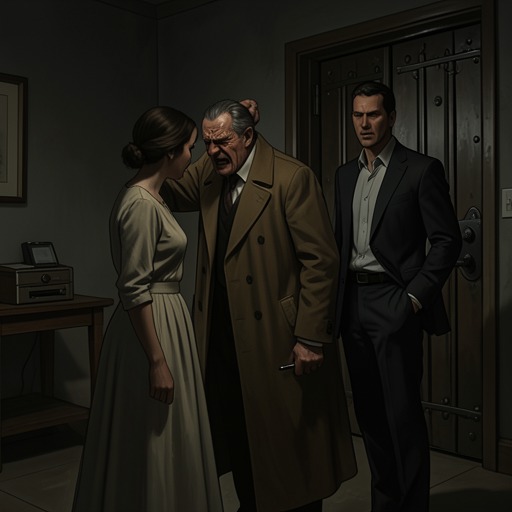
Marriage papers presented by Rupert
When You Were MineThe Marriage papers presented by Rupert are a parchment document used to claim that Isobel is already married to DeLisle and cannot therefore be Dominic’s lawful wife. Their sudden appearance converts Rupert’s campaign of coercion into an apparent documentary case: the paper makes Dominic doubt Isobel, while Isobel and Peter challenge the authority and history behind the claim. The scene leaves the document contested rather than independently authenticated, but shows how a piece of writing can exert immediate power before its truth has been established.
The Document and Its Claim
Rupert produces a roll of parchment from beneath his coat and hands it to Dominic with a flourish, presenting it as a decisive answer to the question of Isobel’s marital status. He says the document shows that she is already married. DeLisle reinforces the claim, maintaining that he and Isobel were wed and that the certificate has already been seen. The two men thus use the paper not merely to allege a past ceremony but to insist that its written record should settle the matter in their favor.
Rupert adds a second asserted foundation for the claim: he says the vicar who married Isobel and DeLisle can confirm the event, and that an entry in the Church register is available for anyone to see. These statements are part of Rupert’s presentation of the document, not independent confirmation within the scene. The narrative offers no verification of the vicar’s testimony or the register entry at this point. The distinction matters: Rupert presents the parchment as settled proof, while the others have reason to question both the claim and the circumstances in which it is deployed.
The Immediate Crisis
The parchment changes the atmosphere because Dominic examines it rather than dismissing Rupert’s allegation. Isobel watches the color leave his face and reads his clenched jaw as a sign that he believes what he sees. As he rereads the document and falls silent by the fireplace, she fears that his confidence in her has given way. The paper’s first consequence is therefore relational as well as legal: it places a visible barrier between Isobel and the husband who had just been with her.
Rupert exploits that silence by calling Isobel a bigamist and presenting DeLisle as the husband entitled to claim her. DeLisle speaks of her possessively and says she belongs with him. Isobel denies ever having married him, calls the men liars and frauds, and threatens to use every available resource to prove their guilt. Her response makes clear that the paper does not persuade her, even as Dominic’s reaction shows how effectively it can unsettle others. When Rupert moves to take her away, Isobel shoves him; Edward intervenes when DeLisle tries to seize her, and Sebastian takes a protective position. The document’s claim has become the pretext for an immediate physical attempt to remove her.
Peter’s Documentary and Legal Counterclaim
Peter challenges the premise that the men can establish a valid marriage simply by presenting a certificate. He says that he was Isobel’s legal guardian when the alleged marriage took place and had not given permission for her to marry anyone except the man to whom he had already agreed she could be betrothed. He also says that papers drawn up and signed about three years earlier, with magistrates as witnesses, recorded Isobel’s betrothal to Dominic. Peter’s account places the alleged marriage within a prior documentary and guardianship history that Rupert’s parchment does not erase merely by being produced.
Peter does not treat his counterclaim as a final ruling on what happened. He says he intends to investigate thoroughly before Isobel goes anywhere, leaving open the question of whether the alleged marriage occurred while denying Rupert and DeLisle the right to act on their assertion without scrutiny. Dominic likewise challenges DeLisle’s credibility and says the claim must be investigated rather than accepted on sight. The conflict is therefore between competing assertions and records, not a settled judgment delivered in the room.
Earlier Coercion and the Papers’ Significance
The confrontation recalls an earlier attempt to make Isobel sign a different document: a betrothal paper naming DeLisle as her intended. Isobel later remembers that she refused to sign it and that she was beaten as a consequence. This earlier episode is not the same as the marriage papers Rupert produces. It establishes, however, that written instruments naming DeLisle had already been used in an effort to control Isobel’s future, and that her refusal had brought violence. The later parchment revives that pattern under a more urgent claim: instead of demanding that she agree to a proposed betrothal, Rupert and DeLisle insist that a marriage has already occurred.
The papers also belong to the wider abuse of guardianship surrounding Isobel. Rupert had earlier claimed that Peter was dead and that this made him Isobel’s guardian, then hurried her away from Willowbrook after she resisted leaving. Peter’s later statement that he was in fact her guardian at the time of the alleged marriage directly contests the authority on which the new claim depends. Set beside Peter’s earlier betrothal papers for Dominic, Rupert’s parchment becomes part of a struggle over who may define Isobel’s marital status and exercise power over her choices. Its significance lies in that unresolved struggle: the document appears to command belief, but its authority is challenged by Isobel’s denial, Peter’s account of guardianship, and the demand that its validity be investigated.