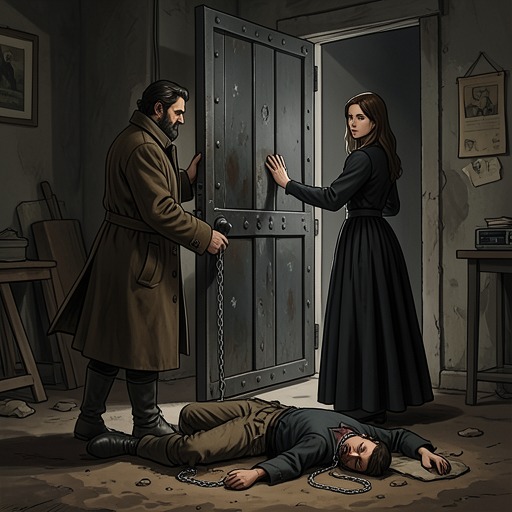
Rupert Davenport and Bertram DeLisle
When You Were MineRupert Davenport and Bertram DeLisle are associated through a plan to marry Isobel Davenport to DeLisle, a scheme presented not as her choice but as a transaction arranged by her uncle. Their connection joins Rupert’s control over Isobel to the danger she faces and, once the arrangement becomes known, helps explain why Kitty acts urgently to secure Isobel’s escape.
The Proposed Marriage
The relation first becomes urgent when Kitty tells Isobel that Rupert’s manservant has been boasting that she will be gone the following morning, married and removed from Rupert’s hands. The intended husband is Bertram DeLisle. Kitty presents the plan as something already being arranged, not as a courtship in which Isobel has a voice; she warns that refusing to go with DeLisle will bring consequences from Rupert. The report makes the proposed marriage an immediate threat rather than a distant possibility.
Isobel understands that threat through her history of Rupert’s violence. His rages have brought beatings that leave bruises and painful cuts, and she fears that his increasingly severe assaults may become fatal. Thus, the prospect of being sent to DeLisle is backed by the danger of remaining under Rupert’s power: the marriage plan and the threat of punishment work together to deprive her of a meaningful choice. The arrangement also reveals how Rupert treats his niece’s future as something he can decide and dispose of.
Isobel as the Object of the Deal
Later, Isobel recalls that Rupert told her he had sold her to DeLisle, who was coming to inspect his goods. She also remembers the manservant telling the few servants still at the house that she was betrothed and would soon leave to marry DeLisle. The contrast between the formal language of betrothal and the degrading idea of an inspection exposes the coercion beneath the proposed match. In Isobel’s account, Rupert does not describe a mutual union; he describes a transfer, with DeLisle expected to examine what Rupert claims to offer.
The two reports also establish the practical force of the arrangement. Rupert’s private announcement to Isobel is echoed by information circulated among the remaining servants, making the planned departure seem imminent and publicly settled. Kitty learns enough to recognize the danger and urges Isobel to flee that night. She gives Isobel her own life savings and asks her to tie her up, so that the escape may appear to have been forced upon her rather than aided by the maid. The alliance’s threat therefore precipitates an act of loyalty that places Kitty herself at risk.
Association and Financial Context
Rupert and DeLisle’s connection is not limited to the marriage plan. After Isobel has escaped, Dominic Cavendish encounters his groom, who reports that a carriage went to the White Horse on the outskirts of town and that another man was there: short, stocky, and loud. Dominic concludes that Rupert is with DeLisle, confirming that the two men are together beyond Isobel’s account of the proposed marriage. The encounter gives Dominic a lead in following Rupert and makes their association relevant to the effort to find him.
Peter Davenport later describes Rupert as in dire financial trouble. Rupert has numerous creditors in Town, some losing patience over his failure to repay them; rumors suggest he has turned to loan sharks, and people are looking for him. Peter adds that Rupert has become close acquaintances with DeLisle. These details place the relationship within a wider pattern of debt and pressure. The text establishes the financial crisis and the closeness, while Isobel’s testimony establishes the intended marriage; together, they invite the reading that the match serves Rupert’s interests. The evidence does not specify the terms of any bargain between the men, so their precise financial arrangement remains unstated.
Significance and Limits
The relationship matters because it links Rupert’s family authority to a second man who is to receive Isobel through a coerced marriage. Rupert controls the decision and threatens punishment; DeLisle is identified as the intended husband and as a close associate who is later found in Rupert’s company. The planned match is therefore not merely an unpleasant prospect for Isobel: it is the point at which Rupert’s abuse, the men’s association, and her threatened loss of freedom converge.
The account presents the proposed marriage through Kitty’s warning and Isobel’s recollection, rather than through a scene between Rupert and DeLisle negotiating it. It confirms their association and the announced plan, but does not establish what DeLisle personally says or does in arranging the match. That distinction preserves the focus of the evidence: the harm is already clear from Rupert’s claim that he has sold Isobel, the servants’ belief that she is betrothed, and Kitty’s decision that escape cannot wait.