Rupert and DeLisle's relationship
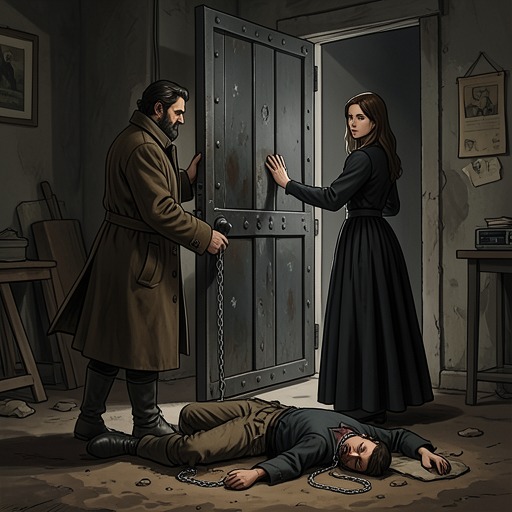
When You Were MineRupert Davenport and Bertram DeLisle’s relationship is an alliance of convenience built on debt, coercion, and a plan to convert Isobel Davenport’s marriage into access to her inheritance. Rupert supplies control over Isobel; DeLisle supplies money and the prospect of a marriage that could help them seize her property and funds. Their partnership turns a family guardianship into a commercial arrangement, and their eventual exposure reveals both its financial terms and its underlying violence.
Formation of the Alliance
Rupert’s need for money precedes the scheme against Isobel. Peter Davenport reports that Rupert is in serious financial trouble, with numerous creditors in London losing patience over unpaid debts and rumors that he has turned to loan sharks. Rupert has left London, and people are looking for him. Against this background, Peter identifies Rupert’s growing closeness with DeLisle as significant. The association first appears as a suspicious connection; later disclosures establish it as a direct partnership in the attempt to exploit Isobel.
The arrangement depends on Rupert’s position as Isobel’s guardian. After Peter was reported dead, Rupert arrived at Willowbrook Hall and claimed that the magistrate Worthing had made him Isobel’s legal guardian. He said he had come to remove her and ordered her to pack, leaving little time for her to question the story or determine where she was being taken. When Isobel resisted leaving her aunt, Rupert threatened to have Elspeth sent to an asylum; Isobel agreed to go only after securing his promise that Elspeth could remain at Willowbrook for the time being. The false report of Peter’s death thus gave Rupert practical control of Isobel, which he could use on DeLisle’s behalf.
Rupert took Isobel to Gosport Hall, a remote hunting lodge inherited by her from her father and intended for her to decide about when she came of age. Peter explains that the family had stopped using it after their mother’s death, and the property had long stood closed. Its distance and isolation made it useful to Rupert’s plan, but it was also a valuable asset in Isobel’s own right. The place DeLisle hoped to obtain was not Rupert’s to give away.
Marriage as a Financial Transaction
The men’s scheme was not simply an effort to arrange an unwanted match. Rupert later admits that DeLisle paid him to bring Isobel to marriage, providing Rupert with money to hold his debtors at bay while he worked to obtain her signature on transfer papers for the house and land. Rupert expected a further payment: DeLisle was to give him half of Isobel’s worth once the marriage took place. The financial bargain joined Rupert’s immediate need for cash to DeLisle’s expectation of gaining control over a wealthy bride’s assets.
DeLisle describes the intended next step as persuading Isobel, after marriage, to sign over Gosport Hall and control of her funds. He also reveals the brutal condition behind his plan: if she had not borne him a child within six months, he intended that she should suffer the fate of his previous wives, whom he dismisses as useless. His proposed marriage therefore promised him property and money while placing Isobel’s safety under threat. Rupert’s bargain made her both the means of settling his debts and the object through which DeLisle hoped to secure wealth and an heir.
Isobel’s consent was an obstacle both men tried to overcome, not a condition they respected. When Kitty helped her escape, she reported that Rupert intended to have her married to DeLisle the next morning. Isobel understood that refusal could bring another of Rupert’s violent rages; his beatings had become so severe that she feared she might not survive another. She fled with only a few coins and clothes, while Kitty risked her own safety and offered her life savings. The escape interrupts the marriage plan, but it also makes clear what the alliance required in practice: isolation, coercion, and violence against Isobel whenever she resisted.
Exposure of the Plan
The evidence against the partnership accumulates as the investigation proceeds. Hubert Williams uncovers information about Rupert’s debts, lies, and duplicity sufficient to support several charges, but the men still need proof that Rupert knew about Isobel’s wealth. DeLisle, too, is in debt, though not as deeply as Rupert; his sources of money have dried up, relatives have closed their doors, and gaming houses have denied him entry. Their parallel financial desperation helps explain why they press so urgently to reach Isobel. Dominic Cavendish suspects that either her fortune or his own could become a ransom target, but the later confession gives the partnership a more specific objective: marriage followed by the transfer of Isobel’s property and control of her funds.
A written betrothal document becomes a crucial link in that investigation. When Isobel is asked to set down the events that forced her onto the streets, arranging them in sequence brings the document back to her memory. Rupert and DeLisle had tried to force her to sign it, naming DeLisle as her intended; she refused and was beaten. Her recollection supplies evidence of the planned match and the violence used to secure it, connecting the men’s intentions to what was done to her.
Their claims also meet a legal challenge from Peter. When Rupert and DeLisle assert their position over Isobel and her supposed marriage, Peter says he was her legal guardian and had not consented to her marrying anyone except Lord Havistock. He further states that documents, drawn up and witnessed by magistrates, recorded Isobel’s prior betrothal to Dominic Cavendish some three years earlier. He does not treat DeLisle’s claim as settled fact, but insists that the purported marriage must be investigated before Isobel is taken anywhere. His intervention contests the authority Rupert had claimed through Peter’s supposed death and challenges the validity of the men’s arrangement.
Breakdown and Significance
The alliance finally exposes itself through the men’s mutual accusations. Rupert’s confession that DeLisle paid him for Isobel and promised him half her worth confirms that Rupert’s guardianship was being used for personal gain. DeLisle’s account of the intended transfer of Gosport Hall and Isobel’s funds confirms that he expected the marriage to deliver control of her estate. Each man then condemns the other: DeLisle calls Rupert greedy, while Rupert mocks DeLisle for being tied up and facing the gallows. Their insults do not undo their shared plan; they reveal how completely its participants understood the bargain once it failed.
Their partnership is therefore both intimate and transactional: DeLisle is Rupert’s close acquaintance and accomplice, but each expects the other to serve his own interests. Rupert wants cash and relief from creditors; DeLisle wants a wife whose inheritance he can redirect, alongside the possibility of an heir. Isobel’s refusal, escape, and remembered evidence expose the difference between their story of a lawful marriage and the coercive process behind it. The alliance’s collapse turns the men’s private bargain into evidence of a wider abuse of guardianship, marriage, and property rights.