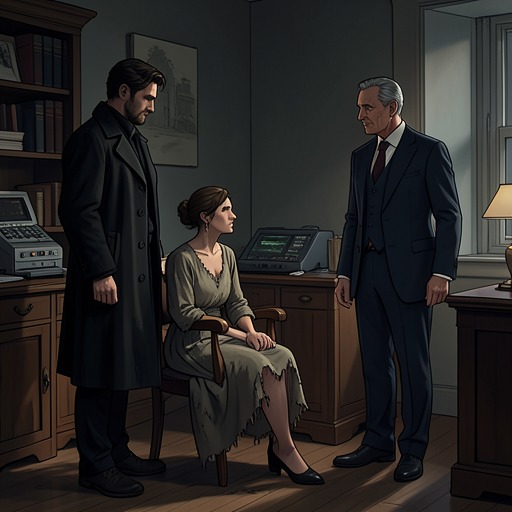
Rupert takes Isobel to Gosport Hall and imprisons her
When You Were MineRupert takes Isobel to Gosport Hall and imprisons her when Rupert Davenport exploits a false report of Peter Davenport’s death to take control of his niece. He removes Isobel from Willowbrook Hall under the authority of guardianship, then subjects her to confinement, repeated beatings, and a proposed marriage to Bertram DeLisle. The episode’s decisive reversal is that Kitty, Isobel’s maid, risks her own safety to make escape possible: the apparent transfer of Isobel into Rupert’s custody becomes the beginning of her flight from it.
Causes and Removal
Before Rupert arrived, Isobel had spent two and a half weeks with her aunt Elspeth at Willowbrook Hall. Rupert came there claiming that Peter had died in Norfolk and that, as a result, he was Isobel’s legal guardian. He said that a magistrate named Worthing had informed him of Peter’s death, while admitting he did not know all the facts. Isobel was shocked by the news and could not establish whether it was true before Rupert pressed her to leave.
Rupert strengthened his claim by threatening Elspeth with confinement in an asylum if she opposed him. Elspeth became distressed, and Isobel agreed to go only after securing Rupert’s promise that her aunt could remain at Willowbrook Hall for the time being. The choice was made under pressure: Isobel was given little time to pack, did not know where Rupert was taking her, and was still reeling from the claim that her brother had died. Her belongings were few, and the move was so hurried that she was ushered into the waiting carriage before she could think through what was happening.
Isobel insisted that Kitty accompany her, refusing to leave without a lady’s maid. Rupert initially resisted but eventually agreed. That decision brought Kitty into the same household as Isobel, where she would later become the person able to help her escape. At Willowbrook, Rupert had presented himself as curt but not openly hostile; his claim to family authority therefore concealed the much harsher treatment that followed at Gosport Hall.
Confinement at Gosport Hall
On their arrival, Rupert summoned Isobel downstairs. He had eaten and was drunk, and he asserted that she must now accept his house rules because Peter was dead and Rupert was her guardian. Isobel recalled that his manner and hatred made the change from his earlier conduct unmistakable. The supposed legal transfer of responsibility did not provide her protection: within Rupert’s house, the guardianship he invoked served to enforce his control over her.
Isobel later told Dominic Cavendish that Rupert beat her on most days. The assaults varied in severity, but she said there were times when she thought she might not survive. She also described periods when she did not want to survive. Her account establishes the effects of the confinement without making the abuse a single isolated outburst: it was a repeated feature of daily life, and its increasing danger shaped the urgency of escape.
Toward the end of her captivity, the beatings became less frequent, but Rupert began preparing for Bertram DeLisle’s visits. He told Isobel that he had sold her to DeLisle, who was coming to inspect her, and expected her to improve her appearance. Rupert’s manservant told the remaining servants that Isobel was betrothed and would soon leave to marry DeLisle. The marriage plan thus accompanied the physical confinement: Rupert treated Isobel as someone whose future could be arranged for his purposes, while presenting the proposed departure as a betrothal.
Kitty’s Intervention and Isobel’s Escape
The prospect of being sent to DeLisle prompted Kitty to act. She warned Isobel that Rupert intended to have her married and taken away the following morning, and urged her to leave that night. Kitty’s warning supplied the immediate cause of Isobel’s escape: the danger was no longer only the recurring beatings but also the imminent removal into a marriage arranged without her consent.
Kitty helped Isobel flee Gosport Hall, but her assistance exposed her to considerable risk. When Isobel considered the few minutes in which events had changed, she knew Kitty had been left behind, bound to a chair and held prisoner in the room Isobel had just left. The escape therefore did not simply end the danger for both women at once. Isobel could get away, while Kitty remained in Rupert’s power for a time.
After Rupert learned that Isobel had escaped, he left with his henchman to search for her. Kitty was eventually found by one of Rupert’s staff and set free. His departure to pursue Isobel gave Kitty the opportunity to escape the house herself. She had given Isobel all her own funds; afterward, she took money from a desk in the library and made her way back to Willowbrook Hall. There she resumed a nervous place among the household staff, apparently not considered important enough by Rupert to be pursued.
Aftermath and Significance
The truth about the removal emerged later, when Peter returned to Willowbrook Hall with Dominic after their affairs in Norfolk had been concluded. Elspeth and the servants had been left in confusion: Rupert had used threats and lies to secure their compliance, while Isobel had been carried away in an unmarked carriage and had sent no word. Elspeth had also believed Peter murdered by smugglers, so his return exposed the false report on which Rupert had based his claim to guardianship.
Kitty’s account of Isobel’s flight and destination helped Dominic and Peter understand what had happened at Gosport Hall. Isobel’s own later recollection filled in the sequence: the false news of Peter’s death, her hurried removal, Rupert’s conduct in his house, the repeated beatings, and the intended marriage to DeLisle. The event is therefore disclosed through both aftermath and testimony. What first appeared at Willowbrook as an abrupt exercise of guardianship is revealed as a sustained seizure of Isobel’s freedom, concealed behind a claim of family and legal authority.
The episode also makes Kitty’s loyalty consequential rather than merely affectionate. She recognizes the immediate danger, warns Isobel, and helps her leave even though she herself is then imprisoned and must later escape separately. Isobel’s flight begins in dependence on that act of solidarity, while Rupert’s false account of Peter’s death and his proposed marriage to DeLisle show how he combines deception, social authority, and coercion to control her future.