the Lake District
When You Were MineThe Lake District is presented as a distant refuge rather than a fully depicted setting in these passages: Kitty gives Isobel Davenport a destination near Coniston after her escape from Gosport Hall, and the prospect of reaching it shapes Isobel’s northward flight. The route remains uncertain and physically punishing; the region’s importance lies in the shelter Isobel hopes to find there and in the distance she must create from Rupert Davenport.
A Proposed Refuge
Kitty tells Isobel that she has relatives in Coniston who can offer somewhere warm and dry until Isobel decides what to do. Their help is explicitly temporary, but Kitty supplies a practical point of contact: Isobel is to ask for Annie, Kitty’s cousin, who works at Winheld Hall. The directions turn the Lake District from a vague place “up in the Lakes” into a possible chain of assistance, though Kitty’s doubtful voice makes clear that the refuge is not guaranteed.
The plan depends on Isobel reaching the region alone. She leaves behind the assembled garments because she has no way to carry them and believes travelling without baggage will be quicker. The Lake District is therefore not merely a destination on a map: it is the uncertain end of an escape that begins with almost no provisions and no assurance that its proposed shelter will last.
The Escape North
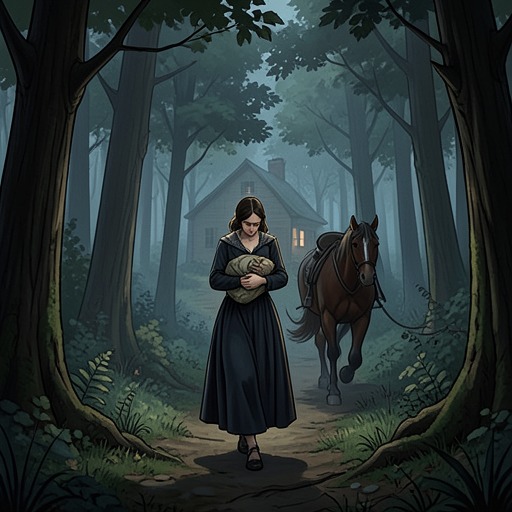
After leaving the familiar darkness of Gosport Hall, Isobel gets out through a bedroom window. Peter’s trellis is still in place, but the crumpled dress she is wearing makes climbing down impractical and would leave her conspicuous. Remembering Peter’s hidden clothes, she changes into his buff breeches and rough shirt, old boots, a thin jacket, flat cap, and riding cloak. The disguise and the concealed route are immediate necessities for travelling without attracting Rupert’s attention.
Isobel walks through the night and into the day, keeping away from busy roads and skirting towns. At dawn she drinks from a small stream near a hamlet; later she stops in long grass and eats one of the two apples she has left. She uses mileage stones to keep heading north, away from London and Gosport Hall, but her knowledge of the way is limited. Although she remembers passing through the area as a child in a carriage, the countryside looks unfamiliar on foot, and she has only a vague sense of direction to guide her toward Coniston.
Distance and Bodily Cost
The journey’s scale is measured less by a reliable itinerary than by Isobel’s fatigue. Peter’s boots are too large and chafe her tender feet; her head pounds, her stomach is empty, and she is already sore after walking through the night. Fear keeps her moving despite that discomfort. She considers taking one of Rupert’s horses, but rejects the idea because he could have her arrested for horse theft; on foot she is slower, yet believes she can disappear more easily if she stays out of sight.
The distance also exposes the gap between Isobel’s childhood memory and her present circumstances. From a carriage, the region had been part of a passing landscape on a visit to a distant relative. Now she must cross the countryside under her own power, without knowing precisely where she is or how far she has left to go. Her brief sleep, wrapped in her cloak at the edge of the trees, offers little warmth or comfort; she wakes crying as the magnitude of her situation catches up with her.
Narrative Function and Limits
The Lake District gives Isobel’s flight a direction and a possible human connection, but the cited passages stop short of showing her arrival at Coniston or meeting Annie. Its role here is consequently prospective: it is the hoped-for shelter that makes a perilous journey imaginable, not a refuge whose safety has yet been established. The contrast between Kitty’s concrete instructions and Isobel’s uncertain progress keeps the destination in view while emphasizing how little protection the plan can guarantee.