First Assault on the Hill-Fort
When the Cold Breathes A Ragnar Stormbringer Tale A Ragnar Stormbringer TaleThe First Assault on the Hill-Fort turns the refuge of the surrounding villages into a battlefield. When the Wights converge on the palisade, the defenders face an enemy vastly more numerous and resistant to injury than ordinary people; the fort’s barriers, rather than any prospect of defeating the horde in open ground, give them a chance to hold. The attack ends without the settlement falling, but not with the siege broken.
Refuge Under Threat
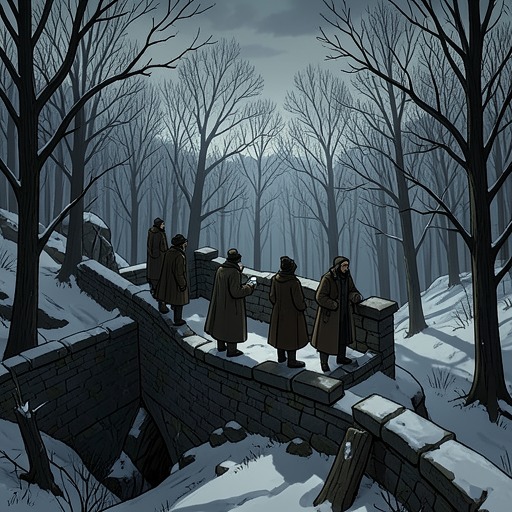
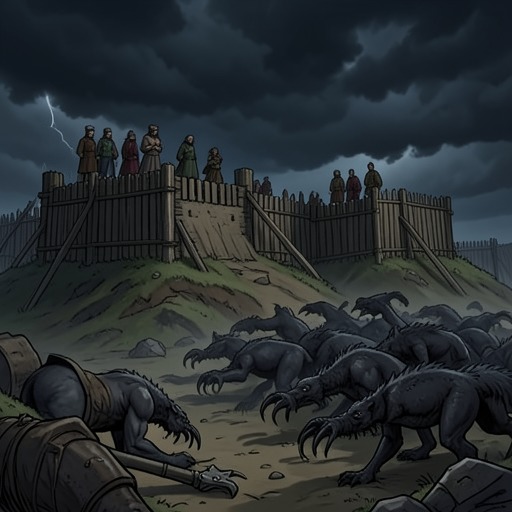
The assault follows the flight of villagers from their homes. Roused in the night by the Wights’ cries, families make their way through the snow to Jarl Thryggvi's Hill-Fort, carrying whatever food and belongings they can gather quickly. The fortress occupies a broad hilltop at the center of the jarl’s territory. A ditch and high earthen rampart, topped by a wooden palisade, enclose a cramped interior of timber huts, animal pens, and storage pits sunk beneath sloping roofs.
The fort was built to shelter the district’s villages and homesteads during war. Now it is the people’s only defensible refuge against an enemy bent on slaughter. As the main groups of refugees arrive, Ragnar Stormbringer takes responsibility for greeting the stragglers. He has the other guards hold back and checks each solitary newcomer himself: in the growing panic, a lone figure appearing through the snow might otherwise be mistaken for a threat and attacked. This makes the gate both a point of safety and a dangerous threshold, where fear can turn against the people seeking shelter.
The snowfall obscures the country beyond the walls, while cries and wails grow louder outside. The defenders sometimes mistake shadows for movement, but the warning becomes real when Ragnar sees gaunt, long-limbed figures moving among the trees beyond the ditch. More appear, spreading around the hill until the fortress is close to encircled. Spectral lights shine from their eye sockets, and their hisses, screeches, and shrieks fill the air. Ragnar calls everyone capable of bearing a weapon to the ramparts; a solid ring of villagers takes position above the approaching host.
The Attack on the Ramparts
The assault begins without a signal. The Wights swarm the ditch and climb the rampart, using their claws and strength to find holds on the steep earthen slope. Their elongated limbs, necks, and jaws make them look far removed from ordinary human proportions. At the palisade, they claw at the wood and try to pull themselves over. The defenders stab and hack at any head or hand that appears above the barrier, turning the narrow crest into a bottleneck: the bodies crowding the top obstruct those still climbing, preventing the horde from using its numerical advantage all at once.
Ragnar fights along the wall-walk with Raven Caller. He knocks one attacker from the palisade, sending it tumbling down the slope and dislodging others. Yet the dead and wounded do not make the defense safe. Axes lodged in skulls, cut throats, and other injuries that would stop a living person fail to halt the Wights. Some have lost an eye, hand, or arm and continue trying to climb. Each attacker the defenders bring down is followed by another, while fallen bodies collect in the ditch and sometimes force climbers to scramble clear before starting up again.
The barrier does not prevent every breach. One Wight gets over the palisade and severely wounds a man near Ragnar with a bite to the face. Ragnar cannot save the victim, but he kills the attacker with a single axe blow. Elsewhere on the wall, defenders face further injuries and deaths as claws and blows reach them. Casualties among the villagers remain comparatively light, but the violence is close and immediate: the rampart gives the people a position from which to fight, not immunity from attack.
Ragnar’s Leadership and the Turning Point
Ragnar combines direct fighting with efforts to steady the defense. He chops down another Wight as it climbs onto the wall-walk, and the spectral light in its eyes goes black before it falls. He calls on the defenders to fight with all they have, then raises a thunderous challenge to the horde: “Come to your ruin! We will not break!” The cry is answered by defenders along the wall, who shout and renew their efforts. His intervention does not make the enemy less numerous or less dangerous; it helps keep the human line engaged as the assault presses on.
Bodies piling against the slope become part of the fort’s practical defense. When Ragnar throws a headless attacker back down the rampart, it knocks other climbers loose. As more Wights are cut or battered down, the ditch fills and damaged attackers lose the use of limbs needed to climb. The pressure at the crest gradually eases. Ragnar continues to hack and strike at those reaching the top until none can get over the palisade and onto the wall-walk.
The change is hard-won rather than decisive. The Wights cease their assault without a distinct call and retreat down the rampart, with those gathered by the ditch withdrawing toward the trees. The defenders cheer or shout insults, but keep their places and their weapons ready. After a short rest, Ragnar surveys the perimeter and recognizes that enough of the host remains to maintain the encirclement. The villagers might hold behind the palisade; on open ground, they would still be outmatched.
Aftermath and Continuing Siege
Ragnar orders the defenders to post a watch along the ramparts and collect both their dead and whatever remains of the attackers they can find. They make separate pyres for the human dead and the Wights. Every recoverable piece of a Wight, down to the smallest fragment, is burned, because the defenders will take no chances with an enemy whose injuries do not reliably stop it. The cleanup is therefore part of the response to the assault, not simply a way to dispose of the dead.
When the immediate fighting gives way to crying and mourning, families and friends grieve for those who have fallen. The Wights’ withdrawal offers a pause, not a release: their surviving numbers still surround the fortress, and the defenders cannot safely leave the protection of its earthworks and palisade. In the larger siege, the hill-fort remains both shelter and confinement. The first assault shows that its defenses can blunt a mass attack, while leaving unresolved how long the refugees can endure another.