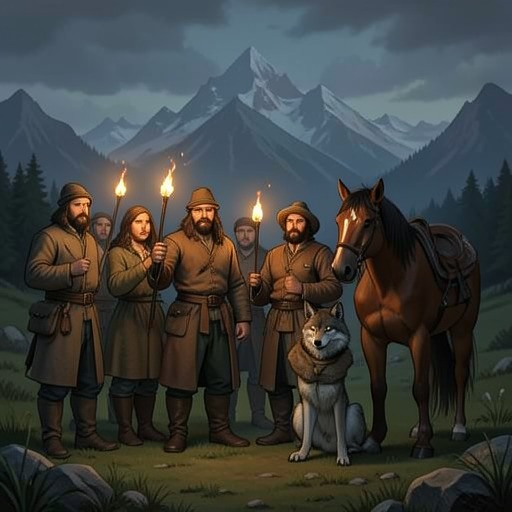
I cannot enter the wilderness alone
When the Cold Breathes A Ragnar Stormbringer Tale A Ragnar Stormbringer TaleThe rule against entering the wilderness alone emerges as a hard-won principle of survival, not as a formally announced law. After eight men vanish from nearby villages without witnesses or clues, Heimval sets out by himself and is killed. Ragnar’s warning that villagers should not stray alone gives the disappearances a practical consequence: in a landscape stalked by a powerful predator, isolation makes a person easier to prey upon and harder to protect.
Origins in the Disappearances
The danger first takes the form of absence. Over a few weeks, eight men disappear from villages in the area, and no one can identify what caused their disappearance. Cnut and others discuss organizing a large armed search party, but fear prevents the plan from becoming action. Several more days pass without anyone venturing out. The delay is not evidence that the danger has passed; it shows how the threat has already disrupted ordinary movement and collective decision-making.
Heimval refuses to wait for agreement. He declares that he will search for the missing men alone and leaves early the next morning. Cnut wants to catch up with him, but will not go after him without companions. Unable to gather anyone else, he asks Ragnar to help. The contrast establishes the rule through opposing choices: Heimval accepts the exposure of a solitary journey, while Cnut recognizes that following alone would compound the risk.
Ragnar eventually finds Heimval dead. The broad paw marks suggest a creature comparable in mass to the great brown bears of Ragnar’s homeland, and one able to run down almost anything in open ground. Ragnar explains that it will continue to threaten people for as long as it can find prey. The original disappearances are thus no longer merely unexplained losses: the tracks and the dead man point to a continuing danger that can reach anyone who travels unwary through the region.
Ragnar’s Warning and the Exception of the Hunter
After examining the tracks, Ragnar tells Cnut to warn the villages that nobody should stray alone while such a creature stalks in the shadows. His instruction turns the immediate discovery into advice for the wider community. It is not enough to mourn Heimval or retrieve his belongings; people must change how they move through the threatened territory.
Ragnar does not, however, treat every solitary journey as equally reckless. He intends to hunt the creature alone, reasoning that the hunt may bring him back together with Cnut sooner. He orders Cnut to return to the villages, attend to Heimval’s family, and gather a large party to recover the remains. When Cnut asks whether they should stay together, Ragnar points out that the predator has fed and gone toward the forest, and says the route back is safe. He accepts the danger for himself while directing Cnut toward the safer task of warning and organizing others.
That distinction is grounded in the circumstances, rather than in an explicit written exemption. Ragnar is an armed and experienced fighter carrying Raven Caller, and he has followed the creature’s tracks; Cnut’s urgent responsibility is to return to the settlements and mobilize help. The episode therefore presents the rule as protective guidance for the villagers, not as a claim that no one can ever venture out alone. Ragnar’s confidence does not undo the warning: his decision is a calculated risk, while Heimval had gone out without the support or information that a group could provide.
From Individual Caution to Common Defense
The principle becomes more consequential when the threat expands beyond the forest predator. As the dead begin to approach the settlements, people leave their homes in the night and stream toward Jarl Thryggvi’s Hill-Fort. The fort’s ditch, high earthen rampart, and wooden palisade make it a defensible refuge for the villages and homesteads. The movement toward it replaces scattered exposure with shelter behind a shared boundary.
Arrival itself requires caution. Once the larger family groups have stopped coming, a few stragglers still reach the gate alone, separated from one another and coming from the outermost dwellings. With the villagers frightened and liable to mistake a lone shape for an enemy, Ragnar insists on greeting each newcomer and determining that each is human before allowing passage. The danger of being alone here is twofold: a traveler faces whatever is outside the fort, while those inside may misread an isolated arrival in the storm.
When no more villagers arrive for a time, Ragnar orders the gates shut. He then directs armed men to keep watch in every direction and calls everyone able to wield a weapon to the ramparts. The arriving wights greatly outnumber the defenders; the fort’s walls are what prevent the people from being overwhelmed with ease. Under siege, survival depends not on individual wandering but on coordinated vigilance, a defended perimeter, and people acting together.
A Rule of Mutual Protection
After the fighting, Ragnar orders the villagers to set a watch and gather both their own dead and the attackers’ remains. They build separate pyres for human bodies and the creatures, burning every wight remnant they can find. The response makes safety a shared obligation that continues after an immediate attack: those who remain alive must guard the settlement and remove the remains of an enemy that cannot safely be treated like an ordinary foe.
The larger crisis also exposes the limits of simply leaving. Ragnar considers whether he could use a tunnel to get beyond the walls, but observes that other settlements are many days’ ride away, there is no horse to take through the passage, and the people cannot hold out that long. A lone escape would not solve the community’s predicament. Across the disappearances, the march to the fort, and the siege, the rule against entering the wilderness alone therefore carries a broader force: safety depends on warning others, returning with help, and defending a place collectively when individual movement cannot protect the people left behind.