Ragnar Stormbringer
When the Cold Breathes A Ragnar Stormbringer Tale A Ragnar Stormbringer TaleRagnar Stormbringer is the central human force in the northern crisis, combining physical courage, tactical judgment, and a deliberate refusal to surrender initiative to fear. His investigation begins with blood on snow and a dead settler, expands into the discovery of a sorcerous Wight awakening beneath the Ancient Barrows, and culminates in his role as the person who turns scattered panic into organized resistance. Even after the immediate danger has passed, he does not settle into safety: when Winter nears its end, he resumes his journey and returns to Belshezan’s cave, carrying an unanswered question with him.
Identity and Introduction
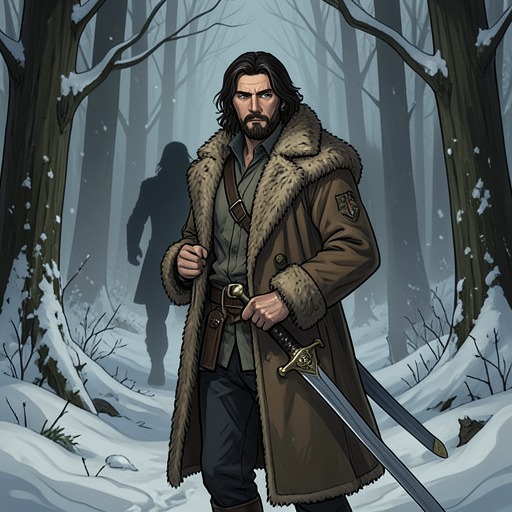
Ragnar first appears as a formidable figure shaped by exposure to the northern wilderness. Under the brilliant glare of the midday sun, frost clings to his thick beard and long dark hair, making him look older than he is. His appearance is not merely decorative: the cold, the snow, and the hostile landscape establish the conditions in which his character is tested. While others read the wilderness chiefly as danger, Ragnar reads it as evidence. He studies crimson stains, human footprints, and broad claw marks, distinguishing the tracks from those of a Snow tiger and recognizing that the unknown predator may explain the disappearances troubling the settlements.
His attention to detail is joined to a readiness for action. The discovery of a corpse reveals both the immediate brutality of the wilderness and the personal cost of the disappearances. Ragnar finds a bloodied silver amulet bearing the rune of the northern god Tireya and uses it to identify the dead man as Heimval, or what remains of him. The amulet transforms an obscure trail into a human loss: Heimval has left behind a wife and two healthy children. Ragnar judges the dead man’s decision to go out alone as foolhardy, especially for someone responsible for a family, but he also respects the courage behind it. His response is therefore neither simple admiration nor condemnation. He resolves to avenge Heimval and to aid the settlers, partly because Jarl Thryggvi has sheltered him through the harshest part of Winter.
Investigation and the First Ordeal
Ragnar’s investigation develops through a succession of enlarging threats. At first he expects either a rare beast or an enemy tribe, but the tracks lead him toward a Mayak, a predator capable of killing larger prey and, as Cnut warns, potentially bringing down a hunting party of ten. Ragnar does not deny the danger. Instead, he treats it as a challenge worthy of his skill, while Cnut’s fear exposes the difference between caution that preserves life and terror that paralyzes it.
That contrast becomes explicit when Cnut grips his spear with white knuckles and searches the landscape for the unseen creature. Ragnar explains that a well-fed predator is unlikely to hunt again immediately, then follows its tracks alone. When Cnut wishes him divine protection, Ragnar answers that he has Raven Caller with him and that a chance is sufficient for him. Cnut appears to regard this confidence as foolishness or madness, but Ragnar understands that ordinary people often see courage in those terms because doing so allows them to avoid confronting their own fear. Yet the same people seek out such a figure when circumstances become desperate.
Ragnar’s confrontation with the Mayak is an ordeal of deliberate exposure. Near the creature’s cave, he crouches beside a towering pine, removes the brooch fastening his cloak, and lets the cloak fall so that he can move freely. When the Mayak is moments from discovering him, he abandons concealment altogether. He raises Raven Caller in both hands, roars, and charges from the trees. The beast responds with its own thunderous roar and lunges across the snow. Ragnar’s first stroke narrowly misses the creature’s skull, forcing the encounter into a close and dangerous struggle rather than ending it with a single heroic blow.
The fight also reveals that the Mayak is more than an ordinary animal. Its mental assault threatens to overwhelm Ragnar, but he regains control by imposing order on his own body and thoughts. He concentrates on possible movements, axe strokes, and stances, using the feel of Raven Caller’s haft as an anchor. His victory therefore depends on more than strength. It depends on recovering disciplined agency while an alien power attempts to dissolve it. Once clarity returns, he drives the axe into the attacker’s face and kills the maniacal figure, whose laughter ends beneath the blade. The apparent beast hunt has become evidence of a human or sorcerous intelligence capable of assuming another form.
From Barrows to Wights
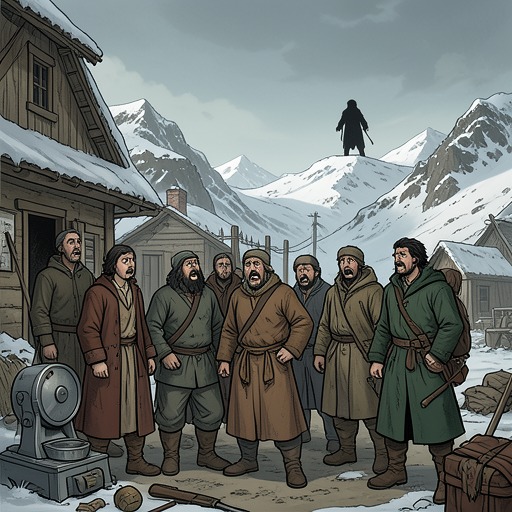
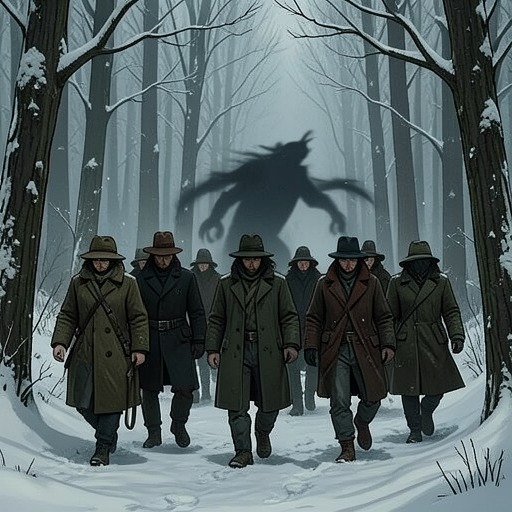
The dead figure’s body leads Ragnar to a larger revelation. Beyond the corpse lies a landscape of low, treeless mounds, and a tremor passes through the ground beneath his feet. The mounds are the Ancient Barrows, and the cries rising through the wind soon make clear that the danger is not confined to one shapeshifting predator. Ragnar and the men with him hear shrieks and panic spreads through the group. One man collapses into despair, declaring that everyone will die, and Ragnar strikes him across the face to force him back into command of himself. He then distinguishes fear from surrender: fear is not shameful, but allowing it to govern the group is disastrous.
Ragnar connects the sounds to the barrows and helps the men identify what has emerged. When one suggests Draugr, he reasons that such beings would not ordinarily appear in numbers of this scale. Cnut proposes Wights, partly because the light in their eyes matches Ragnar’s description. Ragnar accepts the explanation as the best available account and then acts on its consequences. He understands that creatures summoned from the ground by sorcery will not tire and need neither food nor drink. The settlements therefore cannot simply wait for the threat to pass or attempt an ordinary retreat.
His solution is strategic rather than merely aggressive. Ragnar rejects the idea of leading people back into unprotected villages and insists that the Wights will sweep through them whether the defenders move or not. He proposes gathering everyone who can be found and taking them to Jarl Thryggvi’s Hill-Fort, where they can stand together. The decision converts his private investigation into a communal defense. Ragnar becomes not only the man who recognizes the danger but also the person capable of giving frightened settlers a practicable course of action.
Leadership Under Siege
Ragnar’s leadership continues after the refugees reach the fortress and the threat becomes an ongoing siege. His commands are framed around endurance of spirit as much as bodily defense. He tells Cnut to ensure that everyone is informed and urges him not to waver because of what the Wight-bite sickness may do. Cnut answers that maintaining morale is difficult while the people are surrounded and trapped, but Ragnar’s response is characteristically severe and direct: he asks whether Cnut is still alive, forcing attention back to the immediate fact of survival rather than the imagined certainty of defeat.
This exchange clarifies Ragnar’s method. He does not pretend that the siege is safe, nor does he offer reassurance unsupported by circumstances. Instead, he treats fear as a condition that must be mastered collectively. His earlier blow against the panicking settler and his later insistence on communication express the same principle: survival depends on keeping individuals from becoming isolated, uninformed, or spiritually broken. His heroism is therefore organizational as well as martial.
Ragnar’s determination also creates friction with Belshezan. When the sorcerer summons the beasts, Ragnar sees the advancing host of wolves, bears, Snow tigers, wolverines, Mayaks, and enormous cats with sabre-like fangs. The sight is astonishing, but it also reveals the limits of human control. Ragnar wants to go forward, axe in hand, yet Belshezan blocks him by stamping and roaring. Ragnar insists that he does not avoid battles and asks not to be stopped. Only after interpreting the bear’s repeated gesture does he decide to trust the sorcerer, return Raven Caller to the loop at his belt, and step back. This is a significant restraint: the warrior’s courage is not erased, but subordinated to a larger tactical judgment.
The Beast Alliance and the Road South
The battle that follows confirms the wisdom of that restraint. The animals attack the Wights as a combined force, setting aside their ordinary enmity to destroy entities that belong among the dead. Ragnar watches a Mayak rescue a hard-pressed wolf by striking a Wight from the side and tearing into it, while the wolf kills another. He then sees a Snow tiger break three Wights’ attack on a brown bear, after which the two animals destroy their opponents together. These scenes force Ragnar to revise his understanding of Belshezan’s warning. The sorcerer had not been preventing him from sharing in a glorious charge; he had been preventing a human figure from becoming an enemy to every beast moving through the confusion.
The alliance also widens the moral and symbolic scale of Ragnar’s conflict. The animals’ cooperation presents the forest as capable of collective resistance when confronted by an intrusion associated with death and sorcery. The Wights, in contrast, do not retreat or tire; they fight until the last of their otherworldly cries disappears. Ragnar’s role is that of witness, interpreter, and survivor within this spectacle. He does not command the beasts, and he does not claim their victory as his own. His understanding grows through recognizing when human bravery must yield to forces larger than the individual warrior.
When Winter finally draws toward its end, Ragnar leaves Jarl Thryggvi’s settlement and resumes his southward journey with only essential possessions in the pouches at his belt. He initially travels west, then turns north after finding a familiar stream now running with clear Spring waters, and returns to the woodland sorcerer’s cave. The return gives his arc a deliberately unfinished shape. Ragnar has helped the settlements survive, confronted the Mayak, uncovered the Wights’ release, and witnessed Belshezan’s beast summoning, yet the experience has not closed into a final answer. He goes back because a question has remained since the villagers returned home, showing that his defining impulse is not simply to win fights but to pursue knowledge through danger. His path continues with Raven Caller, a readiness to meet the next challenge, and the unresolved consequences of what he has discovered.