Residents in a state of refuge in the mountain fortress
When the Cold Breathes A Ragnar Stormbringer Tale A Ragnar Stormbringer TaleThe villagers’ refuge in Jarl Thryggvi's Hill-Fort turns a place built for wartime shelter into the besieged population’s last defense against the Wights. Families flee through the snow with only what they can carry, and the fort gathers them behind its ditch, earthen rampart, and wooden palisade. Yet safety inside the walls is conditional: the same enclosure that keeps the enemy at bay also traps a crowded population with too little food, limited fuel, and few ways to summon help.
Flight to the Fort
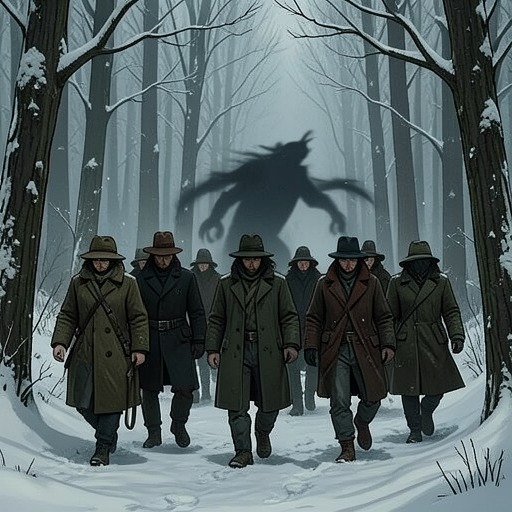
The refuge begins in terror and darkness. Woken from sleep, men, women, and children trudge through the snow as ghastly cries grow louder around them. Those who can be warned leave their villages and homesteads for the fort, carrying baskets, sacks, pouches, or whatever other vessels they can seize in time. Many arrive with little beyond the clothes on their backs; the effort to salvage food and belongings is necessarily hurried and incomplete.
The arrivals come from settlements scattered across the area under Jarl Thryggvi’s rule, making the fort’s central position crucial. At first, family groups stream toward its gates; then the flow dwindles. Later stragglers emerge singly from the snowfall, separated from one another and coming from the dominion’s outermost dwellings. With frightened guards liable to mistake a lone figure for an enemy, Ragnar Stormbringer takes responsibility for greeting these late arrivals and establishing that each is human before allowing entry. The refuge therefore depends not only on walls, but on controlled passage through its gateway.
A Defensive Enclosure
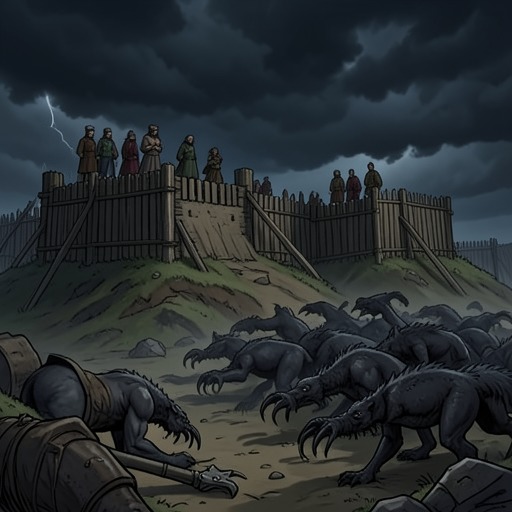
The fort occupies the broad summit of a large hill. A ditch and high earthen rampart, topped by a stout wooden palisade, form its circular perimeter. Within it, slanted roofs and below-ground entrances mark storage pits, while a number of small timber huts and two animal pens fill the cramped interior. These defenses and buildings were intended to shelter the surrounding villages and homesteads in wartime; in the present crisis, they become the only place where the population can try to withstand an enemy bent on slaughter.
That protection is physical but incomplete. Dense snowfall conceals the approaching threat, while cries and howls beyond the ramparts grow in volume. Nervous guards sometimes call false warnings, and shadows provoke fear among those keeping watch. When no more villagers arrive for a time, Ragnar orders the gates shut. The men withdraw, the thick timber gateway is barred, and he directs armed defenders to watch the wall-walk in every direction. Soon afterward, gaunt, long-limbed Wights can be seen moving among the trees beyond the ditch. The decision to close the entrance marks a shift: the fort is no longer simply receiving refugees but holding a line against a visible besieging force.
Life Under Siege
The refuge’s central weakness is its dependence on supplies that could not be gathered in the rush. Too little food has been brought inside to sustain the occupants for long. The Wights, unlike living besiegers, do not need provisions, so time threatens to make hunger spread among the people they have surrounded. They cannot be bargained with or bribed, and the sounds beyond the wall repeatedly remind the inhabitants that the enemy remains close.
Cold compounds the danger. Heavy snowfall and powerful winds batter the fort, while its occupants have no deep stocks of wood and cannot safely go outside to cut more. The defenders cannot simply wait for the Wights to tire or run short of supplies; nor can the villagers survive an open battle beyond the walls. Ragnar judges that no force within feasible range is strong enough to break the siege, while distant settlements lie many days’ ride away. The fort thus shelters its people from immediate attack without giving them a sustainable way to endure indefinitely.
Routes Beyond the Walls
The search for a way out begins with knowledge held by Dvar, an old man Ragnar finds standing alone outside a large hut. Dvar explains that the fort is ancient: his tribe first dug its outer ditch and raised an earthen rampart, long before Jarl Thryggvi improved and centered his lands around the site. As a child, Dvar explored the grounds and discovered a concealed tunnel running from inside the fort toward a place deep in the trees. It could carry Ragnar beyond the walls unseen, but Dvar cannot guarantee that it reaches beyond the ring of Wights. Its narrow, low passage is no simple escape route either: Ragnar must crouch as he travels through it.
Ragnar sees the limits of the tunnel at once. Even if he gets past the Wights, settlements where aid might be found are many days away on horseback, and no horse can be taken through the passage. The people inside may not be able to hold out for that long. Dvar therefore offers more than a possible exit: he gives Ragnar his bronze amulet and tells him of Belshezan, a sorcerer who may be able to help. This information turns the refuge’s prospects toward a riskier search for assistance beyond the fort rather than reliance on its defenses alone.
An Unresolved Shelter
Ragnar leaves the fort through the tunnel and eventually returns from the north with Belshezan and a great bear. From a nearby slope, he can see sentries patrolling the wall-walk and fires burning among the huts and roofed storage pits. The sight offers relief that the defenses remain manned and the interior is still in order, but it does not establish that the siege has ended. The refuge remains a precarious collective shelter: its residents are protected by a fortified boundary, yet exposed to hunger, cold, and the continuing presence of the Wights outside.