Shapeshifting
When the Cold Breathes A Ragnar Stormbringer Tale A Ragnar Stormbringer TaleShapeshifting is a sorcerous power that makes the boundary between human and animal form unstable. Its first decisive appearance in Ragnar Stormbringer’s account turns a hunt for a deadly predator into the discovery of an enemy sorcerer: the Mayak that Ragnar has fought is not simply a beast, but a man whose body can take that form.
The Mayak’s Transformation
After the Mayak falls, Ragnar approaches cautiously, unsure whether its apparent collapse might conceal an ambush. The creature’s sides heave with rattling breaths, then its body trembles and seems at first to sink into the ground. Ragnar recognizes instead that it is shrinking and drawing inward. Having witnessed transformations before, he stays back and lets the process reveal what the creature is.
The Mayak’s body condenses until a naked man lies in the bloodied snow. Strange angular symbols are branded into his pale skin; nearby lies a broad pelt of thick white fur, which Ragnar recognizes as the hide of a Mayak. The change therefore exposes a human shape beneath the predator’s animal form, while the marked skin and animal pelt make the revelation materially visible rather than merely a matter of appearance.
The man’s hostile gaze makes the encounter more threatening, not less. Coughing blood, he fixes his pale eyes on Ragnar and forms a grin without goodwill; then the eyes’ light gray pupils and whites fade into solid coal black. He arches his back and releases a piercing, otherworldly screech that seems to contain many voices. The air shimmers, Ragnar sways with dizziness, and sorcery clouds his thoughts. Shapeshifting is thus introduced alongside hostile supernatural force: the revealed human body does not end the danger posed by the Mayak, but shows that the predator and the sorcerer are one adversary.
Belshezan’s Bear Form
Belshezan presents shapeshifting as a means of summoning aid. At a small clearing near his cave, he leaves Ragnar at the edge and warns him not to fear what he is about to see. Bone and wooden objects hang from the surrounding branches, while symbols carved into the trees face inward toward the clearing. Belshezan walks to its center, raises his arms, speaks briefly in an unfamiliar language, and closes his eyes as he enters a trance.
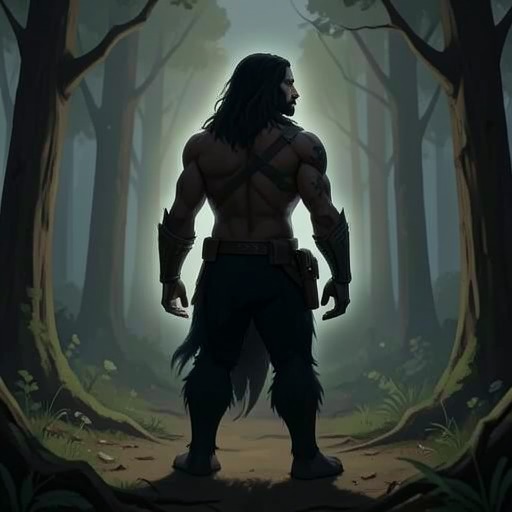
The change begins with distortions in the air that blur Ragnar’s vision in successive waves. As an unseen energy gathers, Belshezan twists and convulses as though in terrible pain; his skin pulses and contorts, accompanied by cracking and popping sounds. Ragnar’s hand drops to his axe, but he leaves it in its belt loop, balancing unease with the trust prompted by Belshezan’s warning. The sorcerer’s fur clothing seems to merge with his body as his nose and jaws push forward into a broad snout, his frame grows in bulk and height, and his limbs thicken into huge paws.
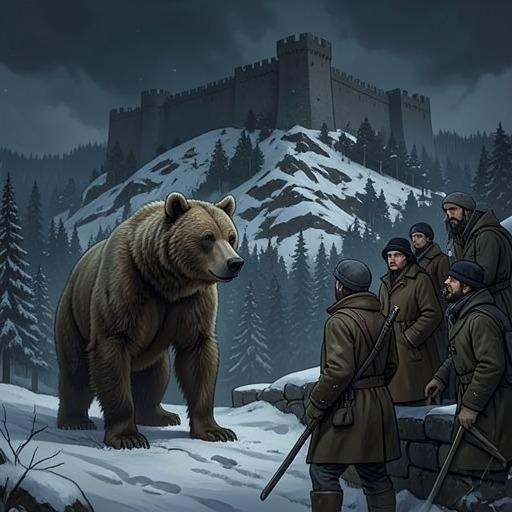
When the transformation ends, a massive brown bear stands before Ragnar, far larger than any bear from his homeland. The change alters more than Belshezan’s size and appearance: the bear turns its gaze toward Ragnar, whose recognition of the familiar quality in its eyes helps him remember that the creature is still the sorcerer. The human identity persists within the animal form, even as the form itself supplies a new physical presence and a means to call allies.
Shared Signs and the Sorcerers’ Kinship
Belshezan’s bear form remains capable of purposeful communication. When Ragnar starts after him with his axe, the bear blocks him with heavy blows of its forepaws and a rumbling growl. Ragnar reads this as a warning not to join the approaching battle; when he accepts the signal and steps back, Belshezan answers with an exaggerated nod. Their exchange shows that the animal body has not displaced the sorcerer’s judgment or his ability to guide Ragnar, even when speech gives way to gesture.
The meaning of the two transformations becomes clearer when Belshezan reveals that the sorcerer Ragnar killed—the shape-shifter who summoned the Wights—was his brother. Ragnar recalls the distinct quality in the eyes of the Mayak and the great brown bear: neither wholly human nor wholly beast, but a mixture of both. Those shared eyes connect the enemy’s predator form with Belshezan’s bear form, making visible a kinship that Ragnar had sensed before he knew its cause.
Belshezan describes his brother as having chosen a darker path and vanished long ago into the far north, where ancient and wicked powers thrive. The barrows west of the fortress held a concentration of dark energies sought by others as well. Shapeshifting therefore links two brothers who became opposing sorcerers: the Mayak form belongs to the one who harnessed those forces to summon the Wights, while Belshezan’s bear form is encountered as part of his effort to aid Ragnar. The revelation recasts the earlier transformations as more than isolated marvels; they are the visible signs of a shared capacity divided by radically different choices.
Threat, Recognition, and Tactical Consequences
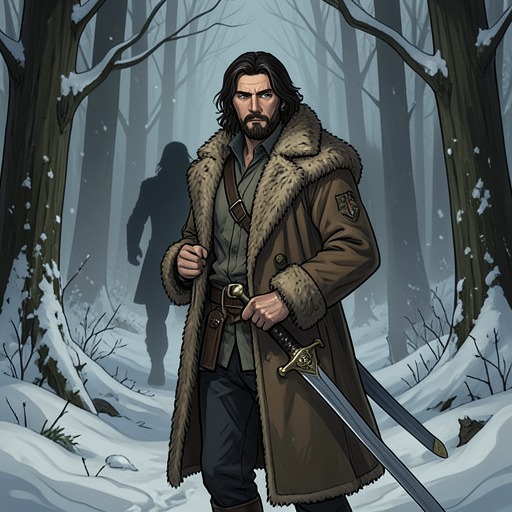
The Mayak’s animal shape first presents itself as a predator so formidable that Cnut fears it could bring down a hunting party of ten. He scans the wintry landscape with a white-knuckled grip on his spear, while Ragnar judges from the creature’s full belly that it has probably gone to sleep rather than hunt again. This difference in response frames the shapeshifter’s threat through both its physical power and the uncertainty of where it may be. Cnut returns toward the villages; Ragnar grips Raven Caller and follows the broad paw prints into the snow.
That pursuit leads from tracking a beast to confronting a sorcerer, but the change of form does not make the danger disappear. Ragnar’s earlier experience of transformations allows him to recognize the Mayak’s shrinking body as a process to watch rather than a reason to approach blindly. The revelation that a man lay beneath the predator’s shape changes what the hunt has meant: the lethal animal was also an intelligent adversary capable of sorcery. Shapeshifting thus makes recognition itself part of the danger, while Ragnar’s caution and willingness to follow the tracks carry him from the visible signs of a beast toward the hidden identity behind them.