Siege of Jarl Thryggvi’s hill-fort
When the Cold Breathes A Ragnar Stormbringer Tale A Ragnar Stormbringer TaleThe Siege of Jarl Thryggvi’s hill-fort is the community’s desperate defense against a horde of Wights, a siege in which the fort’s earthen ramparts offer protection from a foe that does not tire or need food. Ragnar Stormbringer recognizes the danger early and organizes the threatened settlements around a shared refuge; the eventual lifting of the siege will depend on help from the forest’s predators as well as the fort’s human defenders.
Causes and Mobilization
Ragnar’s resolve to protect the settlers is personal as well as strategic. He finds the remains of Heimval, a man killed by a Mayak, and discovers a bloodied silver amulet shaped as the rune of the northern god Tireya. Cnut identifies it as the amulet he had described and mourns that Heimval leaves a wife and two healthy children. Ragnar respects Heimval’s courage, though he also considers his decision to venture into the wilderness with a family to care for foolhardy. He nonetheless determines to avenge him and aid the settlers, whose leader, Jarl Thryggvi, has taken Ragnar in for the harshest part of winter.
Ragnar’s pursuit of the Mayak leads him to a cave, where he waits rather than confront the predator inside its lair. Later, peering into a large cavern, he sees movement in the darkness, hears hissing and rattling, and makes out numerous pairs of luminous eyes. When he reports the danger, the men consider whether the creatures might be Draugr, but Cnut judges that the glowing eyes point instead to Wights. Ragnar connects them to the barrows he has found and concludes that sorcery has called them from the ground. The threat is therefore not simply a predator that can be tracked or driven away: the Wights are a horde advancing on the settlements, and they will not tire or require provisions.
Ragnar insists that the villagers face the danger together rather than leave each settlement exposed. He urges the others to gather everyone they can and take them to the jarl’s fortress, warning that the Wights will sweep through the villages regardless of whether the people move. The warning sets the siege’s central stakes: reaching the fort may offer a chance to resist, but the people must abandon their homes and act before the horde arrives.
Refuge and First Assault
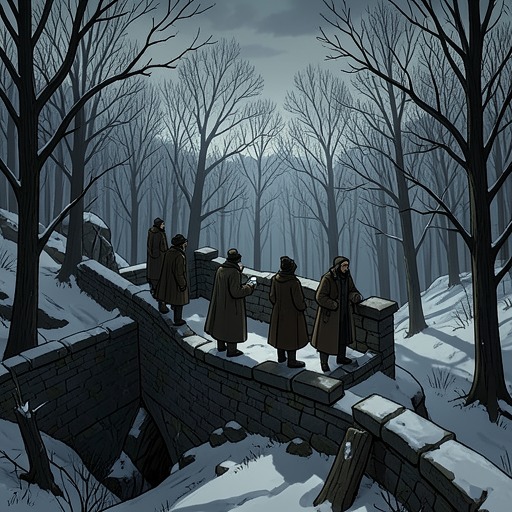
The hill-fort had been built as a refuge for the villages and homesteads in wartime. A ditch and high earthen rampart crowned with a stout wooden palisade enclosed its circular summit; inside stood small timber huts, animal pens, and storage pits marked by slanted roofs and entrances dug below ground level. That compact enclosure now offered the settlers their only chance to defend themselves against an enemy bent on slaughter.
The warning sent people out into the snow in the dead of night. Men, women, and children came from villages and homesteads carrying whatever food and other possessions they could gather in baskets, sacks, and pouches, often with little more than the clothes on their backs. As the ghastly cries beyond the fort grew louder, the people’s arguments gave way to movement. The larger family groups arrived first; later, isolated stragglers emerged far apart from the storm, each coming from the outermost dwellings in Jarl Thryggvi’s domain. With the defenders’ nerves fraying, Ragnar personally checked that each solitary arrival was human before allowing them through the gate, keeping the other guards back so that a frightened sentinel would not mistake a lone villager for an enemy.
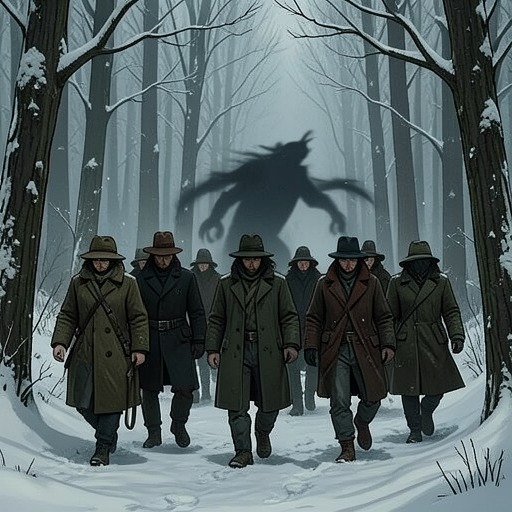
Once no more people had arrived for a while, Ragnar ordered the gates shut. Dim shapes moved among the trees beyond the snow, confirming that the horde was close. The heavy timber gateway was barred behind him, and he directed armed men to keep watch along every side of the wall-walk. When the Wights appeared, gaunt and long-limbed among the trees, Ragnar called everyone capable of wielding a weapon to the ramparts. A solid ring of men and women took up positions above the ditch, facing ranks that thickened by the moment and greatly outnumbered them.
The assault began without a signal. Wights swarmed the ditch and scrambled up the steep rampart, digging holds and hauling themselves toward the palisade with startling strength and dexterity. The defenders fought at close quarters as the attackers reached the top; villagers fell, while blows against the palisade cost the Wights fingers, hands, and entire limbs. Their bodies accumulated in the ditch, obstructing the climb. Ragnar hacked and slashed at those who reached him, and the number making it to the top gradually dwindled until none could get over the palisade and onto the wall-walk.
The Wights then withdrew as abruptly as they had attacked, retreating down the rampart and back toward the trees without any signal. The defenders cheered or cursed them, but stayed at their posts with weapons ready. Ragnar walked the perimeter to assess the damage: the attackers had suffered heavy losses, yet enough remained to keep the fort surrounded. The first assault had been repelled, not the siege.
The Siege’s Unequal Terms
The first repulse left the defenders facing a more difficult contest than the assault itself. Ragnar understood that the Wights outside the ramparts had none of the limits that governed the people inside: they needed neither food nor drink, while the fortress held too few provisions to sustain its occupants for long. The walls could stop an attack, but they could not feed the people sheltered behind them. Hunger would begin to weaken the defenders even if the enemy simply waited, and the Wights’ howls, wails, and screeches carried over the rampart as a constant reminder that the besieged could neither bargain with nor bribe their way out of danger.
The fort’s enclosure was protection and confinement at once. A route through a hole in the ground might take Ragnar beyond the walls unseen, but it offered no practical means of saving the inhabitants. He pointed out that other settlements were many days’ ride away, that no horse could pass through the tunnel, and that the people could not hold out for such a journey. The problem was therefore larger than escape: any plan had to confront the siege before the fort’s dwindling supplies and the distance to help made resistance impossible.
As the villagers returned to their huts for the night, Ragnar walked through the fortress and weighed those constraints. Tales of his deeds, sometimes inflated enough to draw fame-seekers looking to challenge a living legend, now served another purpose: they helped lift morale and encouraged the villagers to fight. Yet reputation could not alter the conditions outside the wall. The enemy remained in force, the food was insufficient for a prolonged blockade, and the sounds from beyond the ramparts made clear that the first assault had only begun the ordeal.
The Forest’s Counterattack
By the time Ragnar returned toward the besieged fortress, the route was set by the sounds of the battle already drawing near. He followed Belshezan west through the night, and the great bear led them along low ground between a series of hills. Wights’ shrieks and cries had carried on the wind for some time; weary from the march, Ragnar held his axe ready in case the bear led them straight into the horde. Instead, they climbed a small hill and looked down on the fortress from the north, with Belshezan beside him.
The forest’s predators converged on the besiegers. Wolves and other beasts gathered in growing numbers, joined by wolverines whose smaller size did not diminish their ferocity. Two Mayaks appeared among the last arrivals, their broad, low-slung bodies showing traits of both wolverines and large hunting cats. The animals surrounded the Wights, trapping them against the fort’s ditch and rampart. The advancing undead stopped just before the opposing forces met; then the battle began, with fangs and claws tearing into their bodies.
Ragnar watched the predators act in concert rather than as rivals. A Mayak struck a Wight attacking a wolf from the side and tore into it, while the wolf seized the other assailant by its extended neck; the pair left two headless bodies in the snow before bounding off to find other opponents. Elsewhere, a snow tiger rushed to aid a brown bear beset by three Wights, breaking the attack and joining the bear in shredding them. Such cooperation revealed the common cause binding the forest creatures: they had set aside their enmity to drive the deathly intruders from their land.
The alliance also explained Belshezan’s earlier forceful refusal to let Ragnar follow the bear down the slope. In the confusion of combat, the animal attackers regarded anything on two legs among the trees as an enemy. Belshezan had been protecting Ragnar from being caught between the beasts and the Wights, not merely keeping him away from the battle.
The Wights dwindled but did not retreat. They fought on, striking with bites and claws until the air carried none of their otherworldly cries. The siege’s balance had shifted: the human defenders were no longer the only force resisting the horde, as the forest itself had turned against the dead.