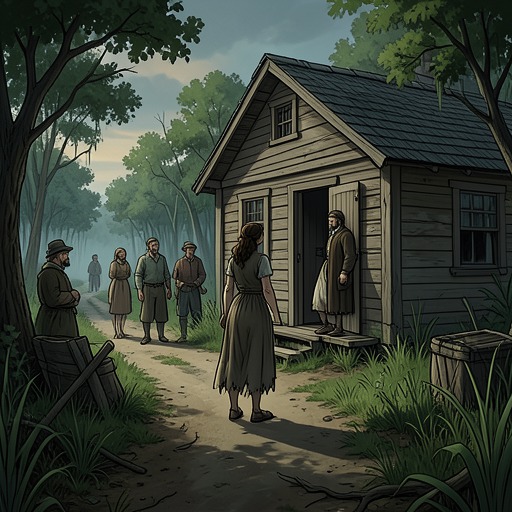
Barkley Cove Diner
Where the Crawdads SingBarkley Cove Diner stands at the center of Main Street’s commercial strip and close against the village pier, making it both an everyday gathering place and a vantage point on the harbor. Its crowded rooms and plentiful food offer a sharp contrast to Kya’s precarious life in the marsh; the reactions she encounters there also expose how readily Barkley Cove turns public space into a test of who belongs. Later, as the town talks about Chase Andrews’s murder, the diner becomes a place where rumor circulates alongside meals and local business.
Setting and Physical Character
The diner occupies the middle of Main Street in Barkley Cove, between the Piggly Wiggly at one end of the street and Western Auto at the other. Its position places it among the town’s shops and businesses, rather than apart from them, while its front windows look toward the harbor. A narrow street separates the building from the soggy steps of the village pier, bringing the working waterfront close to the restaurant’s tables.
The building was constructed in 1889. Hurricane shutters frame its full bank of front windows, which face the harbor. Outside, discarded shrimp baskets and wadded fishing nets lie against the wall; mollusk shells scatter the sidewalk, and seabird cries and droppings mark the waterfront setting. The smell of fish barrels on the dock is overtaken by the kitchen’s sausage and biscuits, boiled turnip greens, and fried chicken. The diner is thus not a separate refuge from the harbor so much as a sheltered room embedded in its sights, work, and odors.
Barkley Cove itself is small and weather-worn: Main runs along the oceanfront, while Broad ends at it, and vacant lots interrupt the businesses. Within that sparse layout, the diner is a central point of local life. Its harbor-facing windows and proximity to the pier place diners within view of the town’s fishing activity, while the restaurant’s position on Main makes it accessible to customers moving among the shops.
Rooms, Food, and Work
Inside, the diner is furnished with high-backed booths upholstered in red padding, alongside tables and a soda-fountain counter. During the later visit by the sheriff and deputy, every booth and nearly every table is occupied; only two stools at the counter are free. The full room suggests a business that draws a steady crowd, and the pair have to make their way between the tables to reach the counter.
The kitchen’s abundance depends on constant, improvised labor. Owner-cook Jim Bo Sweeny moves between flipping crab cakes, stirring creamed corn, and tending chicken thighs in the deep fryer, while also putting piled plates before customers. Local talk credits him with being able to mix biscuit dough with one hand and fillet catfish with the other. His occasional specialty, grilled flounder stuffed with shrimp and served on pimento-cheese grits, is sufficiently sought after that word of its appearance serves in place of advertising. The kitchen’s movement and the crowded dining room make the diner a working establishment, not merely a backdrop for conversation.
Kya’s first meal there shows the diner through a different measure: what it offers to someone who has never been inside. At Pa’s suggestion, she enters with him from the pier, wearing overalls that are too short and trying to brush dried mud from them and pat down her tangled hair. She has never eaten restaurant food and cannot read the menu, so Pa tells her what is on it. She chooses fried chicken, mashed potatoes, gravy, white acre peas, and biscuits; Pa orders fried shrimp, cheese grits, fried okra, and fried green tomatoes. The waitress brings butter pats set on ice, cornbread and biscuits, and as much sweet iced tea as they want. Blackberry cobbler with ice cream follows. Kya eats until she thinks she might feel sick, but judges the meal worth it.
A Public Space with Boundaries
The restaurant’s plenty does not make it an equally welcoming place. When Pa opens the door with Kya, the customers pause in the middle of eating. Some men give Pa faint nods; women frown and turn away. One customer mocks their appearance by suggesting they do not meet the requirement for shirts and shoes. The scene makes Kya’s entrance conspicuous before she has ordered anything: her clothes and mud identify her as someone the room is prepared to judge.
The town’s restrictions extend beyond the diner. The Dog-Gone Beer Hall next to the Piggly Wiggly does not admit women or children through its entrance, although a take-out window allows them to order from the street; Black residents are barred from both door and window. Those rules belong to the neighboring beer hall, not the diner, but they establish the broader commercial landscape in which restaurants and shops operate. Barkley Cove’s public spaces are shaped by exclusions as well as by the routines of buying food, working, and gathering.
After the meal, Kya steps onto the sidewalk while Pa pays. She carries leftover chicken and biscuits wrapped in a greasy napkin, and her overall pockets are stuffed with packages of saltines the waitress has left on the table for the taking. A little girl in a pale blue frock reaches out to greet her. Kya notices the softness and cleanliness of the child’s hand, then sees herself reflected in the girl’s eyes as simply another child. The brief encounter shifts the scene away from the customers’ scrutiny: for a moment, the diner’s social difference is not the only way Kya can be seen.
Rumor and the Murder Investigation
After Chase Andrews’s murder, the diner becomes one of the places where the town’s excitement takes conversational form. The sheriff and deputy enter to find it full, and on their way toward the counter they hear customers speculating about possible suspects. Mr. Lane of Sing Oil proposes Lamar Sands, citing a story that Sands had caught his wife with Chase on the deck of Sands’s ski boat and recalling that Sands had other encounters with the law. The conversation does not establish the accusation as fact; it shows how quickly an alleged motive becomes public talk.
Further inside, Miss Pansy Price suggests that the woman living in the marsh may have been responsible, calling her crazy and associating her with the crime without offering evidence in the portion of the conversation heard. The contrast between the conjectures is revealing: suspicion can attach to a reported grievance against Chase or to the stigmatized figure of the marsh-dwelling woman. The diner’s crowded ordinary life continues around these claims, turning the investigation into shared gossip before the evidence has settled the question.
Narrative Significance
Across Kya’s childhood visit and the later murder investigation, the diner links the town’s material life to its habits of judgment. The restaurant can provide a lavish meal, a seat at the table, and food to carry home, yet Kya’s entry is accompanied by stares and a remark about her clothes. In the investigation scenes, its crowded tables provide a platform for competing stories about guilt. The harbor, the kitchen, the customers, and the rumors all occupy the same public setting: Barkley Cove Diner makes visible how community is formed through both shared daily routines and the boundaries the town enforces.