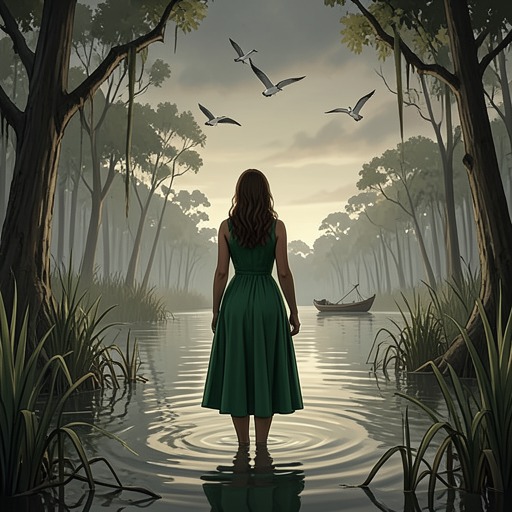
Barkley Cove Marsh
Where the Crawdads SingBarkley Cove Marsh is not merely the setting around Kya Clark’s home but the world that teaches, shelters, and ultimately receives her. Its channels, grasses, creeks, and lagoons give her practical routes through isolation and danger; over time, the marsh becomes the source of knowledge and belonging that human society has failed to provide. The novel’s movement through this landscape traces a change from wary survival to a deep sense of kinship with the living world.
Terrain and Movement
The marsh appears as a network of particular passages rather than as undifferentiated wilderness. In August 1969, Kya Clark motors toward Cypress Cove, a remote peninsula where she has previously found rare toadstools. The place is cool and moist enough to offer a chance of finding them again despite the lateness of the season. Moss-draped trees reach over the bank, their low limbs forming a cave-like opening near shore; Kya glides through it, finds orange mushrooms on an old stump, beaches her boat, and sits cross-legged to draw. The episode establishes how close observation and movement through the terrain belong together: the marsh is something she traverses, but also a subject she studies.
That knowledge of routes becomes urgent when Kya fears Chase Andrews may return after assaulting her. In a gale coming from the sea, she packs biscuits, cheese, and nuts, then makes the forty-five-minute walk through cord grass and channels to Reading Cabin. She scans the undergrowth at every sound, and the cabin appears beside a creek, raised amid tall grasses. The journey leads her from exposure to temporary shelter, yet does not remove her fear. Although Chase has not been told about the hideout, she cannot be sure he does not know of it. The marsh offers concealment and distance, not certainty.
Refuge, Danger, and Familiarity
The Reading Cabin’s setting makes refuge feel conditional. Tate Walker and Scupper Walker have repaired the old log structure for Tate’s overnight expeditions, shoring up its walls and straightening its roof. Inside are a small bed, a cookstove, a table and chair, cookware hanging from the rafters, a microscope on a folding table, and a metal trunk stocked with tins of baked beans and sardines. These practical provisions make the cabin usable, but Kya still feels trapped there because she cannot see whether Chase is approaching. Sitting beside the creek, she watches the grassy water with her right eye; the left is swollen shut. The contrast is sharp: a repaired shelter can protect her from weather, yet its walls and limited view intensify her vulnerability.
After a few days, she returns by boat to areas Chase would not know. Pain and vigilance follow her into the landscape: one eye remains reduced to a slit, bruising has spread across half her face, and her body throbs. A chipmunk’s chirp makes her whirl around; crows’ calls sharpen her attention, and wherever she goes she mentally marks an escape route. The marsh is familiar enough for her to seek its less-known reaches, but familiarity is not ease. It is a learned capacity to notice sounds, choose paths, and remain ready to flee.
A Home and a Teacher
For Kya, the marsh also becomes the long-term answer to abandonment. She has no close circle of friends and never has the family life she associates with other people; years alone have altered how she behaves. Yet the account does not treat her difference as proof that she belongs nowhere. Most of what she knows, she has learned from the wild: nature has nurtured, tutored, and protected her when people did not. The marsh’s importance therefore exceeds its value as a hiding place. It supplies observation, instruction, and a daily relationship with living things through which Kya makes sense of herself.
That education shapes how she understands intimacy and survival. Tate Walker’s devotion eventually persuades her that human love can be more than the mating contests she observes among marsh creatures. At the same time, life has taught her that old survival instincts persist in human beings in troubling forms. Her thought is neither a simple rejection of people nor an idealization of nature: the marsh provides a frame for recognizing both tenderness and predation. Its lessons let her read human conduct without assuming that affection makes her safe.
Belonging and the Final Return
The novel presents Kya’s bond with the marsh as physical as well as intellectual. At sunset she sometimes walks alone to the beach, touches the sand, and stretches her arms toward the clouds, feeling connected not through the family or friendships she never had but through the earth and its life. She understands that isolation has made her different, while locating the origins of her knowledge and ways of living in the wild that raised her. Her sense of connection is thus not a recovered place in human society; it is a belonging formed through sustained contact with the natural world.
That bond gives the marsh its final narrative weight. At sixty-four, Kya does not return from a collecting trip. Tate searches by boat and finds her drifting in a lagoon surrounded by sycamores. She lies back against her old knapsack; when Tate calls and then reaches her, she does not respond. The ending brings her life’s ordinary practice of collecting into its last journey, and places her final stillness within the landscape that has been her home and teacher. The lagoon is not presented as a replacement for human love—Tate is there, searching for her—but as the setting that holds together the life she made and the natural belonging she had claimed.