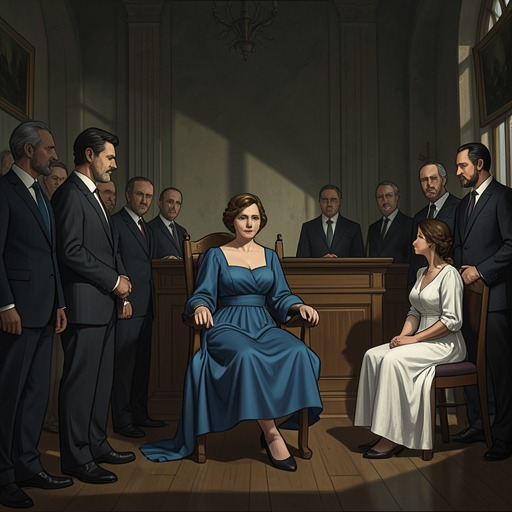
Barkley Cove fire lookout
Where the Crawdads SingThe Barkley Cove fire lookout becomes the physical and evidentiary center of the case against Kya Clark: Chase Andrews fell to his death through an open grate, but the tower’s known hazards and the details of his injuries leave the circumstances contested. At trial, it is not merely a landmark beside the marsh. Its height, access points, and history of unsafe open grates are examined as evidence bearing on whether Chase’s death was an accident or a killing.
The Tower and the Disputed Fall
The coroner testified that Chase died between midnight and two o’clock on October 29 or the morning of October 30, 1969, after falling through an open grate from the tower to the ground sixty-three feet below. He struck the back of his head on a support beam; blood and hair samples from the beam confirmed the impact. The examination found no alcohol or other substance in his blood that could have impaired his judgment.
The direction of that impact became a point of dispute. The defense argued that someone stepping forward into a hole would tend to pitch forward, whereas the blow to the back of Chase’s head supported the possibility that he had been falling backward. The coroner agreed that the evidence supported that conclusion and that a person pushed backward while standing with his back to the open grate could have sustained the injuries found. But the medical evidence did not establish that a push had occurred: there were no bruises specifically identifiable as marks of a shove, and the coroner acknowledged that he knew of no evidence Chase had been pushed. The tower thus supplied a plausible physical account of a backward fall without resolving whether it was accidental or caused by another person.
The open grates also had a history independent of Chase’s death. The sheriff acknowledged that children sometimes left them open while playing on the tower, although the grate used to climb onto the top was more often left open than the others. The danger had been serious enough for the sheriff’s office to send the U.S. Forest Service a written request for a remedy on July 18 of the previous year. That record made the open grate consistent with a pre-existing safety problem, even as the specific circumstances of Chase’s fall remained uncertain.
The tower’s location also figured in the defense’s challenge to the prosecution’s timeline. The prosecution alleged that Kya left the Three Mountains Motel, walked to the Greenville bus station, took the delayed 11:50 p.m. bus to Barkley Cove, reached town at 1:40 a.m., and continued from the bus stop to the wharf, by boat to the cove near the tower, and on foot up to it. The defense calculated that this sequence required at least one hour and seven minutes, before allowing any time to wait for Chase or to reverse the journey. Yet the return bus departed only fifty minutes after Kya arrived in Barkley Cove. The sheriff conceded that the schedule would be tight and suggested she could have jogged or saved time along the way; the defense countered that she would have needed at least twenty additional minutes. The fire lookout therefore anchors two competing questions: how Chase fell through its grate, and whether Kya could have reached it and returned within the time alleged.
The Lookout as Evidence
At trial, the Barkley Cove fire lookout is reconstructed through separate forms of proof rather than a single account of what happened there: the coroner’s reading of the injuries, the sheriff’s acknowledgment of the grate problem, and the defense’s calculation of travel time. Each makes the tower legible in a different way—as a structure from which a fatal fall was possible, a place with a documented safety hazard, and a destination whose alleged connection to Kya’s movements was tested against a bus schedule. None, on its own, settles the central question. The resulting tension is important: the physical setting can support an explanation of how Chase died without establishing why he fell, while the route to the tower can be measured without proving who was there. The lookout’s narrative force lies in this gap between a location that can be mapped and a death whose decisive circumstance remains contested.
Forensic Argument and Its Limits
The courtroom turns the tower’s geometry into a demonstration. Eric steps forward to show how a person entering a hole headfirst would carry the head ahead of the body, making a forehead-first collision with the beam more likely. Chase, however, struck the back of his head. Dr. Cone agrees that the pattern supports a backward fall, and that someone standing with his back to the open grate and pushed could have fallen in that direction. The argument makes the injury pattern compatible with a shove, but compatibility is not proof that one occurred.
That distinction is explicit in the examination: the defense does not present the wound pattern as conclusive evidence of a push. Dr. Cone reports no bruises that could be identified specifically as resulting from a shove, and says he knows of no evidence that Chase was pushed. His professional examination therefore cannot establish that the death was murder rather than accident. The lookout’s evidentiary force remains double-edged: its beam and open grate allow the defense to describe a possible backward fall, while the absence of a specific bodily sign of pushing leaves the cause of that fall unresolved.
The Safety Request as a Record
The sheriff’s testimony gives the danger at the Barkley Cove fire lookout a documentary trace: he identified an official request from his office to the U.S. Forest Service, dated July 18 of the previous year, asking that the open-grate hazard be remedied. The questioning then turned to who had written the request, but the available testimony does not supply an answer. The document establishes that the danger had been formally raised before Chase Andrews’s death; it does not, by itself, establish which grate was open on the night he fell or how it came to be open. Its significance lies in that distinction between a recognized hazard and an unresolved fatal occurrence.