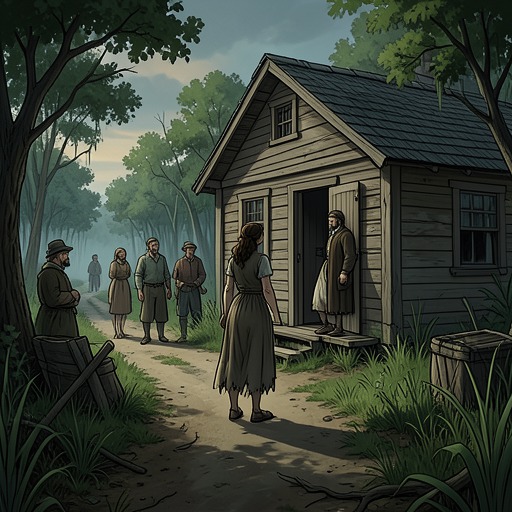
Barkley Cove’s racial segregation
Where the Crawdads SingBarkley Cove’s racial segregation is built into ordinary public life: Black residents are directed to separate schools and churches, barred from a white-owned business’s entrances, and confined to a segregated section of the courthouse gallery. The divisions are more than a backdrop to Kya Clark’s story. They show how the town’s boundaries govern access and safety, while the harassment of Jumpin’ and the support he and Kya receive from others reveal that exclusion is neither abstract nor uncontested.
Public Spaces and Everyday Boundaries
Barkley Cove’s Main Street places shops and public gathering spots along the oceanfront, but the town’s apparent intimacy does not mean equal access. At the Dog-Gone Beer Hall, women and children are not expected to enter; a takeout window allows them to order from the street. Black residents, however, are excluded from both the door and the window. The distinction exposes the different force of these restrictions: some people are kept outside according to local conventions of propriety, while Black customers are denied access to either route.
The restriction is concrete and routine, attached not to a distant institution but to the ordinary act of buying food. The street-facing window might seem to offer an accommodation, yet it does not extend to Black residents. In this small arrangement, access is sorted by race at the threshold itself.
Segregated Institutions
The division is also institutional. Barkley Cove has one school for white children, in a two-story brick building at the opposite end of Main from the sheriff’s office. Black children have a separate school: a one-story cement-block building near Colored Town. The account establishes a clear difference in their locations and physical descriptions, though it does not explain the schools’ curricula or resources. Their separation nevertheless makes racial boundaries visible in the town’s basic civic structure.
Religious life follows a similar pattern. Although the village is small, it has four churches for white residents and three more for Black residents. The churches’ separate counts reinforce that segregation reaches beyond commerce and schooling into community institutions. The evidence does not describe a direct confrontation between congregations; the division appears instead as an established feature of how the village organizes itself.
Harassment and Kya’s Response
The boundary between white and Black residents is enforced not only by places but by racist speech and physical intimidation. While Kya is hidden in the woods, two white boys spot Jumpin’ walking home toward Colored Town. They taunt him with racial slurs, and one throws a stone that hits him beneath the shoulder blade. Jumpin’ lowers his head, steps aside, and continues walking; the boys laugh and follow him with more rocks.
Kya watches the encounter and is angered that Jumpin’ does not turn on the boys. She knows the word they use is an insult, having heard her father use it as a curse, but her expectation that Jumpin’ should fight back reflects her own position as an observer, not the risks he faces. She moves ahead through the brush, waits beside the lane, and strikes one boy across the back of the head with her heavy bag of jam jars. The other boy runs. Kya then slips into the trees and, after watching the first boy get up, returns to her boat. Her intervention interrupts the immediate attack, but the scene also makes plain that Jumpin’ has been left to absorb a violence the boys carry out openly.
Segregation in the Courthouse
During Kya’s trial, the courthouse gallery reproduces the town’s racial ordering. By midmorning, villagers fill the pews and crowd the walls and windows as they discuss the evidence and the death penalty. A small balcony at the rear can seat twenty more people. It has no sign marking it for Black spectators, but everyone understands that they are restricted to it. On this occasion, the gallery is mostly white, with only a few Black people present; the narrative observes that the case is treated as a white one through and through.
The balcony’s unwritten rule shows segregation operating through shared expectation as well as explicit barriers. The crowd’s eagerness to watch Kya, called the Marsh Girl, on trial for murder stands alongside the racial division of the room: public scrutiny is intense, but access to the courtroom is not equal. The courthouse’s long history as the county seat gives this setting civic authority, while its gallery preserves the same social separation visible elsewhere in Barkley Cove.
Support and the Limits of Change
After the verdict, Kya thanks Robert for traveling from Boston, touches Jumpin’s hand, and is hugged by Mabel. She also thanks Tate for what he brought her, embraces Tom, and acknowledges Scupper, who gently squeezes her shoulder. The moment gathers several forms of personal support around Kya, including her connection to Jumpin’ and Mabel. It does not establish that the town’s segregated arrangements have ended; rather, it distinguishes the care people show one another from the larger divisions still documented in the village.
Across the beer hall, schools, churches, roadside attack, and courthouse gallery, racial segregation appears as a system maintained in both everyday access and public conduct. Its details differ from the social stigma Kya faces as a poor, isolated marsh resident, but the novel places both forms of exclusion in the same town. The contrast makes visible how belonging is restricted along more than one boundary, and how a person’s response to injustice does not by itself dissolve the structures that permit it.