Clark family home in the marsh
Where the Crawdads SingThe Clark family home in the marsh is the rough-cut shack beneath the oaks where Kya Clark’s family life breaks apart and where she learns to survive alone. Its screened porch faces the surrounding marsh, but the house is no refuge from loss: Ma’s departure, Pa’s absence, and the family’s dispersal turn its small domestic spaces into a record of abandonment. Later, the threshold Kya keeps closed becomes a measure of how difficult it is to admit another person into the life she has made there.
Setting and Domestic Conditions
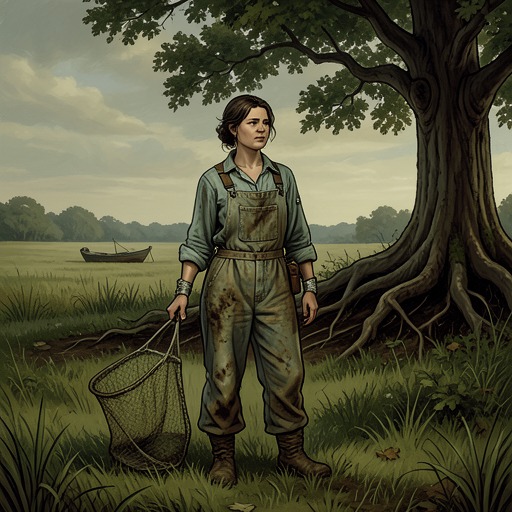
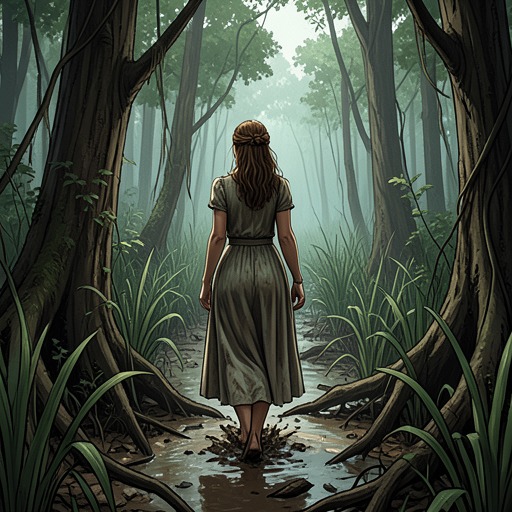
In 1952, the shack is home to Kya, the youngest of five children, her parents, and siblings much older than she is. The family is crowded together in a rough-cut dwelling whose screened porch sits beneath the oaks. At six, Kya is scrubbing grits from a pot when the screen door slaps. The sound interrupts an ordinary chore and signals a change she does not yet understand: Ma has left, carrying a blue train case and wearing the high heels she uses for going out. The lane from the porch passes through bog forest and cattail lagoons toward town; Kya runs after her mother but sees only the case disappearing among the trees. The house is thus defined not just by its construction, but by its exposure to the surrounding landscape and by the departures that begin within it.
Its everyday arrangements show how little infrastructure reaches this home. There is no electricity, and the Frigidaire serves as a cupboard. The door must be propped open with a flyswatter to keep mold at bay, though mildew has spread through its crevices. Kya lights a candle, revives the woodstove with kindling and a bellows, and heats leftover grits in lard. These details make domestic work inseparable from keeping the dwelling usable: cooking, cleaning, and tending the fire are practical necessities rather than settled routines supported by modern conveniences.
A House Emptied by Departure
After Ma leaves, Jodie tells Kya that their mother will return. The household, however, continues to empty. Kya is alone in the porch bed for the first night of her life, on a lumpy mattress with sheets patterned with little blue roses that Ma had bought at a yard sale. She sits up repeatedly to peer through the screen and listen for footsteps. The familiar calls of tree frogs and katydids eventually comfort her, and fog draws close around the shack as she falls asleep. The porch is at once a place of exposure, where she watches for the absent, and the bed where the marsh’s night sounds provide what the family no longer does.
As the children leave and Pa disappears, the house becomes a space Kya must maintain without the people whose belongings remain in it. After rain eases, she cleans the cupboard, mops the stained plywood kitchen floor, and scrapes months of caked grits from the stove burners. She washes Pa’s sheets, which reek of sweat and whiskey, and hangs them over palmettos. In the brothers’ cramped room, dirty socks and yellowed comic books lie beside two soiled mattresses. Kya tries to picture the boys who occupied it, but their faces blur; even Jodie’s features briefly appear and then slip from memory. The room preserves traces of the family while making visible how rapidly those traces are losing their human detail.
Threshold, Threat, and Trust
The shack’s limited entrances shape how safe Kya can feel inside it. One night, after watching wild turkeys, she hears boys coming through the woods and realizes there is no back door. When candles appear and voices call toward the house, escape is no longer possible before they reach her. The dwelling that shelters her is also a place where she can be cornered; its porch and door cannot guarantee protection from the contempt attached to the name Marsh Girl.
Years after Pa’s disappearance, the threshold remains emotionally guarded. When the days shorten and wind makes studying outside difficult, Kya invites Tate Walker into the kitchen to sit by the stove. No one has crossed into the shack since Pa vanished more than four years earlier, and Kya’s invitation marks a change in the house’s use as well as in her trust. Tate accepts without making a spectacle of the moment. The stove-lit kitchen, formerly a place Kya managed alone, briefly becomes a shared space for reading.
The Shack and the Marsh Girl
The community’s image of Kya as the Marsh Girl stands in sharp contrast to the evidence of the shack: a child doing household work, an abandoned family home, and rooms full of ordinary remnants. During the murder trial, Tom Milton tells the jury that local people had turned the abandoned child into a figure of rumor, calling her part wolf or a missing link, while failing to offer her food or clothes. He names Jumpin’ as one of the few friends who helped her. The shack’s privations give that distinction material force: the mildew, improvised cupboard, woodstove, and solitary bed are not signs of a monstrous nature but conditions in which Kya was left to manage by herself.
The home also links private abandonment to public exclusion. Tom argues that the community labeled and rejected Kya rather than helping her, and asks jurors to judge her by the case’s evidence rather than by years of rumor. The shack makes the costs of that rejection visible without reducing Kya to them. It is where family ties disappear, where she acquires the routines that sustain her, and where opening the door to Tate becomes a quiet, consequential exception to years of solitude.