Colored Town
Where the Crawdads SingColored Town is a small, dispersed settlement set deep in the woods near Barkley Cove, where trails lead between family dwellings and the surrounding bogs and mud sloughs. It is home to Jumpin’ and Mabel, whose practical kindness gives Kya a rare invitation into community. Yet the settlement’s isolation and the racism its residents face beyond it make Colored Town more than a refuge: it shows how care can flourish within a landscape structured by exclusion.
Setting and Layout
Colored Town is described as a cluster of shacks and lean-tos, with a few substantial houses, scattered across backwater bogs and mud sloughs. It lies in deep woods, set back from the sea. There are no roads through the settlement; narrow trails branch through the trees toward individual family dwellings. The place is physically dispersed rather than organized around a central street or public square, so moving between homes means following paths through the woods.
The settlement’s remoteness is conveyed through the journey there. One evening, Jumpin’ walks down a sandy track and, after about three miles, smells cookfire smoke drifting through the pines and hears his grandchildren. In the evening air, the smoke and voices signal a lived-in community without erasing its distance from the town. Colored Town is close enough to be part of Barkley Cove’s social world, but its trails and backwoods setting mark it as a distinct, less accessible place.
Jumpin’ and Mabel’s Home
Jumpin’ and Mabel live in a house built from pine lumber by Jumpin’ and his father. A raw-wood fence encloses the hardpan yard, which Mabel keeps swept clean. She watches the ground around the steps closely, ready to spot a snake with her hoe. The house and yard are described through work and upkeep: their solidity and care stand out against the shacks and lean-tos elsewhere in the settlement, while remaining grounded in the labor that sustains them.
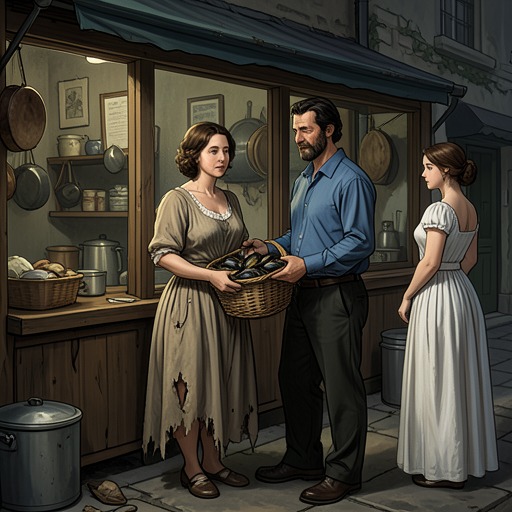
Mabel’s care also reaches beyond her household. When Jumpin’ brings home the smoked fish Kya has made to sell, Mabel recognizes that the child needs more than a buyer. She proposes that their church find clothes and other necessities for Kya, and that they tell her a family will trade clothing for her goods. Jumpin’ describes Kya as painfully thin and expects her to return early because she is broke. Their response turns a difficult attempt at earning money into an opening for mutual aid: Mabel will cook the fish, and the church may help supply what Kya lacks.
Kya has already encountered Mabel at Jumpin’s wharf, where Jumpin’ introduces the two women. Mabel takes Kya’s hand gently and praises her skill at picking oysters. The warmth of that greeting matters because Kya has little experience of being welcomed without suspicion or ridicule. Mabel’s own days are filled with gardening, cooking, and washing and mending for white people, but her manner toward Kya is tender rather than transactional.
Kya’s Attempted Visit
After Tate fails to return for their reading lessons, Kya seeks company instead of waiting alone. She hides her boat in a small cove south of Jumpin’s so that she will not be seen arriving at the wharf, then walks toward Colored Town with a croker sack. Inside are two pint jars of runny blackberry jam she has made for Jumpin’ and Mabel in return for their kindness. She wears jeans and a pink blouse Mabel gave her. The visit is an effort to repay help, but also a tentative attempt to spend time with a woman friend.
Kya has never been to the settlement and hopes she can find Jumpin’ and Mabel’s home. Before she reaches it, she hears two white boys approaching and hides behind a myrtle thicket. The boys insult Jumpin’ as he walks home, and one throws a stone that hits him in the back. Jumpin’ keeps walking. From her hiding place, Kya sees his restraint but does not understand why he does not confront them; to her, his decision to move on looks like an intolerable failure to defend himself.
She moves through the brush to get ahead of the boys, knots the cloth around the jam jars, and swings the heavy bag at one boy’s head as he passes. When the other runs, she retreats into the trees and watches until the first boy gets up, cursing. Kya then returns to her boat with the jam. Although she had set out to visit and talk with Mabel, the attack ends the journey before she reaches their home. She thinks she will probably never go visiting again, revealing how easily a desire for connection can be driven back into isolation.
Racial Boundaries and Community
Colored Town’s position is part of a wider geography of racial exclusion. In Barkley Cove, Black customers are barred from both the entrance and the takeout window of the Dog-Gone Beer Hall. The town’s everyday arrangements determine who may enter public spaces and even who may order from the street. On the path to Colored Town, the boys’ racist abuse of Jumpin’ carries those boundaries into the woods; his choice to avoid them, and Kya’s violent response, show that the people affected by racism do not have equal freedom to challenge it without consequence.
The courthouse later makes the same hierarchy visible inside a public institution. During Kya’s trial, the gallery is crowded, while everyone understands that Black people are restricted to a small rear balcony. The balcony holds only a few Black spectators amid a largely white audience, and the proceedings are framed as a white case. This scene does not establish that every resident of Colored Town is present, but it makes clear that the racial separation governing the region reaches into the courtroom.
After Kya is acquitted, the people who have stood by her gather around her as she prepares to leave. She touches Jumpin’s hand, and Mabel embraces her. These gestures recall the welcome at the wharf and the proposed help with food and clothing: the relationship that Kya could not safely pursue on her first journey has become a lasting source of support. Colored Town remains a place shaped by segregation and vulnerability, but through Jumpin’ and Mabel it also represents care offered without requiring Kya to belong to the town’s dominant social world.