Cypress Cove assault
Where the Crawdads SingThe Cypress Cove assault is a violent encounter in which Chase Andrews tries to force Kya Clark back into a relationship and then attacks her when she refuses. Kya escapes by fighting him off, but the encounter also becomes a contested piece of evidence: two fishermen hear a disturbance and see her striking Chase, though they do not witness the attack itself. The difference between what happened in the secluded cove and what the witnesses could later report is central to the event’s place in the story.
Setting and Background
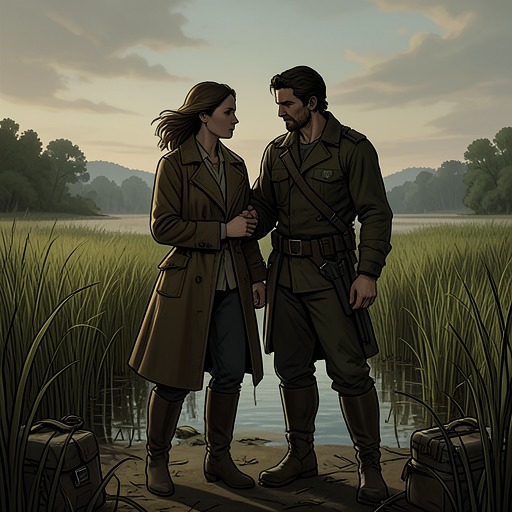
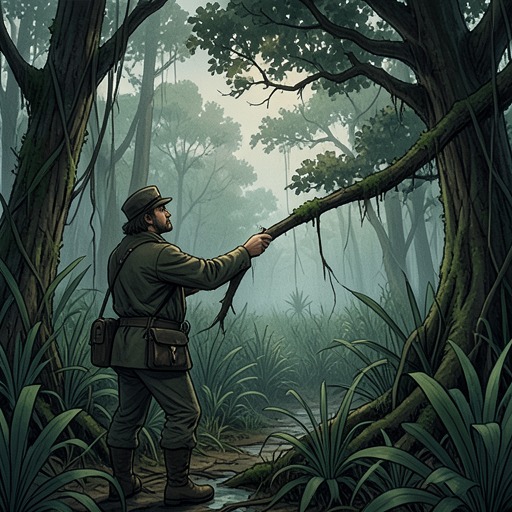
In August 1969, Kya motors to remote Cypress Cove to look for rare mushrooms she had found there before. The cove is cool and moist, with moss-draped trees whose low limbs form a sheltered passage near shore. After landing her boat, she finds orange mushrooms growing on an old stump and sits down to draw them. The scene begins in solitary observation, far from town and beyond the immediate reach of help.
More than a month earlier, Tate Walker had left a compass for Kya on a feather stump. She keeps it in a pocket of her knapsack but has neither used it nor gone near Tate to thank him. That detail places the encounter amid a period of distance and unresolved feeling, while the compass remains a small, unused object carried into the cove.
Chase appears on foot after seeing Kya pass while he was fishing; he says he landed on the other side. His greeting invokes the town’s label for her, and she immediately asks him to leave. He apologizes for how their relationship ended, but his apology gives way to insistence: he says marriage was impossible because she could not have lived near town, claims he had cared for her, and urges them to return to what they had. Kya answers that he had spoken of marriage and building a house together, while she learned of his engagement to someone else from the newspaper. The dispute is not simply about a past romance: Chase treats their former intimacy as a claim on her, while she rejects that claim.
The Assault and Escape
When Kya walks toward her boat, Chase grabs her arm and holds on hard. She pulls free and denies loving him as he claims, but he reaches for her shoulders, pulls her toward him, and kisses her despite her resistance. She knocks his hands away and warns him not to touch her. He calls her a wild animal, knocks her to the ground, and continues to restrain and assault her as she screams and struggles. There is no one nearby to hear.
Kya’s response shifts the encounter. She pushes upward and drives her elbow across Chase’s jaw, then strikes him with her fists until he loses his balance and falls backward. She kicks him in the groin and, as he doubles over and rolls onto his side, kicks him in the back. The narration connects the violence to an earlier memory of Pa striking Ma; when Chase punches her, Kya recognizes the gesture through that remembered family violence. The resemblance makes the assault more than an isolated blow: an older pattern of male force returns in a different place and relationship.
She pulls up her shorts, retrieves her knapsack, and runs to her boat. The starter rope takes effort; while waiting for the motor to catch, she looks back and sees Chase rise to his hands and knees. She fears he may pursue her, turns the tiller sharply, and accelerates away from the bank. Shaking, she holds herself tightly and sees another fishing rig nearby, with two men watching. Her escape is immediate, but the men’s presence means the encounter will also be seen from outside her perspective.
Witnesses and Retelling
At Chase’s trial, one of the fishermen recalls that he and his companion had been fishing since dawn. Near eleven, as they were preparing to pull in their lines, they heard a commotion in the woods on the point. At first the voices were muffled; they could hear a man and a woman arguing, but could not see them. When the fishermen moved closer, they saw a woman beside a man, kicking him. The witness describes her kicking Chase in the groin and then repeatedly in the back, and identifies the woman in court as the defendant, known as the Marsh Girl.
Their account establishes that Kya was present and that she struck Chase, but it does not reveal what happened before they approached: they heard the argument and saw the later blows, not Chase grabbing, kissing, or attacking her. This limit matters. The testimony begins at the point where Kya’s self-defense is visible to outsiders, while the initiating violence remains outside their sight. The assault therefore returns in two unequal forms: Kya’s experience of being attacked and the fishermen’s partial view of her fighting back.
Disclosure and Significance
Kya does not immediately tell others what happened. When Jumpin’ presses her about whether Chase hurt her, she answers that he did, then says he tried to assault her but she fought him off. The confession marks a change from enduring the event alone to naming it to someone she trusts. Its brevity underscores how much of the encounter had remained unspoken, even as its effects and its courtroom retelling continued to matter.
The cove’s isolation and the town’s social judgments shape the event’s stakes. In Barkley Cove, Kya is already treated as an outsider: a woman scolds boys for blaming their misbehavior on her, calling her swamp trash, while the town’s courtroom later fills with villagers eager to watch the Marsh Girl’s murder case. The assault itself is not the same as the later accusation against her, and the eyewitnesses do not see its beginning. Yet their account supplies a public image of Kya as the person delivering the blows. The contrast between the hidden attack and the visible aftermath exposes how incomplete observation can become consequential when a stigmatized person is judged by a community predisposed to watch her as an object of suspicion.