Ed Jackson
Where the Crawdads SingEd Jackson, the sheriff of Barkley Cove, embodies both the reach and the limits of local law in the story. He initially treats the marsh as a place beyond ordinary policing, but Chase Andrews’s death draws him into an investigation that turns suspicion toward Kya Clark. His case rests on clues that seem to form a persuasive chain; its later reputation exposes how readily circumstantial evidence and prejudice can harden into an accusation.
Identity and the limits of his jurisdiction
Jackson is a hefty, medium-height man with reddish hair and pale freckles across his face and arms. His office is a low building in town, lit by bare bulbs dangling from cords. When the boys who find Chase’s body rush there, Jackson is at his desk thumbing through a copy of Sports Afield. The ordinary, unceremonious scene introduces a sheriff whose work is rooted in a small community rather than a broad professional apparatus.
That informality reflects the county’s long-established boundary between town and marsh. Since Barkley Cove was settled in 1751, no lawman had extended jurisdiction beyond the saw grass. In the 1940s and 1950s, some sheriffs had sent hounds after mainland convicts who escaped into the marsh, and the office still kept dogs for that possibility. Jackson, however, mostly ignored crimes there. His outlook treats violence in the swamp as a self-contained order, not a problem policing can usefully interrupt. That history helps explain both his initial distance from marsh life and the significance of his decision to investigate Chase’s death closely.
The investigation into Chase Andrews’s death
At the tower, Jackson and the doctor consider why no one else came forward for help. The young men often visited the tower in groups or pairs, and the sheriff and doctor exchange a knowing look at the possibility that Chase, despite being married, had brought another woman there. Jackson’s attention to Chase’s private life points the inquiry beyond a straightforward account of an accidental fall. He tells the boys to stay put and avoid making more tracks while he and the doctor look over the scene.
Jackson first acknowledges that the visible circumstances could support an accident: Chase may have fallen from the tower and died. But he cannot find Chase’s footprints leading toward the steps, nor tracks from anyone else, and wonders whether someone covered them. Later, he reports that the railing and grates have no fresh fingerprints except those left by the two boys who climbed to the third switchback. There are none from Chase or another person. These absences do not immediately tell him what happened, but they shift his judgment. After further examination, he becomes confident that Chase’s death was no accident.
The sheriff also recognizes that the investigation may reveal a side of Chase’s life the town did not know. He proposes looking into what Chase had been doing and, later, suggests speaking with Kya Clark about where she was that night and asking her about the missing shell necklace. Jackson reasons that someone familiar with the marsh might know how to conceal tracks because marsh residents snare, track, and trap animals. This turns local knowledge into a source of suspicion: Kya’s familiarity with the landscape is treated as a possible means of hiding evidence, rather than only as part of her life there.
Building the case and making the arrest
Jackson’s case gathers several strands. A shrimper is expected to testify that he saw Kya Clark boating toward the fire tower shortly before Chase’s fatal fall, and the shrimper’s colleague is said to support the account. Patti Love Andrews reports that Kya made the shell necklace for Chase and that it disappeared on the night he died. Laboratory analysis finds fibers from Kya’s hat on Chase’s jacket. Jackson arranges these facts alongside a proposed motive—that Kya had been wronged—and the belief that her alibi can be refuted. To him, the items reinforce one another: a reported journey, a missing object, a physical trace, and a motive appear to make a complete case.
Before he seeks a search warrant, Jackson wants to be sure the judge may issue one. The purpose would be to search Kya’s home for red fibers matching those found on Chase’s clothes and to establish her account of that night. The warrant remains a contemplated investigative step in the evidence presented here; the concrete result comes later, when Jackson and other men pursue her by boat. As their motors close in through the storm, one boat cuts in front of Kya’s, and she rams it. Jackson grabs the gunwale as the boats wallow in the wakes, and two men climb aboard. He arrests her for Chase Andrews’s murder.
Testimony and the weakness of the evidence
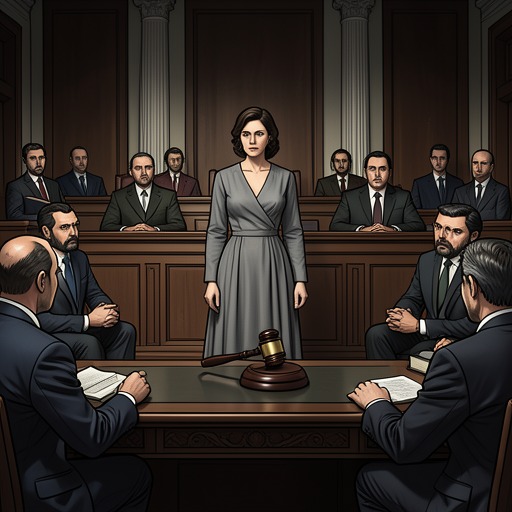
At trial, Eric Chastain asks Jackson to explain what first made him believe Chase had not fallen accidentally. The inquiry returns to the investigation’s central uncertainty: the absence of footprints. The defense raises the marsh’s shifting groundwater, explaining that tides can make an area dry and then soak it again within hours, washing marks from the mud. As this possibility is put to him, Jackson’s eyes dart from side to side and people shift on the benches. The exchange makes the missing tracks less conclusive than they had seemed at the scene. What Jackson regarded as suspicious absence could also result from the marsh’s changing conditions.
The prosecution offers another way to fit Kya Clark into the timeline. Eric Chastain argues that she might have walked or run from the bus stop on Main Street to the tower, a quicker route than traveling by boat and one that could leave time for her to return to the bus. The prosecution also has the shrimper’s testimony that he saw her heading toward the tower by boat. Jackson’s investigation therefore supports a case whose pieces depend on interpretation: the reported sighting, the fibers, the vanished necklace, and the alleged motive must be read together, while the landscape complicates what the absence of tracks can prove.
Aftermath and narrative significance
With time, most people come to believe Jackson should never have arrested Kya Clark. They judge that there was no hard evidence against her and no real proof of a crime, and regard the treatment of the shy woman as cruel. Jackson is never elected sheriff again. Later sheriffs reopen the folder from time to time and make inquiries about other suspects, but those efforts produce little. The case itself gradually becomes a local legend.
Jackson’s role is not simply that of a negligent lawman or a flawless investigator. He notices genuine uncertainties at the scene, revises his initial view of Chase’s death, and pursues evidence through the legal process. Yet he also turns the marsh’s hidden tracks, Kya’s knowledge, and a cluster of suggestive clues into a confident accusation whose weaknesses become clearer in court and in the community’s later judgment. His trajectory links the town’s long reluctance to police the marsh with its sudden readiness to scrutinize one of its most isolated residents. The eventual doubt about the arrest does not erase its consequences: Kya is never entirely healed from the scorn and suspicion surrounding her.